Reading Pew's findings on 'Religious Diversity' through the lens of 'Hindutva'
Neighboring states that transitioned into religious majoritarian frameworks witnessed shrinking diversity over time. India’s democracy, paradoxically, survives because its majority ethos has historically resisted theocratic centralization.
NewsBharati 25-Feb-2026 17:39:18 PM
Total Views |


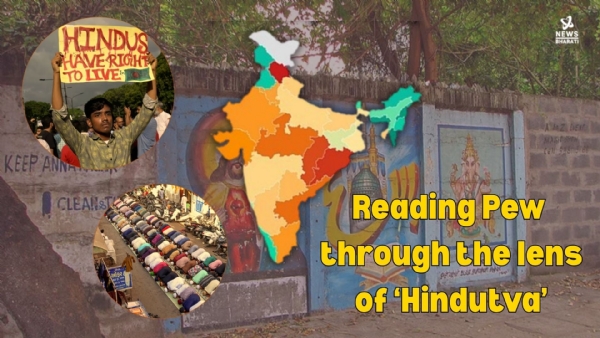
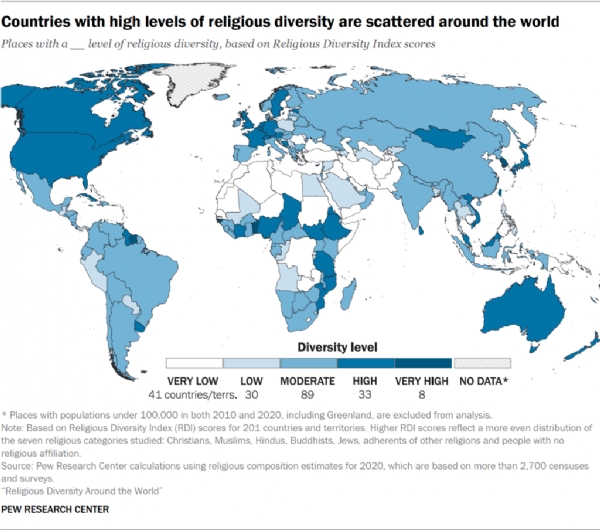
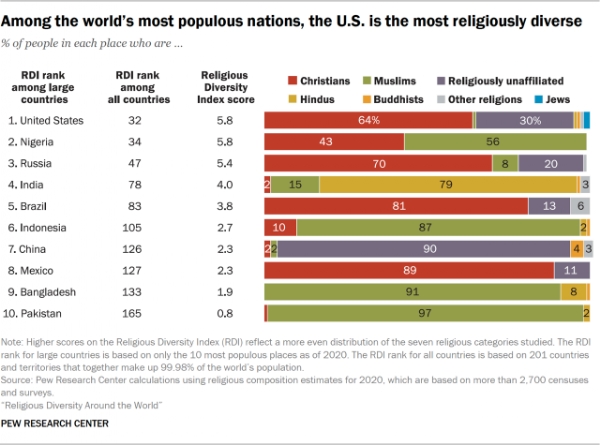
The Pew Research Center recently released its 2026 report “Religious Diversity Around the World,” where India’s Religious Diversity Index (RDI) score of 4.0 was described as “moderate.” On paper, it placed India 79th globally. But when Pew's observation for diversity in India is viewed through the lens of 'Hindutva', this score reveals exactly how the diversity has been part of the Indian society, since when has it existed as an essential part of the Indian society and how is this reflected in today's world.
Unlike most nations measured in that report, India cannot be viewed merely as a political unit. It is the only demographic homeland of nearly 95% of the world’s Hindus. This single statistic transforms the entire conversation from diversity management to civilizational survival.
The Illusion of Neutral Measurement
The RDI measures how evenly a population is distributed across eight major religious groups. It is a clean mathematical tool. But mathematics often conceals psychology. India’s 4.0 score reflects something much deeper than demographic spread. It reflects a Hindu-majority civilization that has historically accommodated difference without state coercion.
Jews found refuge here without ghettos. Parsis arrived without forced assimilation. Early Christians flourished without demographic elimination. Unlike several countries, in case of India this was not engineered multiculturalism.
Unlike Abrahamic frameworks built on singular theological authority, Hindu Dharma evolved without centralized dogma. It allows philosophical plurality within itself; dualism, non-dualism, ritualism, asceticism, even atheism. A civilization comfortable with internal multiplicity, has always been confident to face the fears of external difference.
India’s pluralism was not born in 1950 with a Constitution. It predates the modern state.
The 95% Reality: A Civilizational Single Point of Failure
Hinduism is geographically concentrated to an unprecedented degree, whereas Christianity and Islam span continents. Their demographic futures do not hinge on one nation-state but for Hinduism, it does. Nearly 95% of Hindus live within India’s borders. If India destabilizes demographically, culturally, or politically, there is no parallel sanctuary.
This creates what strategic thinkers would call a “single point of failure.” In such a framework, even a 1% decline in demographic share is crucial. From 80% to 79% may appear negligible to global observers. But for a civilization whose global continuity depends almost entirely on one republic, slow proportional decline acquires existential weight.
National Majority vs Regional Reality
Another layer often ignored in surface-level discussions is the distinction between national majority and regional dominance. India may remain 79% Hindu nationally. But democracy functions locally. When minority communities consolidate voting patterns while the Hindu majority fragments along caste and political lines, local power equations shift rapidly. Electoral leverage, policy direction, and administrative priorities begin to reflect demographic concentration, not national averages.
Over decades, small differences in age structure have compounded. A slightly younger population profile in one community today , possessing a structural shift tomorrow. These are slow-moving transformations.
The Asymmetry Question
India is constantly reminded of its obligation to remain secular and pluralistic. That reminder is also justified because Hindu civilization has historically demonstrated plural accommodation. But where is reciprocity?
Pakistan constitutionally defines itself through Islam. Bangladesh has steadily reasserted Islamic identity. Across the Middle East and North Africa, among the least religiously diverse regions globally, religious homogeneity is normalized. Yet when India articulates a 'Hindu' identity, it is framed as regression. Why is religious self-definition legitimate elsewhere but suspect only in Bharat?
This asymmetry creates psychological imbalance within the Hindu social psyche, a majority expected to absorb indefinitely without asserting its foundational identity.
Hindutva: Cultural Glue, Not Weapon
The caricature of 'Hindutva' as inherently aggressive ignores a structural reality: in a hyper-diverse society of thousands of castes, languages, and sects, only a shared civilizational framework prevents fragmentation. India’s unity was never purely administrative, it was civilizational to its very core.
The reason India did not disintegrate into dozens of ethno-religious states post-Independence lies not merely in constitutional design but in a shared culture rooted in Hindu civilization. Neighboring states that transitioned into religious majoritarian frameworks witnessed shrinking diversity over time. India’s democracy, paradoxically, survives because its majority ethos has historically resisted theocratic centralization.
Strengthening that cultural anchor is vital for stabilization, considering the present day challenges.
Diversity Without Dissolution
An RDI score of 4.0 categorizes India as moderately diverse nation. But the deeper question here is that how has that diversity endured for centuries without any internal war or religious homogenization? The answer lies in a majority that did not fear extinction.
However, the 95% concentration changes the stakes. When one civilization holds almost its entire global population within one political boundary, demographic shifts cannot be viewed through a purely liberal lens of neutral transition. For Hindus, there exists zero fallback geography.
Pluralism in India survives because of cultural conviction. The moment that conviction weakens, equilibrium tilts.
From Post-Colonial State to Civilization-State
India today is navigating a shift, from a post-colonial secular framework anxious about majority identity to a civilization-state rediscovering its anchor. Global observers increasingly recognize this transition. India is no longer merely a developing democracy. It is emerging as a stabilizing pole in a multipolar world. However, stabilization begins internally.
A nation of 1.4 billion cannot be sustained by borrowed ideological templates alone. It requires civilizational confidence strong enough to protect diversity without dissolving itself.
The Pew report provides data. The interpretation, however, depends on whether India sees itself as a routine nation-state or as the sole demographic custodian of an ancient civilization.
--
Himali Nalawade
Himali Nalawade is associated with News Bharati as an Author since a considerable period. She is mostly linked with researched articles from the areas of Defence, Defence Infrastructure and Culture-Religion. Along with her Masters in Mass Communication and Journalism after her graduation in History, she has also studied Diploma in Underwater Archaeology and Diploma in Indology.