Bhandara-Gadchiroli Expressway: Stitching Vidarbha into Maharashtra’s connectivity map
Total Views |


In recent years, several initiatives have been launched for the holistic development of the Vidarbha region. From attracting industrial investment and generating livelihoods to strengthening infrastructure, connectivity, agriculture, and irrigation, the region is witnessing a massive transformation.
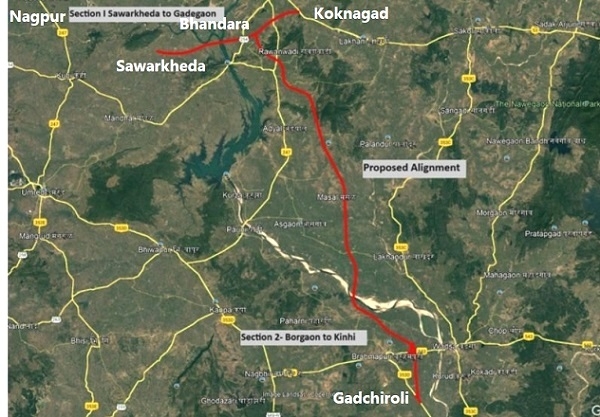
Among the key infrastructure projects driving this shift is the Bhandara-Gadchiroli Access Controlled Expressway, which will improve connectivity for Gadchiroli, Bhandara, and Nagpur. It will become a part of a broader push to strengthen Vidarbha's road infrastructure by linking key eastern Maharashtra districts to the state's expressway network. Once operational, the corridor will integrate with the Hindu Hrudaysamrat Balasaheb Thackeray Maharashtra Samruddhi Mahamarg. This means it establishes a route from Gadchiroli to Mumbai, positioning the expressway as a high-speed chain that connects the resource-rich yet historically isolated tribal districts of eastern Vidarbha with the global trade gateways of the Mumbai Metropolitan Region.
Key Features of Bhandara-Gadchiroli Access Controlled Expressway
An extension to Samruddhi Mahamarg
The real strength of the expressway lies in its contribution to the Samruddhi Mahamarg. Together, they create a fast, uninterrupted road network that connects eastern Vidarbha directly to Mumbai. The Samruddhi Mahamarg is the main highway between Nagpur and Mumbai. But its real value depends on feeder roads that bring traffic into it. The Bhandara–Gadchiroli Expressway acts as one such feeder, along with Nagpur–Gondia and Nagpur–Chandrapur corridors. Together, they form an Eastern Corridor that channels goods smoothly into the Samruddhi route.
One can think of it as a high-speed chain:
Minerals and goods move from Gadchiroli → reach Nagpur → enter the Samruddhi Expressway → go straight to Mumbai and JNPT port.
E.g., today, a truck travelling from Gadchiroli to Mumbai covers more than 800 km and takes 16–20 hours, mainly due to narrow roads, traffic, and poor road quality. Once the expressway network is complete:
This is a 34% reduction in freight cost. For mining districts like Gadchiroli, where large volumes of iron ore are moved every year, this can mean savings worth hundreds of crores, which can be invested back into local industries and jobs.
Maharashtra’s Bigger Connectivity Plan
It is not just about the Samruddhi Mahamarg. It is part of a much larger vision to connect every region of Maharashtra, especially areas that were earlier neglected. This vision, led by Devendra Fadnavis, focuses on ensuring that no district remains cut off from growth, markets, or opportunities.
At the heart of this plan is Nagpur, which is being developed as a major logistics and transport hub for central and eastern India. Multiple high-speed expressways converge here, creating a hub-and-spoke model where goods, minerals and agricultural produce can move quickly in all directions.
The Bhandara–Gadchiroli Expressway connects mineral-rich and tribal districts to this Nagpur hub.
From here:
Together, these corridors ensure that eastern Vidarbha is a through route for national trade and industry. Minerals from Gadchiroli, agricultural produce from Bhandara, and industrial goods from Chandrapur can move seamlessly to Mumbai, JNPT port and beyond. This integrated connectivity model reflects a clear policy intent: balanced regional development. By linking remote districts to expressways, ports, and markets, Maharashtra strengthens its internal economy, attracts investment, creates jobs, and reinforces its position as one of the top contributors to India’s economic growth.
Impact Beyond Industry
Moreover, the expressway is not just about factories and mining. Its real impact is also visible in farms, villages and tribal communities across eastern Vidarbha.
Eastern Vidarbha is a major producer of rice and oranges. However, the lack of high-speed connectivity has historically resulted in 25-30% post-harvest losses due to the inability to reach urban markets in time. The state cabinet has integrated the expressway with the "Krushi Samruddhi Nagar" township model, under which new growth centres are being developed along major highways. These centres will provide:
Development as a tool against Naxalism
Gadchiroli has long been affected by Naxal violence, mainly because of isolation, lack of jobs, and weak government presence. The multi-prolonged strategy of security and development is changing this reality. Under this, connectivity has changed the course of the development. With improved connectivity:
Security forces can reach remote areas quickly, strengthening law and order
Industries in Surjagad and Konsari are creating jobs, including for former Naxals who have returned to normal life
This shift from isolation to opportunity has had a powerful effect. In recent years, no new youth from Gadchiroli have joined Naxal groups, showing how development and employment can succeed where force alone cannot. By connecting villages, farms, forests, and industries, the expressway is helping integrate tribal regions into the mainstream economy. It represents a move from neglect to inclusion, where roads become instruments of peace, prosperity, and dignity.
Among the key infrastructure projects driving this shift is the Bhandara-Gadchiroli Access Controlled Expressway, which will improve connectivity for Gadchiroli, Bhandara, and Nagpur. It will become a part of a broader push to strengthen Vidarbha's road infrastructure by linking key eastern Maharashtra districts to the state's expressway network. Once operational, the corridor will integrate with the Hindu Hrudaysamrat Balasaheb Thackeray Maharashtra Samruddhi Mahamarg. This means it establishes a route from Gadchiroli to Mumbai, positioning the expressway as a high-speed chain that connects the resource-rich yet historically isolated tribal districts of eastern Vidarbha with the global trade gateways of the Mumbai Metropolitan Region.
Key Features of Bhandara-Gadchiroli Access Controlled Expressway
| Aspect | Details & Significance |
|---|---|
| Project Length | 94 km long access-controlled expressway |
| Implementing Agency | Maharashtra State Road Development Corporation (MSRDC) |
| Administrative Approval | Over ₹931 crore sanctioned for land acquisition |
| Cabinet Decision | Approved on 16 September 2025, with immediate land acquisition clearance |
| Strategic Orientation | Designed as a north–south corridor linking with existing east–west highways in Vidarbha |
| Districts Covered | Nagpur, Bhandara, Chandrapur, extending up to the edge of Gadchiroli district |
| Urban Decongestion Strategy | Alignment avoids crowded cities and weak state roads, enabling faster freight and passenger movement |
| Expressway Structure | Built in two main stretches to ensure seamless integration with existing highways 1. From Sawarkheda Interchange on the Nagpur–Gondia Expressway, allowing traffic from Gondia and Raipur to bypass Nagpur city 2. From Borgaon Interchange to NH-353D near Armori, the main entry point into Gadchiroli district |
| NH Connectivity (Stretch 1) | Connects to NH-53, a major national trade and long-distance transport corridor |
| Last-Mile Industrial Access | Direct highway linkage supports mining zones, steel plants, and industrial clusters in Gadchiroli |
| Talukas Benefited | Passes through five talukas, improving access to agriculture, industry, and mineral-rich regions |
| Environmental Planning | Route avoids sensitive forest zones and densely populated settlements |
| Major Engineering Feature | High-level bridge over the Wainganga River with approximately 825 metres |
| Problem Addressed | Replaces the narrow, flood-prone bridge on NH-353B that frequently submerged during monsoons |
An extension to Samruddhi Mahamarg
The real strength of the expressway lies in its contribution to the Samruddhi Mahamarg. Together, they create a fast, uninterrupted road network that connects eastern Vidarbha directly to Mumbai. The Samruddhi Mahamarg is the main highway between Nagpur and Mumbai. But its real value depends on feeder roads that bring traffic into it. The Bhandara–Gadchiroli Expressway acts as one such feeder, along with Nagpur–Gondia and Nagpur–Chandrapur corridors. Together, they form an Eastern Corridor that channels goods smoothly into the Samruddhi route.
One can think of it as a high-speed chain:
Minerals and goods move from Gadchiroli → reach Nagpur → enter the Samruddhi Expressway → go straight to Mumbai and JNPT port.
E.g., today, a truck travelling from Gadchiroli to Mumbai covers more than 800 km and takes 16–20 hours, mainly due to narrow roads, traffic, and poor road quality. Once the expressway network is complete:
- Travel time will reduce to 9–10 hours
- Goods from Armori can reach the JNPT port in a single, continuous drive
This is a 34% reduction in freight cost. For mining districts like Gadchiroli, where large volumes of iron ore are moved every year, this can mean savings worth hundreds of crores, which can be invested back into local industries and jobs.
Maharashtra’s Bigger Connectivity Plan
It is not just about the Samruddhi Mahamarg. It is part of a much larger vision to connect every region of Maharashtra, especially areas that were earlier neglected. This vision, led by Devendra Fadnavis, focuses on ensuring that no district remains cut off from growth, markets, or opportunities.
At the heart of this plan is Nagpur, which is being developed as a major logistics and transport hub for central and eastern India. Multiple high-speed expressways converge here, creating a hub-and-spoke model where goods, minerals and agricultural produce can move quickly in all directions.
The Bhandara–Gadchiroli Expressway connects mineral-rich and tribal districts to this Nagpur hub.
From here:
- The Nagpur–Gondia Expressway links eastern Vidarbha to Chhattisgarh.
- The Nagpur–Chandrapur Expressway connects coal, cement, and power-producing regions directly to Mumbai.
- The upcoming Nagpur–Goa Shaktipeeth Expressway will open access to western and southern markets and ports.
Together, these corridors ensure that eastern Vidarbha is a through route for national trade and industry. Minerals from Gadchiroli, agricultural produce from Bhandara, and industrial goods from Chandrapur can move seamlessly to Mumbai, JNPT port and beyond. This integrated connectivity model reflects a clear policy intent: balanced regional development. By linking remote districts to expressways, ports, and markets, Maharashtra strengthens its internal economy, attracts investment, creates jobs, and reinforces its position as one of the top contributors to India’s economic growth.
Impact Beyond Industry
Moreover, the expressway is not just about factories and mining. Its real impact is also visible in farms, villages and tribal communities across eastern Vidarbha.
Eastern Vidarbha is a major producer of rice and oranges. However, the lack of high-speed connectivity has historically resulted in 25-30% post-harvest losses due to the inability to reach urban markets in time. The state cabinet has integrated the expressway with the "Krushi Samruddhi Nagar" township model, under which new growth centres are being developed along major highways. These centres will provide:
- Orange processing units in Nagpur and nearby areas, so farmers can sell value-added products instead of raw produce
- Cold storage and warehouses, helping farmers store rice and fruits and export them through Mumbai ports
- Local jobs and self-employment are reducing the need for youth to migrate to cities
Development as a tool against Naxalism
Gadchiroli has long been affected by Naxal violence, mainly because of isolation, lack of jobs, and weak government presence. The multi-prolonged strategy of security and development is changing this reality. Under this, connectivity has changed the course of the development. With improved connectivity:
Security forces can reach remote areas quickly, strengthening law and order
Industries in Surjagad and Konsari are creating jobs, including for former Naxals who have returned to normal life
This shift from isolation to opportunity has had a powerful effect. In recent years, no new youth from Gadchiroli have joined Naxal groups, showing how development and employment can succeed where force alone cannot. By connecting villages, farms, forests, and industries, the expressway is helping integrate tribal regions into the mainstream economy. It represents a move from neglect to inclusion, where roads become instruments of peace, prosperity, and dignity.