Naming of Nationhood: Why "Keralam" matters?
The anglicized “Kerala” carries the imprint of colonial phonetics, shaped by Portuguese and British administrative usage. “Keralam,” by contrast, reflects the self-description of the land and its people.
NewsBharati 02-Mar-2026 17:35:14 PM
Total Views |


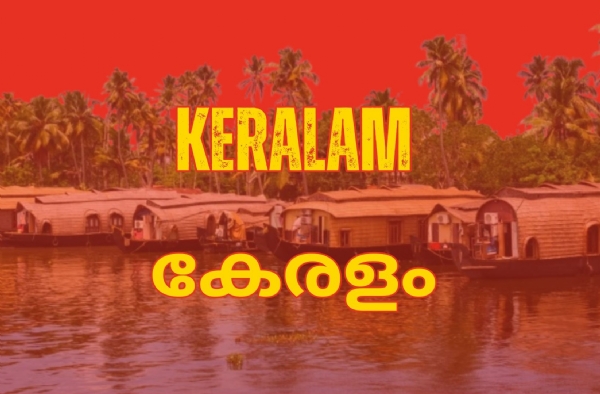
On February 24, 2026, India witnessed a procedural administrative development, that will be remembered as a landmark moment in the political history of the nation. As the Union government accepted the proposal raised by the CPI(M)-led Kerala government to officially rename the state from “Kerala” to “Keralam,” the moment quietly marked a correction dominated by the will to identify their roots, overpowering the existing ideological differences.
For decades, the call to restore indigenous names was dismissed as symbolic politics, often caricatured as cultural nostalgia masquerading as nationalism. Yet the acceptance of “Keralam” demonstrates that decolonization is no longer confined to one ideological camp. It has matured into a national instinct.
The constitutional process was followed with clarity. Under Article 3 of the Constitution, Parliament holds the authority to alter the name of a state. The proposal originated in the state assembly and was democratically processed before receiving Union approval. The legality is unambiguous. What makes the moment significant, however, is not merely constitutional compliance but ideological transcendence.
When a proposal emerges from a communist government in Kerala and receives approval from a Union government led by Prime Minister Narendra Modi, representing sharply divergent ideological traditions, it reveals how civilizational authenticity has moved beyond partisan politics. Identity has quietly triumphed over ideology. “Keralam” is not an invention. It is organic, ancient, and embedded in Malayalam’s lived linguistic reality. The anglicized “Kerala” carries the imprint of colonial phonetics, shaped by Portuguese and British administrative usage. “Keralam,” by contrast, reflects the self-description of the land and its people.
One prevalent explanation traces the name to the Sanskrit roots “Kera” (coconut palm) and “Alam” (land or abode), meaning the “Land of Coconuts.” The region’s ecological identity supports this interpretation. Yet the story does not end there. Early epigraphic evidence strengthens the antiquity of the term. Rock Edict II of Emperor Ashoka (c. 257 BCE) refers to the local ruler as “Keralaputra,” meaning “Son of Kerala.” The suffix “putra” is Sanskritic, but the geographical identity predates colonial historiography. The land was known. The people were known. The name was known.
At the same time, several historical linguists argue that “Keralam” is fundamentally Dravidian in origin, possibly derived from “Cheralam.” In this reading, “Chera” refers to the ancient Chera dynasty that ruled the region, while “Alam” signifies land or region in Dravidian linguistic structures. Thus, “Keralam” may signify the “Land of the Cheras.” But, what is striking is not the debate between Sanskritic and Dravidian derivations.
What is striking is how this debate was historically weaponized. The perceived civilizational divide between an “Aryan North” and a “Dravidian South” owes much to 19th-century colonial scholarship, particularly the linguistic-racial constructs of Friedrich Max Müller. His interpretations, later institutionalized through colonial education systems, laid the groundwork for the Aryan Invasion Theory (AIT), framing Indian civilization as a product of migration and rupture rather than continuity.
Critics of this colonial paradigm, including scholars like Michel Danino and David Frawley, have argued that the AIT rested on speculative chronologies often constrained by 19th-century Biblical timelines. According to this critique, colonial historiography artificially separated linguistic families into racial identities and exaggerated north-south divides to fit European frameworks of conquest and migration. In this context, the renaming to “Keralam” acquires layered significance. It challenges the colonial habit of freezing Indian identities within externally imposed categories. Whether the word’s roots are interpreted as Sanskritic, Dravidian, or an organic synthesis of both, the deeper truth remains unchanged, that the civilization of this land evolved through interaction, not invasion.
The acceptance of “Keralam” by governments shaped by divergent ideological traditions also reflects a subtle transformation within Indian political discourse. Decolonization is no longer an exclusive slogan of cultural nationalism. It has become an unavoidable intellectual reckoning. India’s civilizational confidence is steadily outgrowing inherited colonial anxieties. The act underlines an acceptance of the fact that reclamation of indigenous names, be it cities, institutions, or states, is not an exercise in erasure but it is an act of restoration. Critics may still dismiss such developments as symbolic. Yet symbols shape memory, and memory shapes identity. People disconnected from their self-description gradually internalize borrowed narratives about themselves. Conversely, people who reclaim their linguistic and historical vocabulary regain agency over their civilizational story.
The change that is taking place through the February 24 announcement of "Keralam", is a signal to the fact that India’s future will not be constructed on imported intellectual scaffolding, but on the quiet, steady restoration of its own civilizational vocabulary. In that sense, the journey from “Kerala” to “Keralam” is not about a suffix. It is, in fact, about sovereignty of memory.
--

Himali Nalawade
Himali Nalawade is associated with News Bharati as an Author since a considerable period. She is mostly linked with researched articles from the areas of Defence, Defence Infrastructure and Culture-Religion. Along with her Masters in Mass Communication and Journalism after her graduation in History, she has also studied Diploma in Underwater Archaeology and Diploma in Indology.