Iran, Israel and American war: The world caught in the crossfire
NewsBharati 20-Mar-2026 11:34:18 AM
Total Views |


"Santa Claus was white and everything bad was black. The little ugly duckling was the black duck, and the black cat was the bad luck. And if I threaten you, I'm going to blackmail you. I said, 'Momma, why don't they call it 'whitemail'? They lie too.'" - Muhammad Ali
SIT-REP (Situation Report)
As I write this piece on the 18th of March 2026, the whole world is crystal gazing at the war in Iran and the impact it is having on the rest of the world due to the choke point called Hormuz. This Strait has become like an H-bomb. The LPG and petroleum are stuck, and Iran is not letting any ship, friend or foe pass through this. Iran is attacking indiscriminately on the gulf nations around it, which do not want to get drawn into the conflict. Yet it is a geographical dilemma for all of them as these countries are very closely located, sharing multiple borders with each other.
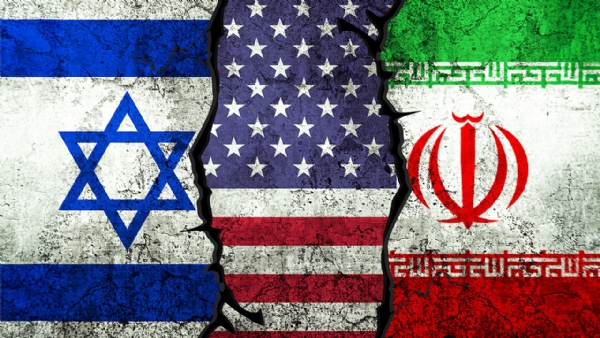
No straight solution comes to mind of any one- think tank, strategists or military planners, including geostrategic specialists.
Yet the catastrophic danger is ‘here and now’.
‘The enemy for the fanatic is pleasure, which makes it extremely important to continue to indulge in pleasure. Dance madly. That is how you get rid of terrorism.’- Salman Rushdie
International Catch 22 situation
It is such an entanglement that it is a typical paradox for one and all. Let me briefly explain this for those who are not aware of it.
A Catch-22 is a paradoxical situation where an individual is trapped by contradictory rules or conditions. The term originates from Joseph Heller’s 1961 novel, describing a military rule: a pilot can be grounded for insanity if they ask, but the act of asking for one's safety proves they are sane and must continue flying.
In broader terms, it refers to a circular dilemma where the solution is blocked by a circumstance inherent in the problem. A classic modern example is the "entry-level" job search: you cannot get a job without experience, but you cannot get experience without a job.
You do, you are damned you don’t, you are damned.
Many ask why Israel started this war with American support
Is a very often asked question in the cocktail circuit where every one is wearing an I- Cap or intellectual Cap.
When nine nations have nuclear Bombs including North Korea, so called a rogue state with an unpredictable leader like Kim Jong Un what is the problem if Iran also has one? Point to be noted.
While Israel maintains "nuclear opacity"—it neither confirms nor denies having a weapon. Yet no one has publicly said that we will conduct a nuclear attack to annihilate a marked enemy. Nuclear arsenal is seen only as a ‘deterrent’. The world has not seen use of a nuke after August 1945 almost 80 years ago when two bombs were dropped on Japan to stop second world war. It is said that nuclear deterrent has worked till now as the horrors of a nuke attack are unacceptable- idea of MAD (Mutual Assured Destruction) kept everyone in check. If I kill you, I am sure to be killed.
Yet, Iran has been racing along to make a nuclear bomb with a stated goal ‘to finish Israel’ to obliterate it from the world map. They feel that no Jew has a right to live! They frequently call for the destruction of the State of Israel, often referring to it as a "cancerous tumour." Leaders have used phrases like "wiping Israel off the map," which critics and many international leaders interpret as a call for genocide against the people living there. If they say we will wipe you out then where is the question of interpretation? Wipe out means wipe out. Some Iranian-backed groups, such as the Houthis in Yemen, use more explicit language. The Houthi slogan (the Sarkha) includes the phrase "A curse upon the Jews,".
America too is in their Nuclear Cross hair
"Death to America" (Marg bar Âmrikâ)
This slogan has been a pillar of the Islamic Republic's rhetoric since the 1979 Revolution.
Official Interpretation: Iranian leaders, including the late Supreme Leader Ali Khamenei, have consistently stated that the slogan is directed at U.S. government policies and "imperialism," rather than the American people themselves. Khamenei once clarified, "This slogan means death to the U.S.'s policies, death to arrogance."
Context: It is regularly chanted at state-sponsored rallies and Friday prayers. However, in the current 2026 conflict (following the reported death of Khamenei in March 2026), this rhetoric has intensified as a rallying cry against the joint U.S.-Israeli military operations.
Context or no context, it is death to America.
If Iran has a stated ‘Two-nation annihilate’ goal, is there any choice? Foreign Minister of Israel recently stated that 60% enriched uranium is far more than required for nuclear energy/ peaceful use for development and the can reach 90% weapon grade within months if not weeks.
With indiscriminate attacks on all friendly nations around and blocking oil, gas for the whole world they have demonstrated their intention loud and clear – we don’t care, we will not stop and go to any length- last round last man kind of stance.
Are we at the crossroads of 1945?
This analogy implies that, just as in 1945, humanity is facing a choice between establishing a sustainable, cooperative world order or drifting toward intense conflict and instability. Let me explain.
The Allies won the World War II against Germany and its allies- only Japan was worth counting.
Hitler was dead and Germans had surrendered. Japanese were still hell bent on fighting it alone.
Japan's Refusal to Surrender despite the devastating firebombing of other cities, it had not formally accepted the terms of the Potsdam Declaration requiring unconditional surrender.
The declaration demanded the unconditional surrender of Japan or face "prompt and utter destruction". It outlined the dismantling of Japan’s militarism, occupation of its territory, and restriction of sovereignty to its four main islands. Japan initially ignored it.
Japan was time and again told by Americans that they had a weapon so powerful that it would devastate Japan, but their leaders refused to either believe or accept it.
While many in the Japanese high command were hesitant to accept the terms of the Potsdam Declaration, the most prominent leader who adamantly opposed surrender—even after the fall of Germany and the atomic bombings—was General Anami Korechika, the Minister of War.
As the highest-ranking officer in the Imperial Japanese Army, Anami was the primary voice for the "hardliners" within the Big Six (the Supreme Council for the Direction of the War).
Anami Korechika, Minister of War, believed Japan should fight a "decisive battle" on the mainland (Ketsu-go) to force better peace terms. Yoshijirō Umezu, Chief of the Army General Staff, argued that the military was still capable of inflicting massive casualties on an invading force. Soemu Toyoda, Chief of the Navy General Staff maintained that the Navy, though decimated, could still defend the home islands.
America had to bite the bullet
President Truman's primary justification (to use nuke option) was to avoid an invasion of the Japanese home islands, which experts estimated could have cost hundreds of thousands of American lives.
Ultimately, the first bomb was dropped to save millions of lives and prevent the war from dragging on indefinitely. Yet the Japanese did not surrender- more than 100,000 people killed in the first five minutes!
Following the Hiroshima bombing on August 6, there was no official response from the Japanese government.
Internal deadlock wherein the Japanese Supreme Council (the "Big Six") was split. Hardliners like General Anami argued that the US likely only had one bomb and that Japan could still fight a decisive battle on the mainland.
It took time for the Japanese government to confirm the nature of the destruction in Hiroshima. By the time they realized it was indeed an atomic weapon, the mission to Nagasaki was already underway.
Finally, good sense prevailed; after so much death and devastation caused by the twin bombings, the emperor decided to surrender.
The opposition to surrender was so intense within, that when Emperor Hirohito finally decided to "bear the unbearable" and surrender on August 15, 1945, a group of mid-level army officers attempted a coup d'état. Known as the Kyūjō Incident, they tried to seize the Imperial Palace and destroy the recording of the emperor’s surrender speech before it could be broadcast. General Anami, despite his personal opposition to surrendering, refused to support the coup because it defied the emperor's direct will. On the morning the surrender was broadcast, Anami committed seppuku (ritual suicide).
Can you call it honour or madness in this day and era?
Silly point and foggy thinking
Even after Germany’s surrender in May 1945, Anami and the military chiefs were not necessarily expecting a total "victory," but a negotiated peace instead of the "unconditional surrender" demanded by the Allies.
They wanted to ensure that the emperor remained the sovereign head of state. Also, insisting that Japan disarm its own troops rather than being occupied and for war crimes Japan should conduct its own trials for any accused officials.
Iran is behaving today as Japan did in 1945. The nation has been pulverised, their top leaders gone, internal unrest is big.
Psychologically Japanese give a lot of credence to honour- death is better than living without honour. Iranian Mulla regime thinks pretty much the same way.
“The enemy is anybody who's going to get you killed, no matter which side he is on.” ― Joseph Heller, Catch-22
The GCC dilemma a regional Catch 22
Iran has launched thousands of missiles and drones at GCC targets since March 1, 2026, striking airports, oil facilities, and hotels in Dubai, Abu Dhabi, and Riyadh. Iran claims these strikes target U.S. bases hosted in these countries, though the GCC views them as violations of sovereignty.
The "Neutralize" Shift: Following these attacks, reports have surfaced that Gulf leaders are shifting their private stance. There is growing concern that if the U.S. stops its campaign now, Iran will be left with a residual military capacity to "hold the region's energy lifeline hostage" indefinitely. Consequently, some sources suggest the GCC is now urging the Trump administration not to stop short and to comprehensively degrade Iran's military and arms manufacturing capabilities.
An injured snake is more dangerous than a healthy one- to put it crudely.
Not only Israel and America, the GCC is in their tertiary aim plus and the world at large and world economy too cannot tolerate it for long.
The GCC faces a "strategic predicament." Openly backing the destruction of Iran's military risks:
Immediate Retaliation causing further devastating strikes on desalination plants and oil infrastructure.
Public perception issues regarding alignment with Israel and the U.S. against a neighbouring Islamic nation.
A completely "destroyed" or unstable Iran could lead to a power vacuum or a surge in proxy warfare (e.g., from the Houthis in Yemen) that would be difficult to contain.
In short, the GCC doesn't necessarily want a "destroyed" Iran that leaves a chaotic void, but they increasingly appear to want the U.S. to ensure Iran is militarily neutralized to the point where it can no longer threaten its neighbours.
This is asking for the moon. You want to have the cake and eat it too.
Post script- A diplomat on a podcast has said ‘hope America or Israel, does not use a tactical nuke to sort it out’. Today anyone can say anything but it is one of the toughest nuts to crack in our entire contemporary history. His head says it may but heart says- ‘never’. It will take the world geopolitics and warfare to a different level for coming centuries.
‘When you have to deal with a beast, you have to treat him as a beast. It is most regrettable but nevertheless true.’
Harry S. Truman

Virender Kapoor
A thinker, educationist and an inspirational guru. Kapoor is an Indian who wears many hats. An educationist of repute, he was the Director of a prestigious management Institute under the Symbiosis umbrella. He has emerged as a leading think tank in human behavior, motivation and success. As a celebrity author, his name appears with the likes of Thomas Friedman and Dale Carnegie. He has authored more than 30 books as of now which are on Amazon worldwide and several of his books are in the pipeline.