Indian National Calendar vs Gregorian Calendar: Science, Seasons, and Logic
Total Views |


-Archit Gokhale
March 22 marks the commencement of India’s official New Year, in accordance with the Indian National Calendar. Much like the national flag, national anthem, national bird, and national animal, symbols that are ingrained in citizens from an early age and remain widely recognised, there exists another official national symbol that is far less known: India’s national calendar. Some people make mistake in taking the term Indian National Calendar with the Lunar Calendar and the festivals or the Panchang. But the Indian National Calendar is a Solar Calendar. It is based on the movement of the Sun and contains 365 or 366 days.
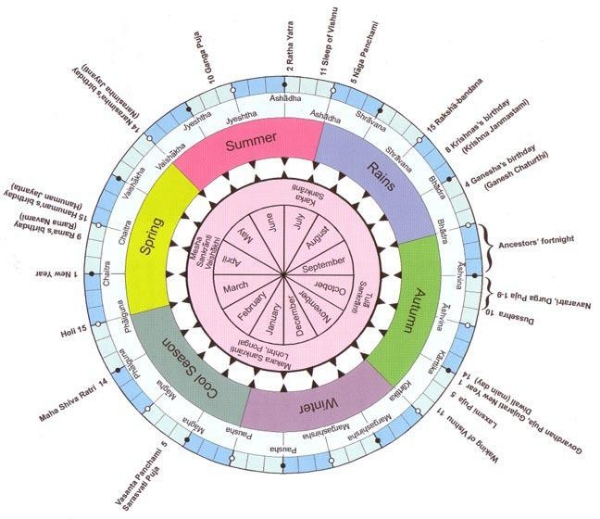
Government of India appointed a calendar reform committee in 1952 under the well - known scientist Dr. Meghnad Saha. Parliament of India, Lok Sabha accepted the calendar recommended by the committee on March 22, 1957.
According to this National Calendar the date mentioned was Chaitra 1, 1879. Since 1957 this calendar is India’s National Civil Calendar. Unlike Gregorian calendar this National Calendar considers the vantage points of the Sun to commence the year and the solar months. As this is the official calendar of India, Reserve Bank of India (RBI) has issued the circulars from time to time to all the Indian Banks. According to these circulars the dates of Indian National Calendar are valid on the cheque!
There are some limitations of Gregorian calendar which we use in our day to day life. The drawbacks are as follows:
• The commencement of the months is not associated with the seasons. For example, the longest day marks the summer season. But in the Gregorian calendar, new month does not start on that day. The longest day in Northern hemisphere is 22nd June which is the random date of a month.
• Commencement of the year has no relation with the starting of the seasons. Winter solstice and the shortest day is on 22nd December and the Vernal Equinox is on 22nd March. The year commences on 1st January, which is just a random date with no scientific base.
• The number of days in a month are not based with the movement of the Sun. Considering 30 and 31 days in the alternate months does not have any scientific base and is not in accordance with the movement of the Sun.
Indian National Calendar has solutions to all these drawbacks and is based on scientific approach.
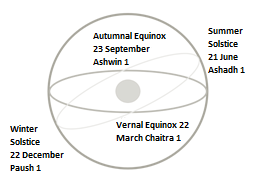
• A new year as per the Indian National Calendar commences on the day of Vernal Equinox. The first date of the year is Chaitra 1 and the year is taken as per the Shaka Calendar. On the day of Summer Solstice the date is Ashadh 1. On Autumnal Equinox it is Ashwin 1 and on Winter Solstice it is Paush 1. The readers may note that Chaitra 1 according to Indian National Calendar is not the Tithi or Chaitra Shukla Pratipada. It is first day of Indian National Calendar which is a solar calendar. Hence, in this calendar, a new month commences on each vantage point on the path of the Sun.
• The numbers of days in a month of the Indian National Calendar are based on movement of the Sun. We all know that the orbit of the Earth is elliptical and not circular. Hence, at some point the Earth is far away from the Sun and that point is called as Aphelion. At some point the Earth is closer to the Sun and that point is called as Perihelion. When the Earth is at Aphelion, the distance between the Earth and the Sun is greater. We are aware that an object which is far away seems to move slower. Hence, the movement of the Sun in different Zodiacs is slower than the movement of the Sun when the Earth is at its Perihelion (closest to the Sun).
• Chaitra has 30 days in case of a non - leap year and has 31 days in case of a leap year. In case of a non – leap year Saur Chaitra 1 is on 22nd March and in case of a leap year Saur Chaitra 1 is on 21st March. Hence, in Indian National Calendar leap day is adjusted in the beginning of the calendar as a result of which the dates of other months do not change.
Arrangement of the Months is as follows
In a way, let us imagine that we forget the dates in a Gregorian calendar. Then in such a case there is no comeback. We will be totally lost and there will be no time keeping. Unlike in Indian National Calendar, if we lose the track of time, we can observe the movement of the Sun and calculate the date. Hence, when the Sun rises exactly in the East and the Sun is subsequently appearing northwards, we can figure out that the day is Vernal Equinox and the date will be Saur Chaitra 1.
According to me, we all should promote the use of Indian National Calendar for many reasons like the Calendar is completely of Indian origin as well as it is scientifically precise. We can make use of an android application “Indian National Calendar” to get the corresponding National Date of a Gregorian Date and vice a versa. We can start getting acquainted with the National Dates by using them in our day to day life. At early stages we can start using National as well as Gregorian Date. Once we are well versed with the National Dates, we can motivate our friends and everyone in the society to use National Dates. We can even start using National Dates on cheque transactions.
Indian National Calendar will get its well - deserved popularity once we develop an awareness about the same and a huge number of people start practically using the Indian National Calendar.
March 22 marks the commencement of India’s official New Year, in accordance with the Indian National Calendar. Much like the national flag, national anthem, national bird, and national animal, symbols that are ingrained in citizens from an early age and remain widely recognised, there exists another official national symbol that is far less known: India’s national calendar. Some people make mistake in taking the term Indian National Calendar with the Lunar Calendar and the festivals or the Panchang. But the Indian National Calendar is a Solar Calendar. It is based on the movement of the Sun and contains 365 or 366 days.
Government of India appointed a calendar reform committee in 1952 under the well - known scientist Dr. Meghnad Saha. Parliament of India, Lok Sabha accepted the calendar recommended by the committee on March 22, 1957.
According to this National Calendar the date mentioned was Chaitra 1, 1879. Since 1957 this calendar is India’s National Civil Calendar. Unlike Gregorian calendar this National Calendar considers the vantage points of the Sun to commence the year and the solar months. As this is the official calendar of India, Reserve Bank of India (RBI) has issued the circulars from time to time to all the Indian Banks. According to these circulars the dates of Indian National Calendar are valid on the cheque!
There are some limitations of Gregorian calendar which we use in our day to day life. The drawbacks are as follows:
• The commencement of the months is not associated with the seasons. For example, the longest day marks the summer season. But in the Gregorian calendar, new month does not start on that day. The longest day in Northern hemisphere is 22nd June which is the random date of a month.
• Commencement of the year has no relation with the starting of the seasons. Winter solstice and the shortest day is on 22nd December and the Vernal Equinox is on 22nd March. The year commences on 1st January, which is just a random date with no scientific base.
• The number of days in a month are not based with the movement of the Sun. Considering 30 and 31 days in the alternate months does not have any scientific base and is not in accordance with the movement of the Sun.
Indian National Calendar has solutions to all these drawbacks and is based on scientific approach.
• A new year as per the Indian National Calendar commences on the day of Vernal Equinox. The first date of the year is Chaitra 1 and the year is taken as per the Shaka Calendar. On the day of Summer Solstice the date is Ashadh 1. On Autumnal Equinox it is Ashwin 1 and on Winter Solstice it is Paush 1. The readers may note that Chaitra 1 according to Indian National Calendar is not the Tithi or Chaitra Shukla Pratipada. It is first day of Indian National Calendar which is a solar calendar. Hence, in this calendar, a new month commences on each vantage point on the path of the Sun.
Figure 35: Celestial Sphere and Path of the Sun
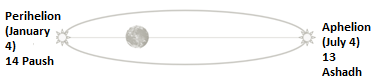
• The numbers of days in a month of the Indian National Calendar are based on movement of the Sun. We all know that the orbit of the Earth is elliptical and not circular. Hence, at some point the Earth is far away from the Sun and that point is called as Aphelion. At some point the Earth is closer to the Sun and that point is called as Perihelion. When the Earth is at Aphelion, the distance between the Earth and the Sun is greater. We are aware that an object which is far away seems to move slower. Hence, the movement of the Sun in different Zodiacs is slower than the movement of the Sun when the Earth is at its Perihelion (closest to the Sun).
Figure 36: Aphelion and Perihelion
• In this diagram, we can see the Gregorian as well as Indian National Calendar date of Perihelion and Aphelion. The months which are near to the Aphelion date consists of 31 days as the displacement of the Sun is slower and the months near to the Perihelion date consist of 30 days.• Chaitra has 30 days in case of a non - leap year and has 31 days in case of a leap year. In case of a non – leap year Saur Chaitra 1 is on 22nd March and in case of a leap year Saur Chaitra 1 is on 21st March. Hence, in Indian National Calendar leap day is adjusted in the beginning of the calendar as a result of which the dates of other months do not change.
Arrangement of the Months is as follows
| Sr. No | National Month & Date | Gregorian Date | Number of Days | Vantage Point |
| 1 | Saur Chaitra 1 | 21st / 22nd March | 30/31 | Vernal Equinox |
| 2 | Saur Vaishakh1 | 21st April | 31 | |
| 3 | Saur Jyeshtha 1 | 22nd May | 31 | |
| 4 | Saur Ashadh 1 | 22nd June | 31 | Summer Solstice |
| 5 | Saur Shravan 1 | 23rd July | 31 | |
| 6 | Saur Bhadrapad 1 | 23rd August | 31 | |
| 7 | Saur Ashwin 1 | 23rd September | 30 | Autumna l Equinox |
| 8 | Saur Kartik 1 | 23rd October | 30 | |
| 9 | Saur Agrahayan 1 | 22nd November | 30 | |
| 10 | Saur Paush | 22nd December | 30 | Winter Solstice |
| 11 | Saur Magh 1 | 21st January | 30 | |
| 12 | Saur Phalgun 1 | 20thFebruar y | 30 |
In a way, let us imagine that we forget the dates in a Gregorian calendar. Then in such a case there is no comeback. We will be totally lost and there will be no time keeping. Unlike in Indian National Calendar, if we lose the track of time, we can observe the movement of the Sun and calculate the date. Hence, when the Sun rises exactly in the East and the Sun is subsequently appearing northwards, we can figure out that the day is Vernal Equinox and the date will be Saur Chaitra 1.
According to me, we all should promote the use of Indian National Calendar for many reasons like the Calendar is completely of Indian origin as well as it is scientifically precise. We can make use of an android application “Indian National Calendar” to get the corresponding National Date of a Gregorian Date and vice a versa. We can start getting acquainted with the National Dates by using them in our day to day life. At early stages we can start using National as well as Gregorian Date. Once we are well versed with the National Dates, we can motivate our friends and everyone in the society to use National Dates. We can even start using National Dates on cheque transactions.
Indian National Calendar will get its well - deserved popularity once we develop an awareness about the same and a huge number of people start practically using the Indian National Calendar.