Graded social media limits protect, not punish, Indian children
Total Views |


-Amita Apte
(The article is based on the inputs of a book written by Bala Kishore, a Digital Wellness Expert and a Certified Leadership Coach)
The March 10, 2026, Indian Express column by Meghna Bal and Aaquib Qayoom critiques Karnataka’s proposed social media ban for minors under 16, arguing it will fail due to workarounds and may drive children to less safe spaces. While acknowledging implementation challenges and the value of digital literacy, the piece understates the severe, evidence-based harms of unrestricted access, particularly addiction engineered by platform design, and misrepresents the Union Government’s nuanced, graded approach as mere prohibition. Far from an “abdication of responsibility,” India’s central proposals embody layered, evidence-driven protection that curbs addictive consumption, preserves developmental opportunities, and empowers oversight.
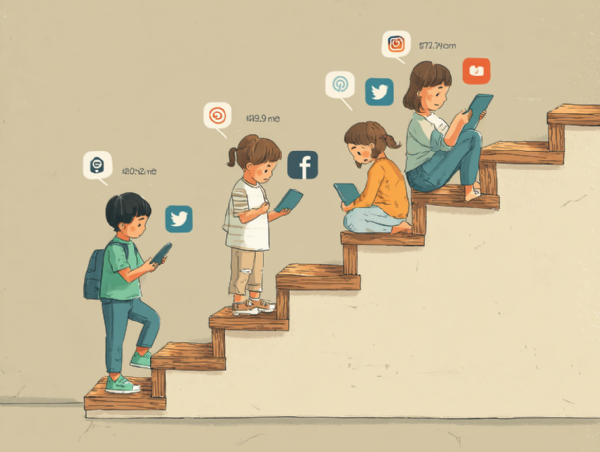
Addictive design features drive compulsive use beyond mere access. Social media platforms exploit psychological vulnerabilities through lack of end-queues (infinite scrolling), push notifications, unpredictable rewards (variable reinforcement), information overload, constant social comparison, unlimited content variety, choice explosion, and anonymity. These elements create dopamine-driven loops akin to behavioural addiction, leading to habitual overuse. Global and Indian evidence confirms this: excessive use correlates strongly with reduced attention spans, decision-making fatigue, and dissatisfaction.
In India, the Economic Survey 2025-26 explicitly links social media addiction to anxiety, depression, low self-esteem, cyberbullying stress, and diminished productivity among 15-24-year-olds, describing it as a measurable threat to mental health and long-term economic outcomes.
Quantifiable negative effects outweigh selective positives. The authors note 55% of surveyed children report positive stranger interactions, yet this selective benefit does not negate systemic risks. Studies show bidirectional links: heavy use exacerbates depression and anxiety, while vulnerable youth engage more compulsively. In Indian contexts, correlations are pronounced, depression symptoms in up to 37.9% and anxiety in 33.3% of adolescents/young adults tied to screen time; social media addiction prevalence reaches 36.9% among college students, with associated sleep disruption and anger. Broader harms include body dysmorphic disorders from idealized comparisons, echo chambers reinforcing isolation and limited perspectives, and grooming risks masked as “communities.” Bengaluru surveys report 41% of families noting child anxiety/fear from online interactions, 31% cyberbullying, and 33% abusive stranger messages. For developing brains (especially 8-12-year-olds), these erode self-esteem and cognitive function far more than occasional positives justify unchecked exposure.
Children’s adeptness and workarounds necessitate robust enforcement, not inaction. The survey’s findings, 69% long-term device use, half comfortable tweaking settings, are valid but underscore the need for mandatory, tech-forward safeguards rather than voluntary age-gating. Platforms dominate 90%+ market share; compelling compliance via heavy fines (as in EU’s DSA or proposed IT Rules amendments) using AI-driven age verification, biometrics, and verified parental consent significantly reduces under-age access. Workarounds diminish when major apps (Instagram, YouTube, WhatsApp) block logins at source.
The “double-proxy” dynamic can be transformed into supervised access. 71% using family accounts highlights current loopholes, but graded restrictions enable solutions: linking minor accounts to verified guardian IDs, real-time oversight dashboards, and instant disable features. Stricter rules for younger bands turn proxies into controlled gateways, enhancing rather than undermining safety.
International bypass evidence supports tightening, not surrender. Australia’s 80% under-13 account rate despite rules shows imperfections, yet Australia, France, and the EU advance stricter measures precisely because harms (addiction, mental health decline) persist. India can adopt advanced verification and platform liability, learning from gaps instead of excusing inaction.
Restrictions enhance safety by containing activity on mainstream platforms. Claims of driving children to encrypted/dark spaces are speculative; enforced rules on dominant apps maintain visibility for parents/regulators. Age-appropriate defaults, no behavioural tracking, targeted ads, or algorithmic feeds for younger users, reduce exploitation vectors and addictive design. Unregulated corners predate proposals; fewer entry points and default safeguards lower overall risk.
Education complements, but does not substitute, structural protection. Digital literacy in curricula and parental tools are essential, no dispute. However, against dopamine-engineered addiction, education alone is insufficient. The government’s layered model pairs awareness with enforceable limits: platform accountability, parental empowerment, school-based hygiene, and legal guardrails.
The Union’s graded framework delivers balanced stewardship. Rejecting Karnataka-style blanket bans, the Centre pursues a three-tier system (likely monsoon 2026 law):
This acknowledges maturity gradients while protecting vulnerable brains, backed by Economic Survey calls for age-based limits, ad bans, and compulsive-design curbs. Discussions with platforms (per IT Minister Ashwini Vaishnaw) enforce verification and safeguards. For India’s 350+ million young users, this contains proven harms, addiction-shrunk attention, eroded self-esteem, grooming, while enabling supervised growth. Platforms profiting from minors now bear safer-design costs.
India’s youth represent its future. Protecting them from engineered addiction is prudent stewardship, not prohibition. The graded model achieves the preparation-plus-protection balance the column advocates, grounded in data, prioritising safety without isolation. Far from making children less safe, these measures make them demonstrably safer online and beyond.
(The article is based on the inputs of a book written by Bala Kishore, a Digital Wellness Expert and a Certified Leadership Coach)
The March 10, 2026, Indian Express column by Meghna Bal and Aaquib Qayoom critiques Karnataka’s proposed social media ban for minors under 16, arguing it will fail due to workarounds and may drive children to less safe spaces. While acknowledging implementation challenges and the value of digital literacy, the piece understates the severe, evidence-based harms of unrestricted access, particularly addiction engineered by platform design, and misrepresents the Union Government’s nuanced, graded approach as mere prohibition. Far from an “abdication of responsibility,” India’s central proposals embody layered, evidence-driven protection that curbs addictive consumption, preserves developmental opportunities, and empowers oversight.
Addictive design features drive compulsive use beyond mere access. Social media platforms exploit psychological vulnerabilities through lack of end-queues (infinite scrolling), push notifications, unpredictable rewards (variable reinforcement), information overload, constant social comparison, unlimited content variety, choice explosion, and anonymity. These elements create dopamine-driven loops akin to behavioural addiction, leading to habitual overuse. Global and Indian evidence confirms this: excessive use correlates strongly with reduced attention spans, decision-making fatigue, and dissatisfaction.
In India, the Economic Survey 2025-26 explicitly links social media addiction to anxiety, depression, low self-esteem, cyberbullying stress, and diminished productivity among 15-24-year-olds, describing it as a measurable threat to mental health and long-term economic outcomes.
Quantifiable negative effects outweigh selective positives. The authors note 55% of surveyed children report positive stranger interactions, yet this selective benefit does not negate systemic risks. Studies show bidirectional links: heavy use exacerbates depression and anxiety, while vulnerable youth engage more compulsively. In Indian contexts, correlations are pronounced, depression symptoms in up to 37.9% and anxiety in 33.3% of adolescents/young adults tied to screen time; social media addiction prevalence reaches 36.9% among college students, with associated sleep disruption and anger. Broader harms include body dysmorphic disorders from idealized comparisons, echo chambers reinforcing isolation and limited perspectives, and grooming risks masked as “communities.” Bengaluru surveys report 41% of families noting child anxiety/fear from online interactions, 31% cyberbullying, and 33% abusive stranger messages. For developing brains (especially 8-12-year-olds), these erode self-esteem and cognitive function far more than occasional positives justify unchecked exposure.
Children’s adeptness and workarounds necessitate robust enforcement, not inaction. The survey’s findings, 69% long-term device use, half comfortable tweaking settings, are valid but underscore the need for mandatory, tech-forward safeguards rather than voluntary age-gating. Platforms dominate 90%+ market share; compelling compliance via heavy fines (as in EU’s DSA or proposed IT Rules amendments) using AI-driven age verification, biometrics, and verified parental consent significantly reduces under-age access. Workarounds diminish when major apps (Instagram, YouTube, WhatsApp) block logins at source.
The “double-proxy” dynamic can be transformed into supervised access. 71% using family accounts highlights current loopholes, but graded restrictions enable solutions: linking minor accounts to verified guardian IDs, real-time oversight dashboards, and instant disable features. Stricter rules for younger bands turn proxies into controlled gateways, enhancing rather than undermining safety.
International bypass evidence supports tightening, not surrender. Australia’s 80% under-13 account rate despite rules shows imperfections, yet Australia, France, and the EU advance stricter measures precisely because harms (addiction, mental health decline) persist. India can adopt advanced verification and platform liability, learning from gaps instead of excusing inaction.
Restrictions enhance safety by containing activity on mainstream platforms. Claims of driving children to encrypted/dark spaces are speculative; enforced rules on dominant apps maintain visibility for parents/regulators. Age-appropriate defaults, no behavioural tracking, targeted ads, or algorithmic feeds for younger users, reduce exploitation vectors and addictive design. Unregulated corners predate proposals; fewer entry points and default safeguards lower overall risk.
Education complements, but does not substitute, structural protection. Digital literacy in curricula and parental tools are essential, no dispute. However, against dopamine-engineered addiction, education alone is insufficient. The government’s layered model pairs awareness with enforceable limits: platform accountability, parental empowerment, school-based hygiene, and legal guardrails.
The Union’s graded framework delivers balanced stewardship. Rejecting Karnataka-style blanket bans, the Centre pursues a three-tier system (likely monsoon 2026 law):
- 8-12 years: Strictest, supervised access, time caps, no personalised feeds, full parental controls.
- 12-16 years: Moderate, parental consent, restricted algorithms, default privacy.
- 16-18 years: Flexible, age-appropriate defaults, no behavioural tracking.
This acknowledges maturity gradients while protecting vulnerable brains, backed by Economic Survey calls for age-based limits, ad bans, and compulsive-design curbs. Discussions with platforms (per IT Minister Ashwini Vaishnaw) enforce verification and safeguards. For India’s 350+ million young users, this contains proven harms, addiction-shrunk attention, eroded self-esteem, grooming, while enabling supervised growth. Platforms profiting from minors now bear safer-design costs.
India’s youth represent its future. Protecting them from engineered addiction is prudent stewardship, not prohibition. The graded model achieves the preparation-plus-protection balance the column advocates, grounded in data, prioritising safety without isolation. Far from making children less safe, these measures make them demonstrably safer online and beyond.