Strategic Reawakening of India’s "Trading" Civilization
Alongside silk and spices, India exported ideas that transformed human civilization. The decimal system and the concept of zero, developed in ancient Indian mathematical traditions, traveled across trade routes and reshaped global science, astronomy, and commerce.
NewsBharati 06-Mar-2026 16:42:06 PM
Total Views |


May it be the spice routes of the Indian Ocean or the silk corridors of Central Asia, India once formed the pulse of global trade and commerce. Long before modern globalization emerged, Indian merchants navigated maritime networks that connected Southeast Asia, the Middle East, and the Mediterranean world. Ports along India’s western and eastern coasts served as thriving hubs where textiles, spices, gemstones, and knowledge circulated across continents. Colonial rule disrupted this organic economic ecosystem, reducing India from a manufacturing powerhouse to a supplier of raw materials. Yet while colonialism dimmed India’s commercial primacy, it did not erase the civilizational instinct for enterprise that has defined the subcontinent for millennia.
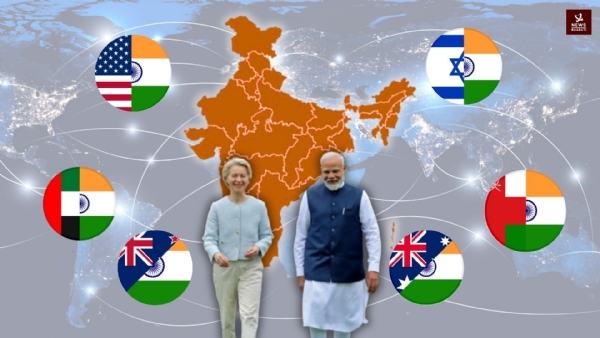
Today, as the international economic order undergoes profound transformation, India is consciously reclaiming that legacy. The world is witnessing the gradual fragmentation of traditional multilateral frameworks and the rise of strategic bilateral arrangements driven by national interests and supply-chain security. Within this shifting environment, India’s trade diplomacy is undergoing a calibrated shift, one that combines selective multilateralism with targeted bilateralism to secure economic growth while safeguarding strategic autonomy.
Historically, India’s influence in global exchange extended far beyond commodities. Alongside silk and spices, India exported ideas that transformed human civilization. The decimal system and the concept of zero, developed in ancient Indian mathematical traditions, traveled across trade routes and reshaped global science, astronomy, and commerce. In many ways, India’s historical trade networks functioned not merely as economic corridors but as conduits of knowledge, culture, and governance models.
This civilizational legacy informs India’s contemporary economic strategy. A defining moment in this strategic pivot came in 2019 when India withdrew from the proposed Regional Comprehensive Economic Partnership. At the time, critics interpreted the decision as protectionism. However, the move reflected a deeper strategic calculation, that economic integration must not come at the cost of domestic industrial capacity or long-term strategic balance. Instead of joining a framework that risked accelerating de-industrialization, India chose to pursue a more calibrated approach, built on carefully negotiated bilateral and mini-lateral agreements designed to strengthen supply chains, boost manufacturing, and expand market access.
In recent years, this strategy has translated into a series of ambitious trade partnerships that collectively represent one of the most active phases of India’s trade diplomacy.
Among the most significant negotiations underway is the proposed India–European Union Free Trade Agreement, often described by observers as the “mother of all deals.” With tariffs expected to be eased on the vast majority of goods, the agreement could fundamentally realign supply chains between India and Europe at a time when geopolitical uncertainties are reshaping global trade flows. Beyond tariff reductions, the deal also seeks to deepen cooperation in technology, sustainability, and digital commerce, reflecting the evolving nature of modern trade partnerships.
Similarly, the ongoing negotiations for the India–United Kingdom Comprehensive Economic and Trade Agreement represent a strategic recalibration in the post-Brexit era. While traditional trade agreements focused largely on goods, this partnership places significant emphasis on services, a sector where India enjoys a natural leverage. By facilitating mobility for professionals in information technology, healthcare, finance, and education, the agreement seeks to unlock new avenues for India’s human capital in global markets.
India’s engagement with the Gulf region has also acquired renewed strategic depth through the India–UAE Comprehensive Economic Partnership Agreement and the emerging India–Oman Comprehensive Economic Partnership Agreement. While Oman’s domestic market is smaller compared to some of its regional neighbors, its geographic location at the entrance to the Gulf makes it a vital node in India’s maritime strategy. These agreements are therefore not merely commercial arrangements; they form part of a broader effort to secure energy flows, strengthen maritime connectivity, and deepen India’s economic presence in the Arabian region.
Another landmark development in India’s trade architecture is the India–EFTA Trade and Economic Partnership Agreement, signed with the European Free Trade Association nations.
For the first time in its trade diplomacy, India has secured a binding investment commitment from its partners, amounting to $100 billion in Foreign Direct Investment over the next fifteen years. This inflow is expected to create approximately one million jobs while strengthening India’s manufacturing and technology ecosystem.
The Indo-Pacific has emerged as another crucial frontier of India’s economic diplomacy. The India–Australia Economic Cooperation and Trade Agreement grants preferential access to Australia across roughly 70 percent of India’s tariff lines, particularly facilitating the import of critical raw materials such as coal, mineral ores, and other resources essential for India’s green energy transition. In return, Indian textiles, pharmaceuticals, and agricultural products receive immediate duty-free access to the Australian market.
Negotiations with New Zealand have followed a similarly calibrated approach. While the proposed India–New Zealand Free Trade Agreement aims to eliminate tariffs on a large share of New Zealand’s exports, including wood and wool, India has maintained strict protections for sensitive sectors such as dairy and poultry. This reflects a broader principle guiding India’s trade policy; integration with global markets must proceed without undermining rural livelihoods and domestic food security.
Beyond traditional trade agreements, India’s strategic partnerships with technological leaders such as the United States and Israel also play a critical role in shaping the country’s economic future. Engagement with United States has helped ease trade tensions, while collaboration with Israel leverages its innovation ecosystem to strengthen India’s capabilities in high-end electronics, cybersecurity, and defense technologies.
Complementing these external engagements is an ambitious domestic effort to rebuild the infrastructure backbone that once supported India’s historic trade networks. The PM Gati Shakti National Master Plan seeks to integrate ports, highways, railways, and logistics infrastructure into a unified framework that accelerates connectivity across the country. Economists estimate that infrastructure spending under this initiative could generate a multiplier effect of nearly three times the initial investment, significantly boosting India’s long-term economic growth.
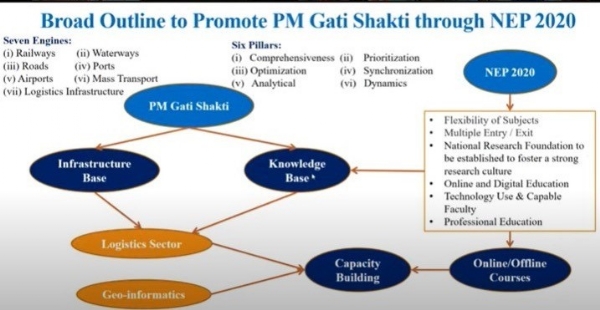
Yet India’s modern economic resurgence is not limited to goods, services, or infrastructure alone. Increasingly, India is also exporting governance models and digital public infrastructure to the world. Platforms such as Unified Payments Interface have emerged as globally recognized innovations in digital finance, while integrated planning frameworks like Gati Shakti demonstrate how technology can transform governance and development.
Taken together, these developments signal a deeper transformation in India’s global economic role. The country is no longer merely a participant or beneficiary of the global trade but it is now actively shaping new economic corridors, partnerships, and institutional frameworks.
In many ways, this moment represents a return to historical continuity. For centuries, India’s civilizational strength lay in its ability to connect markets, cultures, and ideas across vast geographies. Today, through strategic diplomacy, infrastructure modernization, and digital innovation, India is rediscovering that role.
The corridors may look different, ranging from maritime supply chains to digital platforms, but the underlying spirit remains the same, that "India as a confident trading civilization, reclaiming its space in the global economic order while contributing to the emergence of a more balanced, multipolar, and non-Western architecture of globalization."
--

Himali Nalawade
Himali Nalawade is associated with News Bharati as an Author since a considerable period. She is mostly linked with researched articles from the areas of Defence, Defence Infrastructure and Culture-Religion. Along with her Masters in Mass Communication and Journalism after her graduation in History, she has also studied Diploma in Underwater Archaeology and Diploma in Indology.