Naxalbari: Turning Right, Deserting Left
Naxalbari, once the epicentre of a radical "revolutionaries", symbolises today the rise and eventual decline of Naxalism in India. What began as a powerful ideological movement now reflects its stagnation and fading relevance.
NewsBharati 10-Apr-2026 14:46:40 PM
Total Views |


Naxalbari was once an inspiration for radical Communists. Its story is not just the history of a small village in northern West Bengal. It is a compressed narrative of rise, violence, stagnation and eventual decline of radical Left politics in India. An armed agrarian uprising in 1967 soon acquired a mythical status in revolutionary circles. Decades later, Naxalbari stands transformed. It is no longer a symbol of revolution but a marker of the ideological exhaustion of Naxalism.
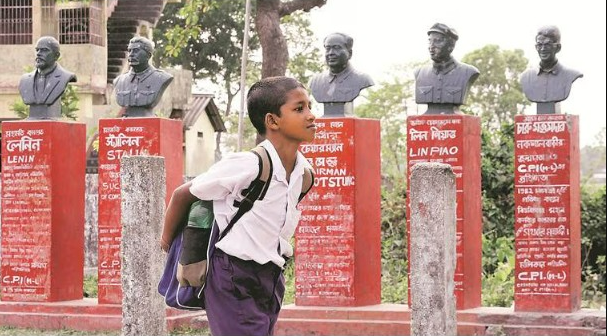
The Naxalbari uprising is said to have emerged from socio-economic distress. The so-called legitimacy of grievance quickly gave way to the brutality of the method. Leaders like Charu Majumdar, Kanu Sanyal, and Jangal Santhal provided ideological and organisational direction to it. Inspired by Maoist doctrine, they rejected parliamentary democracy and advocated armed ‘revolution’.
Majumdar promoted the ‘annihilation line’, making violence central to its strategy. It reduced Naxalism to targeted killings and coercion. This marked the first fundamental flaw of Naxalism – mistaking terror for transformation. The cycles of fear ultimately alienated the masses it claimed to liberate.
The Communist Party of India (Marxist-Leninist) in 1969 formalised this radical break from democratic politics. But the movement’s expansion into other regions, Bihar, Andhra Pradesh, and tribal belts of central India, exposed its ideological and structural weaknesses. Inspired by Karl Marx and Mao, Naxalism was an imported ideology. It lacked Indian orientation, adaptability. Overestimating revolutionary fervour, it failed miserably to understand the ethos of India.
From 1977 to 2011, the Communist Party of India (Marxist) governed West Bengal. Mamata Banerjee defeated the Left, which created a political vacuum after 2011 in regions like Naxalbari. Decades of cadre-based dominance had eroded alternative grassroots structures. The Left’s collapse left behind organisational fragility. Bharatiya Janata Party (BJP) emerged in this vacuum as a new political force.
Since 2014, the BJP has steadily expanded its presence in North Bengal, including Naxalbari. BJP won in Matigara-Naxalbari assembly constituency in 2021 and continued dominance in Darjeeling parliamentary seat. Today, BJP dominates in all the areas of Naxalbari. People are disillusioned by Naxalism, and voter preference has changed. Charu Muzumdar’s birthplace, Hathi Gheesa, is now a BJP bastion. Naxalbari witnesses huge processions on Ram Navami. This is an ideological transformation.
Rashtriya Swayamsevak Sangh played a crucial role in this. It built organisational strength through disciplined grassroots work, shakhas, tribal outreach, and youth mobilisation. RSS was active even during the peak of Naxalism. It filled the vacuum once occupied by Left cadres. The Left relied on class conflict. The RSS-BJP ecosystem mobilised around identity, cultural continuity, and nationalism. The shift reflects a bigger psychological change in political consciousness.
Naxalbari’s transformation from an epicentre of Maoist rebellion to right-of-centre democratic politics is profoundly symbolic. It underscores the decline of class-based revolutionary ideologies in contemporary India. Naxalism, rooted in imported theoretical frameworks, failed to align with India’s civilisational ethos and democratic aspirations. Its insistence on violent upheaval proved incompatible with a society preferring reform over revolution despite inequalities.
The trajectory of leaders hinted at this ideological dead-end. Majumdar remained committed to the rigid line until his death. Kanu Sanyal later distanced himself from the excesses of violence. He implicitly acknowledged the limitations of the original strategy. Such internal reassessments weakened the intellectual coherence of the movement.
Today, Naxalbari doesn’t inspire revolutionary romanticism. It serves as a cautionary tale. The promise of instant justice through armed struggle stands replaced. It favours the realities of democratic negotiation and development-oriented politics. Communities once mobilised for class war are participating in electoral processes. They seek tangible improvements in livelihood rather than abstract ideological victories.
Naxalbari’s journey from ‘Red rebellion’ to ‘Rightward consolidation’ is part of a broader national pattern. Across India, Left-wing extremism has receded territorially and ideologically. Politics that blends nationalism, cultural identity, and developmental aspirations has emerged. BJP’s rise in former Left strongholds proves this shift.
Naxalbari is not a monument to revolution but a verdict on its failure. It once rejected the Indian state through the barrel of a gun. Today, it has returned to the democratic framework it sought to destroy. The people of Naxalbari have chosen ballots over bullets, participation over insurrection, and nationhood over nihilism.
BJP’s rise, supported by the grassroots expansion of other organisations, is not an accident of electoral maths. It reflects a civilisational assertion that India’s future will be shaped not by imported doctrines of class war but by a synthesis of democracy, cultural identity, and national purpose. Naxalbari has written its own epitaph. From the epicentre of armed revolution to a participant in mainstream democratic politics with a rightward turn. It has exposed the hollowness of an ideology that once claimed inevitability. The dawn of a ‘new order’ of Naxalism has ended as a historical footnote.
Satyajit Shriram Joshi
Satyajit Shriram Joshi is Pune based senior journalist.