Congress’ delimitation concern ignores political inequity it created in 1976
Total Views |


The recent article in The Hindu by Sonia Gandhi, where she questions aspects of the proposed delimitation and its link to women’s reservation, feels disconnected from historical reality. It attempts to downplay what is clearly a landmark step forward: the inclusion of women’s reservation alongside the expansion of Parliamentary seats. More than that, the argument appears intellectually disingenuous, glossing over both context and consequence.
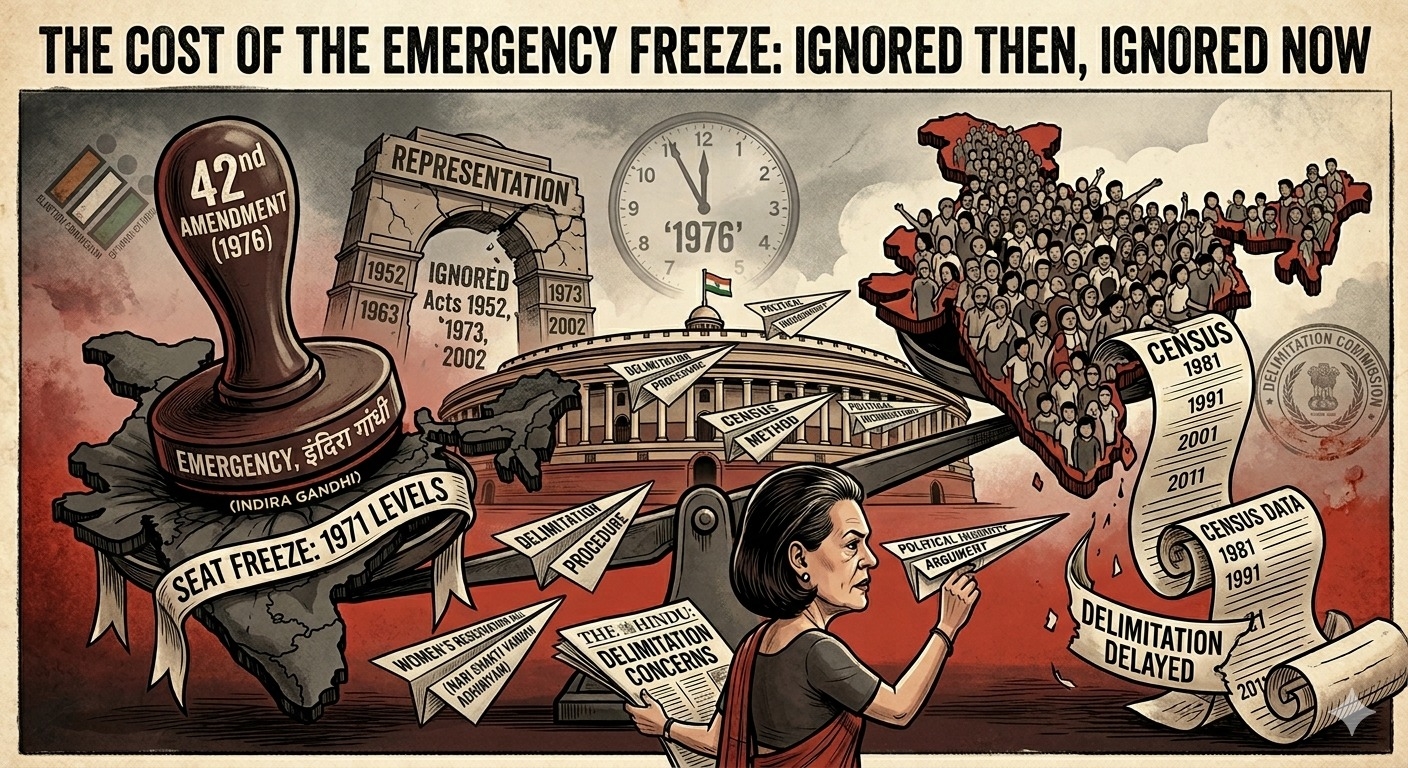
The Delimitation Commission of India is tasked with redrawing constituency boundaries in coordination with the Election Commission of India. Over the years, such commissions have been constituted under the Acts of 1952, 1963, 1973, and 2002. Each of these exercises relied on the most recent Census data to ensure that representation remained broadly proportional within states.
This was never an arbitrary exercise. It was built into the constitutional framework to maintain balance in representation. Since population growth varies across regions, a reasonable population range per Lok Sabha constituency has always been maintained to ensure fairness. The idea was simple: similar population sizes should ideally have similar representation in Parliament.
Yet, despite multiple Census exercises, delimitation has taken place only four times. The gap between 1973 and 2002, followed by another pause until 2026, raises an obvious question. Why was this constitutionally mandated process effectively frozen for decades? This is the critical issue that Congress leaders, including Sonia Gandhi, consistently avoid addressing.
The answer lies in the Emergency period between 1975 and 1977 under Prime Minister Indira Gandhi. During this time, sweeping constitutional changes were introduced with minimal democratic scrutiny. Among them, the 42nd Amendment Act of 1976 stands out for its long-term consequences.
Through this amendment, the number of Lok Sabha constituencies was frozen at 1971 levels until the year 2000 by modifying Article 82. The stated justification was to encourage population control measures, particularly the aggressive family planning drive associated with Sanjay Gandhi. The amendment also made other far-reaching changes, including alterations to the Preamble.
The freeze imposed in 1976 fundamentally altered the trajectory of representation in India. While the population continued to grow, especially in northern states, the number of seats in Parliament remained unchanged. This created a widening gap between population size and political representation. The freeze was later extended in 2002, delaying any fresh delimitation until after the first Census conducted post-2026. As a result, the number of Lok Sabha seats has remained fixed at 543 for nearly five decades. Before this freeze, the number had steadily increased, from 494 in 1952 to 522 in 1963 and then to 543 in 1976, reflecting population growth.
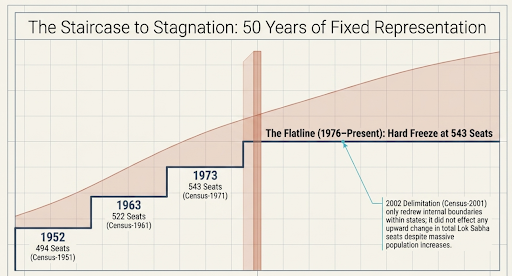
The consequences of this prolonged freeze are now impossible to ignore. Larger states with higher population growth have seen their representation diluted in real terms, with each Member of Parliament representing far more citizens than originally intended. This has distorted the principle of equal representation.
A fresh delimitation exercise is therefore not only justified but necessary. The proposed expansion of Lok Sabha seats to around 816 seeks to correct this imbalance by aligning representation with current population realities. Importantly, this expansion does not reduce seats for any state; it only adds new ones.
This is where the argument of political inequity begins to weaken. If no state is losing representation, the claim that delimitation would unfairly disadvantage certain regions does not hold strong ground. The Constitution itself mandates periodic delimitation based on Census data precisely to prevent such distortions.
Turning to women’s reservation, the hesitation expressed by Sonia Gandhi is surprising. The Nari Shakti Vandan Adhiniyam represents a long-pending reform aimed at ensuring greater participation of women in legislative bodies. Instead of embracing it, Congress appears to be diluting its importance by linking it to broader political concerns.
There is also a visible inconsistency in the party’s position. Rahul Gandhi has repeatedly advocated for reservation proportional to population, encapsulated in the slogan “Jitni Aabaadi, Utna Haq.” In that framework, population becomes the central basis for fairness. However, when delimitation applies the same principle, the argument suddenly shifts.
This selective reasoning raises questions about the party’s credibility. One cannot argue for population-based equity in one context and resist it in another without appearing inconsistent. Over time, such contradictions weaken the legitimacy of the broader argument.
Delimitation, therefore, must be understood in its proper historical and constitutional context. The current imbalance is not accidental; it is the direct result of a political decision taken during the Emergency and extended later. Correcting it is not an act of political opportunism but a constitutional necessity.
At the same time, women’s reservation should not be treated as a secondary issue or a bargaining tool. It is a reform whose time has long come and deserves clear and unequivocal support.
This brings us to a fundamental question. Does the Congress intend to acknowledge and correct the imbalance created under its own rule, or continue to defend it under the language of political equity?