One Nation One Symbol for Made in India: Why Bharat Needs Its Mark
One Nation One Symbol for Made in India seeks to change that every product made in this country should carry, at a glance, one unmistakable sign that it was made here.
NewsBharati 22-Apr-2026 18:22:48 PM
Total Views |


Why India needs an official symbol for Made in India
Every great civilization leaves a mark. Rome left its roads. Greece left its ideas. Britain left its railways. What will Bharat leave in this century of its rising?
The answer is already being written. It is being written in factories in Tamil Nadu and Gujarat, in weaver’s sheds in Varanasi, in startups in Bengaluru, in pharmacies in Hyderabad, in craft clusters from Kutch to Kashmir. India is making more, and making better, than at any point in its modern history. But there is one thing still missing - and it is a small thing that carries a large meaning.
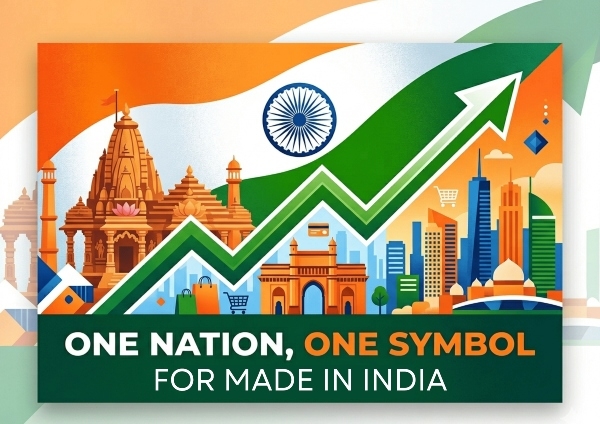
Bharat does not yet have a mark. This is what One Nation One Symbol for Made in India seeks to change.
Every product made in this country should carry, at a glance, one unmistakable sign that it was made here. Not buried in small text. Not hidden on the back of the packet. Not available only to those who can read English or navigate an e-commerce filter. One symbol, seen instantly, understood universally, carried with pride from a village kirana to a global showroom.
This is the call of One Nation One Symbol for Made in India. It is a simple idea. But simple ideas, rightly executed, have built nations.
A symbol a child can recognise.
A symbol a grandmother can trust.
A symbol a manufacturer can wear with pride.
A symbol the world learns to respect.
That is what Bharat deserves. And that is what this movement is asking for.
Consider the journey so far. In 2020, India made it mandatory for e-commerce platforms to disclose the country of origin of every sku listed on the platform. For the first time, the ordinary buyer could see where a product was coming from. In February 2026, the government went a step further. The Ministry of Consumer Affairs notified the Legal Metrology (Packaged Commodities) Amendment Rules, 2026, which take effect on 1 July 2026. From that date, every e-commerce platform selling imported products must offer country of origin as a searchable and sortable filter. Disclosure has become discovery.
These are real victories. They have moved Bharat from opacity to transparency in one of the fastest-growing digital marketplaces on earth. But transparency on a screen is not the same as pride on a packet. A filter helps a buyer choose online; it does not walk with the product into a shop, onto a shelf, into a home, onto an export stage. For that journey, Bharat needs a mark.
Think of what a mark does that text cannot.
It speaks without language. In a country of twenty-two scheduled languages and countless dialects, a symbol is the one signal every Indian can read at the same speed. The grandmother in a mofussil town, the daily-wage worker in a metro, the schoolchild in a tribal belt, the techie in a mall - all of them decode the same mark in the same instant. No other form of communication in a diverse country can claim that reach.
It carries pride. “Made in Germany.” “Made in Japan.” “Made in Italy.” These are not descriptions. They are declarations. Each one took decades to build, but each one now commands a premium in markets across the world. Indian textiles, Indian pharmaceuticals, Indian engineering goods, Indian software, Indian handicrafts - all are worthy of that stature. Without a visible, consistent marker, our excellence is too often recognised by category, not by country. A single Made in India symbol, carried on exports as well as domestic goods, can build that equity over time. The world must know, at a glance, what Bharat has made.
It turns intent into action. Crores of Indians want to support what their country makes. That intent already exists - it is visible in every Diwali purchase, in every Atmanirbhar Bharat conversation, in every Vocal for Local campaign. But intent without ease is effort, and effort fades under the pressure of busy lives. A clear symbol removes that friction. When choosing Indian becomes as simple as recognising a shape, a billion small purchases become a force. That force becomes demand. Demand becomes factories, jobs, livelihoods, investment. This is how a Viksit Bharat is built - not only through mega-projects and policy announcements, but through the everyday pride of everyday citizens.
There is another way to think about this. India is guarded at its borders by soldiers who stand in snow and heat and silence, asking nothing in return but that the country behind them remain strong. That is their work. The civilian has work too. Every time a citizen chooses what Bharat has made, she strengthens the country from within - the factories that employ, the workers that earn, the families that prosper, the taxes that build. A nation is defended at its borders and nurtured in its markets. One is done with a rifle; the other with a purchase. Both matter. A Made in India symbol is simply the instrument that makes the second act as clear, as proud, and as conscious as the first.
Two honest questions about One Nation One Symbol for Made in India deserve answers.
First: if disclosure and filtering are already law, why a symbol? Because law on a screen does not reach the shelf. The 2020 and 2026 rules have transformed the online experience, but the majority of Indian consumption still happens in offline shops, local markets, and neighbourhood stores. A symbol completes the system. It does offline what the filter now does online. And it carries Indian identity into every place a product is seen - an advertisement, a billboard, a festival pack, an export catalogue, a foreign marketplace. A filter helps you find. A symbol stays.
Second: will this burden small manufacturers, and what stops a dishonest player from misusing it? The symbol must be government-issued, publicly owned, and free. No fees, no audits, no gatekeeping - as accessible as the recycling symbol is today. Small manufacturers, who cannot afford to build country-of-origin recognition on their own, will gain the most. On misuse, the answer is simple and non-negotiable: enforcement. Any company that imports products and affixes this symbol to pass them off as Indian-made must face penalties serious enough to stop the attempt before it begins. This concern was shared with the Commerce Ministry four years ago and it stands today. A national symbol is only as strong as the penalty that protects it. Consumer trust, once given to Bharat, must be fiercely protected. The Legal Metrology Act and the Consumer Protection Act already provide the scaffolding. What is needed now is a specific provision for symbol misuse, calibrated to deter even the largest players.
Design, of course, matters. The symbol should be simple, distinctive, and instantly recognisable. It should work on a tiny sachet and on a shop hoarding, on a website favicon and on a shipping container. It must proudly represent our civilisation - dignified, timeless, and unmistakably Indian. It should be ours, and it should look like it.
There is a larger thought at work here. Nations are built in two ways. One is through grand announcements - roads, rockets, reforms. The other is through quiet instruments that change everyday behaviour - a flag, an anthem, a seal, a mark. Both matter. India has done remarkably well at the first. It is time to do the second.
The 2020 disclosure rule gave Bharat visibility. The 2026 filter rule gave Bharat discovery. One Nation One Symbol for Made in India will give Bharat recognition - instant, universal, and proud. In a country where every citizen is a builder of Viksit Bharat, the tools of nation-building must fit in their hands and under their eyes. A symbol does exactly that. It puts the act of choosing Bharat within reach of every Indian, every day.
The soldier guards the border. The citizen nurtures from within. Bharat is ready for its mark. The time to give it one is now.
The author is the founder of the One Nation One Symbol for Made in India movement. Her advocacy helped bring about the 2020 regulation making country-of-origin disclosure mandatory on e-commerce platforms in India, and the Legal Metrology (Packaged Commodities) Amendment Rules, 2026 - notified by the Ministry of Consumer Affairs on 13 February 2026 and effective 1 July 2026 - which require every e-commerce entity selling imported products to offer country of origin as a searchable and sortable filter.
Every great civilization leaves a mark. Rome left its roads. Greece left its ideas. Britain left its railways. What will Bharat leave in this century of its rising?
The answer is already being written. It is being written in factories in Tamil Nadu and Gujarat, in weaver’s sheds in Varanasi, in startups in Bengaluru, in pharmacies in Hyderabad, in craft clusters from Kutch to Kashmir. India is making more, and making better, than at any point in its modern history. But there is one thing still missing - and it is a small thing that carries a large meaning.
Bharat does not yet have a mark. This is what One Nation One Symbol for Made in India seeks to change.
Every product made in this country should carry, at a glance, one unmistakable sign that it was made here. Not buried in small text. Not hidden on the back of the packet. Not available only to those who can read English or navigate an e-commerce filter. One symbol, seen instantly, understood universally, carried with pride from a village kirana to a global showroom.
This is the call of One Nation One Symbol for Made in India. It is a simple idea. But simple ideas, rightly executed, have built nations.
A symbol a child can recognise.
A symbol a grandmother can trust.
A symbol a manufacturer can wear with pride.
A symbol the world learns to respect.
That is what Bharat deserves. And that is what this movement is asking for.
Consider the journey so far. In 2020, India made it mandatory for e-commerce platforms to disclose the country of origin of every sku listed on the platform. For the first time, the ordinary buyer could see where a product was coming from. In February 2026, the government went a step further. The Ministry of Consumer Affairs notified the Legal Metrology (Packaged Commodities) Amendment Rules, 2026, which take effect on 1 July 2026. From that date, every e-commerce platform selling imported products must offer country of origin as a searchable and sortable filter. Disclosure has become discovery.
These are real victories. They have moved Bharat from opacity to transparency in one of the fastest-growing digital marketplaces on earth. But transparency on a screen is not the same as pride on a packet. A filter helps a buyer choose online; it does not walk with the product into a shop, onto a shelf, into a home, onto an export stage. For that journey, Bharat needs a mark.
Think of what a mark does that text cannot.
It speaks without language. In a country of twenty-two scheduled languages and countless dialects, a symbol is the one signal every Indian can read at the same speed. The grandmother in a mofussil town, the daily-wage worker in a metro, the schoolchild in a tribal belt, the techie in a mall - all of them decode the same mark in the same instant. No other form of communication in a diverse country can claim that reach.
It carries pride. “Made in Germany.” “Made in Japan.” “Made in Italy.” These are not descriptions. They are declarations. Each one took decades to build, but each one now commands a premium in markets across the world. Indian textiles, Indian pharmaceuticals, Indian engineering goods, Indian software, Indian handicrafts - all are worthy of that stature. Without a visible, consistent marker, our excellence is too often recognised by category, not by country. A single Made in India symbol, carried on exports as well as domestic goods, can build that equity over time. The world must know, at a glance, what Bharat has made.
It turns intent into action. Crores of Indians want to support what their country makes. That intent already exists - it is visible in every Diwali purchase, in every Atmanirbhar Bharat conversation, in every Vocal for Local campaign. But intent without ease is effort, and effort fades under the pressure of busy lives. A clear symbol removes that friction. When choosing Indian becomes as simple as recognising a shape, a billion small purchases become a force. That force becomes demand. Demand becomes factories, jobs, livelihoods, investment. This is how a Viksit Bharat is built - not only through mega-projects and policy announcements, but through the everyday pride of everyday citizens.
There is another way to think about this. India is guarded at its borders by soldiers who stand in snow and heat and silence, asking nothing in return but that the country behind them remain strong. That is their work. The civilian has work too. Every time a citizen chooses what Bharat has made, she strengthens the country from within - the factories that employ, the workers that earn, the families that prosper, the taxes that build. A nation is defended at its borders and nurtured in its markets. One is done with a rifle; the other with a purchase. Both matter. A Made in India symbol is simply the instrument that makes the second act as clear, as proud, and as conscious as the first.
Two honest questions about One Nation One Symbol for Made in India deserve answers.
First: if disclosure and filtering are already law, why a symbol? Because law on a screen does not reach the shelf. The 2020 and 2026 rules have transformed the online experience, but the majority of Indian consumption still happens in offline shops, local markets, and neighbourhood stores. A symbol completes the system. It does offline what the filter now does online. And it carries Indian identity into every place a product is seen - an advertisement, a billboard, a festival pack, an export catalogue, a foreign marketplace. A filter helps you find. A symbol stays.
Second: will this burden small manufacturers, and what stops a dishonest player from misusing it? The symbol must be government-issued, publicly owned, and free. No fees, no audits, no gatekeeping - as accessible as the recycling symbol is today. Small manufacturers, who cannot afford to build country-of-origin recognition on their own, will gain the most. On misuse, the answer is simple and non-negotiable: enforcement. Any company that imports products and affixes this symbol to pass them off as Indian-made must face penalties serious enough to stop the attempt before it begins. This concern was shared with the Commerce Ministry four years ago and it stands today. A national symbol is only as strong as the penalty that protects it. Consumer trust, once given to Bharat, must be fiercely protected. The Legal Metrology Act and the Consumer Protection Act already provide the scaffolding. What is needed now is a specific provision for symbol misuse, calibrated to deter even the largest players.
Design, of course, matters. The symbol should be simple, distinctive, and instantly recognisable. It should work on a tiny sachet and on a shop hoarding, on a website favicon and on a shipping container. It must proudly represent our civilisation - dignified, timeless, and unmistakably Indian. It should be ours, and it should look like it.
There is a larger thought at work here. Nations are built in two ways. One is through grand announcements - roads, rockets, reforms. The other is through quiet instruments that change everyday behaviour - a flag, an anthem, a seal, a mark. Both matter. India has done remarkably well at the first. It is time to do the second.
The 2020 disclosure rule gave Bharat visibility. The 2026 filter rule gave Bharat discovery. One Nation One Symbol for Made in India will give Bharat recognition - instant, universal, and proud. In a country where every citizen is a builder of Viksit Bharat, the tools of nation-building must fit in their hands and under their eyes. A symbol does exactly that. It puts the act of choosing Bharat within reach of every Indian, every day.
The soldier guards the border. The citizen nurtures from within. Bharat is ready for its mark. The time to give it one is now.
The author is the founder of the One Nation One Symbol for Made in India movement. Her advocacy helped bring about the 2020 regulation making country-of-origin disclosure mandatory on e-commerce platforms in India, and the Legal Metrology (Packaged Commodities) Amendment Rules, 2026 - notified by the Ministry of Consumer Affairs on 13 February 2026 and effective 1 July 2026 - which require every e-commerce entity selling imported products to offer country of origin as a searchable and sortable filter.

Savitha Rao
Savitha Rao is the Founder of the India Positive Citizen initiative (www.indiapositivecitizen.com) and is focused on sustainability and social work. The vision of her initiative is to inspire every Indian to contribute towards nation building with one action, once a week, every week. She speaks of building a great nation India with one positive action at a time.
She has authored the books a) India Positive Citizen b) 500+ Ways to be an India Positive Citizen c) Putting India First: India Positive Citizen Perspectives
Through her non-profit foundation, Positive Citizen Foundation she leads on-ground initiatives to enable a kinder, joyous and more sustainable world. Prime Minister Modi too has appreciated the concept of her work and the book.
Click Here To Buy Her Books on Amazon
She has authored the books a) India Positive Citizen b) 500+ Ways to be an India Positive Citizen c) Putting India First: India Positive Citizen Perspectives
Through her non-profit foundation, Positive Citizen Foundation she leads on-ground initiatives to enable a kinder, joyous and more sustainable world. Prime Minister Modi too has appreciated the concept of her work and the book.
Click Here To Buy Her Books on Amazon