There is a particular kind of trust that a society extends to its educated class. A doctor is welcomed in houses, hospitals, and communities without suspicion. A professor commands intellectual authority. A corporate professional move freely through institutions built on merit and credibility. For years, the degree has been the ultimate symbol of civilisational progress, a proof that education elevates human beings above violence and barbarism.
That assumption is collapsing.
The modern extremist no longer arrives from an isolated place or a lawless frontier carrying the visible markers of militancy. He arrives carrying an ID card, a laptop, a medical degree, or an employee access badge. He speaks polished English, navigates institutions effortlessly, and blends into the professional class without resistance. He does not stand outside the system. He operates from deep within it.
This is the terrifying reality of white-collar terrorism: the weaponisation of education, professional credibility, and institutional trust against the nation itself.
The danger lies not merely in violence, but in invisibility. Society is conditioned to suspect the uneducated drifter, the radical preacher, or the armed operative crossing borders. It is far less prepared to suspect the surgeon, the academic, the HR executive, or the software engineer. The profession becomes camouflage. The degree becomes a shield. Respectability becomes operational cover.
India’s gravest internal threat today is not simply terrorism in its conventional form. It is terrorism that has learned how to wear a tie, teach in classrooms, treat patients, infiltrate offices, and exploit the very openness of democratic society.
How has education failed to displace radicalism?
For decades, policymakers and intellectuals repeated a comforting theory: education reduces extremism. The logic appeared simple. Provide opportunity, economic mobility, and higher learning, and radical ideology would weaken naturally.
Reality has demolished that assumption.
Many of the individuals emerging in recent terror investigations are not impoverished, uneducated, or socially excluded. They are highly trained professionals who have spent years inside universities, hospitals, laboratories, and corporate institutions. Yet their academic success never displaced their ideological conditioning.
This is because education alone does not necessarily transform belief systems. A radicalised worldview rooted in supremacist Islamist ideology often develops long before higher education enters the picture. It can emerge through tightly knit ideological ecosystems, madrasa trainings, online propaganda networks, sectarian indoctrination, or extremist religious influence. Once deeply embedded, that worldview does not disappear when an individual enters medical college or corporate employment. Instead, education enhances capability.
The degree becomes a tool. The ideology remains the command centre.
The result is a far more dangerous extremist than the conventional foot soldier. An educated radical possesses technical knowledge, institutional access, financial mobility, communication skills, and most importantly, social legitimacy. He knows how systems function because he operates inside them every day.
India is no longer dealing only with radicalisation at the margins. It is dealing with radicalisation embedded within the professional class itself.
Here are some recent examples:
Case 1: The doctor who planned mass poisoning
One of the most chilling recent cases involved Syed Ahmed Mohiuddin, a Hyderabad-based doctor who was chargesheeted by the National Investigation Agency along with co-accused Azad and Mohammad Suhel from Uttar Pradesh in an ISIS-linked terror conspiracy.
According to investigators, the module was preparing to carry out mass poisoning attacks in public spaces using ricin, an extremely lethal biological toxin derived from castor seeds and classified under Schedule I of the Chemical Weapons Convention. Ricin is so deadly that even microscopic exposure can trigger organ failure and death. There is no antidote.
The case surfaced in November 2025 when Gujarat ATS arrested Mohiuddin near a toll plaza allegedly carrying illegal weapons, castor oil, and suspicious materials. Subsequent investigation revealed that his residence had allegedly been converted into a clandestine ricin production facility. Agencies further claimed he was in communication with foreign ISIS handlers who had allegedly promised him the role of “ISIS Amir of South Asia.”
Investigators alleged that co-accused Azad and Suhel handled logistics, arms movement, financing channels, and operational coordination through dead-drop networks spanning Rajasthan and Gujarat. Suhel was also accused of preparing ISIS propaganda material and recording oath-of-allegiance videos.
What makes the case particularly horrifying is that Mohiuddin’s medical expertise was not incidental to the conspiracy. His training enhanced the threat itself. The knowledge society trusted him with as a physician was being redirected toward mass civilian harm.
This is the precise nature of white-collar terror: expertise converted into a weapon.
Case 2: Professor accused in the Red Fort bombing conspiracy
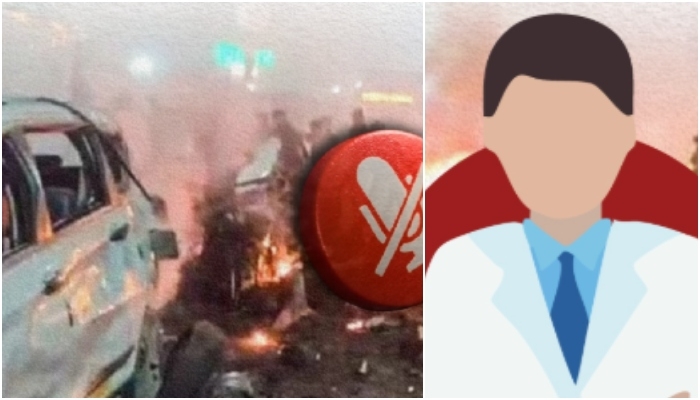
On November 10, 2025, a devastating explosion near Delhi’s Red Fort shook the national capital. The attack killed 12 civilians and injured dozens more in what became one of the deadliest terror incidents in Delhi since 2011.
Investigators identified Dr. Umar Un Nabi, an assistant professor of medicine at Al Falah University in Haryana, as the suicide bomber who drove the explosives-laden vehicle.
The revelation stunned the country.
A university professor, someone entrusted with educating future medical professionals, was accused of participating in a large-scale terror operation linked to Jaish-e-Mohammed. Authorities claimed the attack was carried out in retaliation for Operation Sindoor.
The broader conspiracy involved several educated operatives including Shaheen Sayeed, Muzammil Ahmed Ganaie, Mujammil Shakil, Muzaffar Rather, and Adil Ahmed Rather. The recruiter and ideological handler, Maulvi Irfan Ahmad, had reportedly worked earlier as a paramedic at GMC Srinagar.
Investigators recovered massive quantities of explosives, ammonium nitrate, and assault weapons that had allegedly been procured gradually over months to avoid detection. The operation required planning sophistication, logistical discipline, financial coordination, and technical execution.
This was not spontaneous radicalism. It was organised, educated, methodical extremism operating beneath the cover of professional normalcy.
Dr. Umar Un Nabi taught medicine by day while preparing mass murder by night. That contradiction is exactly why white-collar extremism is so difficult to detect. The system assumes that professional achievement automatically indicates moral integration into society.
Increasingly, that assumption is proving catastrophically naive.
Case 3: Corporate office became centre of Dawah
In Nashik, Maharashtra, nine employees from a major IT company came forward alleging systematic religious harassment inside the workplace. The accused included Danish Sheikh, Tausif Attar, Raza Memon, Sharukh Qureshi, Asif Ansari, Shafi Sheikh, Ashwini Chanani and Nida Khan.
The complainants alleged that Hindu employees were subjected to religious ridicule, intimidation, psychological pressure, and sustained attempts at ideological influence and conversion-oriented coercion.
The allegations raised disturbing questions about how professional environments can be exploited for religious targeting while management structures fail to intervene effectively.
Nida Khan’s role became particularly controversial because complainants claimed her inaction enabled the hostile environment to continue unchecked. Media reports further pointed toward her connections between with Dr Shaheen who was linked to the Red Fort terror module.
If such links are established through investigation, the implications become deeply alarming. It shows that this was not an isolated misconduct, but overlapping ideological ecosystems spanning campuses, corporate offices, and extremist networks.
The issue here extends beyond workplace misconduct. It concerns the use of professional environments as recruitment, intimidation, and ideological conditioning spaces operating under the cover of corporate normalcy.
India’s corporate and HR systems remain unequipped to identify or respond to this form of ideological infiltration because they continue to interpret such incidents merely through the framework of interpersonal workplace conflict rather than organised sectarian radicalism.
Case 4: The doctor accused in a counterfeit currency network
Another disturbing case emerged from Bhopal, where Koh-e-Fiza police arrested Saif-ul-Islam, a 27-year-old MBBS doctor originally from Murshidabad, West Bengal, in connection with a counterfeit currency racket.
Police recovered 280 counterfeit Rs 500 notes valued at Rs 1.40 lakh, along with an iPhone, a pen drive, and a UK series plus 44 foreign phone numbers. Investigation revealed the paper used for the fake notes had direct links to Pakistan and Nepal, pointing to an international counterfeiting syndicate.
Saif-ul-Islam had married locally in Bhopal, settled in Arera Colony, and presented himself as a corporate employee, using his medical degree and domestic stability as a shield of social legitimacy. He had been circulating approximately Rs 60,000 worth of fake currency over ten days, acquiring counterfeit notes worth Rs 2 lakh for just Rs 60,000 from an associate in West Bengal. He further admitted to supplying fake bank accounts to cyber fraudsters, connecting the case simultaneously to counterfeit currency operations, cybercrime, and suspected foreign handler networks.
Behind that facade, investigators allege he was circulating counterfeit currency, facilitating fraudulent bank accounts for cybercriminals, and operating within a broader economic destabilisation network.
Counterfeit currency is not an ordinary financial crime when linked to hostile foreign networks. It is economic warfare. Its objective is to damage trust in the financial system, inject illicit funding into criminal ecosystems, and weaken institutional confidence from within.
Again, the pattern remains identical.
The accused relied upon professional respectability to evade suspicion. The medical degree did not merely provide employment. It provided camouflage.
These are not isolated incidents. Time and again, cases of radicalisation have emerged from among individuals belonging to some of the country’s most respected professions. The pattern is no longer confined to metropolitan centres alone. From major cities to smaller towns, educated and professionally established individuals have repeatedly surfaced in investigations linked to extremist networks, ideological coercion, terror conspiracies, and organised subversive activities. The spread is wider, deeper, and far more normalised than India is willing to acknowledge.
The system must learn to recognise threats within
Education was never meant to produce merely skilled professionals. Its deeper purpose is to cultivate moral responsibility, constitutional values, intellectual honesty, and a sense of shared humanity that makes peaceful coexistence possible. A society invests in its universities, medical colleges, and institutions because it believes education civilises the individual and strengthens the nation.
But radical Islamist indoctrination fundamentally rejects that very idea of coexistence.
For the radicalised mind, society is not a shared civilisational space built on mutual respect. It is a battlefield divided between the believer and a kaffir. In such an ideological framework, education is not viewed as a means to serve humanity. It becomes a means to penetrate systems, gain legitimacy, acquire influence, and eventually weaponise institutional trust itself.
That is what makes white-collar extremism uniquely dangerous.
The years spent inside a medical college, university campus, or corporate institution are not necessarily years of ideological reform. Often, they become years of silent preparation. The examination is cleared. The degree is earned. The professional image is perfected. Trust is accumulated patiently. Society lowers its guard because the individual appears educated, articulate, and successful.
And then the very knowledge, access, and credibility gifted by that society are allegedly turned against it.
These cases are alarming not merely because crimes were committed, but because the accused operated from within institutions that society instinctively associates with service, intelligence, and respectability.
A doctor plots ricin attacks.
A professor becomes part of a suicide bombing conspiracy.
Corporate professionals transform workplaces into spaces of dawah.
Another doctor participates in counterfeit currency and cyber-linked networks tied to hostile foreign channels.
This is not conventional extremism operating from the shadows of forests or border regions. This is ideological radicalisation embedded inside the educated class itself.
India’s security framework still largely looks for threats at the border, in underground cells, or among visibly suspicious networks. But the far more dangerous threat is the one capable of blending seamlessly into everyday life while enjoying the protection of social credibility.
The country cannot afford to confuse professional qualification with loyalty to constitutional values. Degrees alone do not guarantee integration into the civilisational and democratic ethos of the nation. A person may be highly educated and yet deeply hostile to the society that educated him.
That is the uncomfortable reality India must confront.
Because the greatest internal threat is not always the man who openly declares war against the nation. Sometimes, it is the man the nation trusted unquestioningly.