Kerala: Muslim League demands 'new Malapuram' for Muslims under the guise of improved administrative growth, exposing true intent
NewsBharati 02-May-2026 15:27:12 PM
Total Views |


The Muslim Youth League (MYL), associated with the Indian Union Muslim League (IUML) in Kerala, has renewed its demand to bifurcate Malappuram district in the state. The League proposes the formation of a new district with Tirurangadi as its headquarters. Malapuram district is a highly Muslim-populated district, and IUML has been demanding a separate region, claiming administrative concerns. However, it is reported that a separate district comprising Muslims only could encourage vote bank politics. (Malapuram new district)
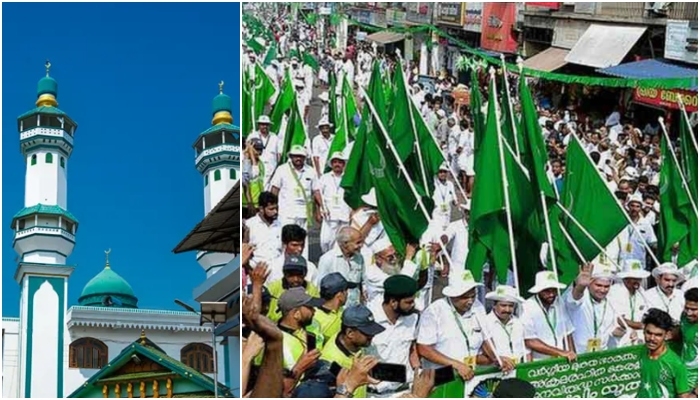
The resolution by MYL outlines several 'benefits' of this proposed bifurcation, such as improved administrative efficiency, quicker delivery of public services, reduced regional disparities, and the development of new infrastructure, along with job opportunities. It also notes that the new arrangement would allow more focused development policies tailored to coastal, hilly, and urban areas.
With a population of over four million, Malappuram continues to be the most populous district in Kerala. The Youth League argues that its large population, diverse geography, uneven development, and limited administrative capacity have made effective governance increasingly difficult.
Ahead of the recently held elections in the state, the IUML could be seen working to consolidate the maximum number of Muslim votes across Kerala, particularly in the five Malabar districts, where the community’s demographic presence ranges from nearly 70% in Malappuram to around 29% in Wayanad, a factor seen as critical for the UDF to return to power.
Also, in February 2026, the IUML had openly called for the bifurcation of Malappuram, urging a scientific review of the boundaries of districts. Notably, the proposal to create a new district in such a region could strengthen identity-driven political consolidation, potentially reinforcing “vote-bank” dynamics. In such a scenario, administrative decisions perceived through a communal lens may deepen social divisions, even if not intended.
The IUML, which claims to have come into existence after 1948, is an offshoot of the All India Muslim League (AIML), a party founded by Pakistan’s founder and Islamist leader Mohammad Ali Jinnah. After partition, the AIML was succeeded by the Muslim League in Pakistan and the Indian Union Muslim League (IUML) in India. It is a known fact that the Muslim League openly demanded the establishment of a separate nation for Muslims, and their demand was fulfilled with the creation of Pakistan.
The formation of the IUML was a part of the plan to keep the spirit of the AIML alive. It is evident from the fact that the first president of the IUML, Muhammad Ismail, actively participated in the partition movement of the country and was an ardent supporter of the creation of Pakistan. Besides, Ismail, who on one hand claimed that the IUML was a secular outfit, supported the retention of Sharia law for Indian Muslims in the Constituent Assembly after independence. Not just that, Ismail went to bargain with the Congress to “recognise the League as the sole representative of Muslims” on the lines of Jinnah’s claim that AIML was the sole representative of the Muslims in undivided India.
A resolution regarding this was passed by the Tirurangadi constituency committee of the organisation on Friday, May 1.
According to the proposal, a new district with Tirurangadi as its headquarters would be created by merging the towns of Tirur, Ponnani, Kondotty, and Tirurangadi. The remaining Malappuram district would be reorganised with Malappuram town as its administrative centre, consisting of Eranad, Perinthalmanna, and Nilambur taluks.
What is the Muslim League proposing?
The resolution by MYL outlines several 'benefits' of this proposed bifurcation, such as improved administrative efficiency, quicker delivery of public services, reduced regional disparities, and the development of new infrastructure, along with job opportunities. It also notes that the new arrangement would allow more focused development policies tailored to coastal, hilly, and urban areas.
With a population of over four million, Malappuram continues to be the most populous district in Kerala. The Youth League argues that its large population, diverse geography, uneven development, and limited administrative capacity have made effective governance increasingly difficult.
However, it is important to note that while the MYL has framed the proposal as an administrative necessity aimed at improving governance and development, it is observed that the move could carry underlying political implications. The organisation is affiliated with the Indian Union Muslim League, which holds significant influence in Malappuram, a district with a sizeable Muslim population.
IUML works for Muslim rights
Ahead of the recently held elections in the state, the IUML could be seen working to consolidate the maximum number of Muslim votes across Kerala, particularly in the five Malabar districts, where the community’s demographic presence ranges from nearly 70% in Malappuram to around 29% in Wayanad, a factor seen as critical for the UDF to return to power.
Also, in February 2026, the IUML had openly called for the bifurcation of Malappuram, urging a scientific review of the boundaries of districts. Notably, the proposal to create a new district in such a region could strengthen identity-driven political consolidation, potentially reinforcing “vote-bank” dynamics. In such a scenario, administrative decisions perceived through a communal lens may deepen social divisions, even if not intended.
The Indian Union Muslim League (IUML), a political entity dedicated to safeguarding Muslim rights, has Congress's silent support as the latter, several times in the past, has called the former a 'secular' party. This is even after IUML openly stating that it works to safeguard only Muslim rights.
Is the Indian Union Muslim League (IUML) 'secular' as often claimed by Congress?
The IUML, which claims to have come into existence after 1948, is an offshoot of the All India Muslim League (AIML), a party founded by Pakistan’s founder and Islamist leader Mohammad Ali Jinnah. After partition, the AIML was succeeded by the Muslim League in Pakistan and the Indian Union Muslim League (IUML) in India. It is a known fact that the Muslim League openly demanded the establishment of a separate nation for Muslims, and their demand was fulfilled with the creation of Pakistan.
The formation of the IUML was a part of the plan to keep the spirit of the AIML alive. It is evident from the fact that the first president of the IUML, Muhammad Ismail, actively participated in the partition movement of the country and was an ardent supporter of the creation of Pakistan. Besides, Ismail, who on one hand claimed that the IUML was a secular outfit, supported the retention of Sharia law for Indian Muslims in the Constituent Assembly after independence. Not just that, Ismail went to bargain with the Congress to “recognise the League as the sole representative of Muslims” on the lines of Jinnah’s claim that AIML was the sole representative of the Muslims in undivided India.
The IUML is known for flaring up communal incidents in the state of Kerala. As per the report of the Justice Thomas P Joseph Commission, which was set up to investigate the 2003 Marad massacre in Kerala, the IUML was found to be involved in the planning as well as the execution of the brutal violence. The report had declared the massacre as “a clear communal conspiracy, with Muslim fundamentalist and terrorist organisations involved”. In 2017, the Central Bureau of Investigation (CBI) filed an FIR in connection with the Marad massacre, naming IUML leaders P.P. Moideen Koya and Moyeen Haji as accused of funding, conspiring, and executing the riots.
In the given case, the proposal to create a new district in Malapuram could strengthen identity-driven political consolidation, potentially reinforcing “vote-bank” dynamics. In such a scenario, administrative decisions perceived through a communal lens may deepen social divisions, even if not intended.
Siddhi Somani
Siddhi Somani is known for her satirical and factual hand in Economic, Social and Political writing. Having completed her post graduation in Journalism, she is currently engaged in completing her Masters in Politics. The author meanwhile is also exploring her hand in analytics and statistics.