Beneath the Doab, a Civilization Remembers: Rediscovery of Saraswati’s Ancient Course
Scientists involved in the study have acknowledged that the channel lies within the same geographical zone where ancient Indian texts and traditional memory locate the lost Saraswati river.
NewsBharati 20-May-2026 15:41:44 PM
Total Views |


The Saraswati river occupied a unique space in India’s civilizational consciousness for centuries. Treated as "mythology" by colonial scholarship and simultaneously as living reality by millions who gathered at the Triveni Sangam in Prayagraj, believing in the presence of an invisible third river beneath the confluence of the Ganga and Yamuna. Today, a remarkable geological discovery beneath the Ganga-Yamuna Doab is reopening that debate, not through faith alone, but remarkably through the language of science itself.
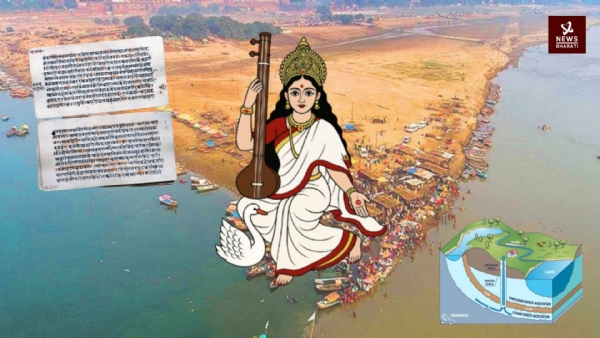
Scientists from the CSIR-National Geophysical Research Institute, working alongside the National Mission for Clean Ganga, have identified a massive buried palaeo-river system stretching from Kanpur to Prayagraj. The surveyed stretch spans nearly 45 kilometres, while the broader channel system is believed to extend over 200 kilometres beneath the fertile plains of the Doab. Measuring nearly 4 to 5 kilometres in width and descending up to 15 metres below present ground level, the discovery is not a minor underground stream but the remnant of a once-powerful river system.
The geological characteristics of the buried channel are particularly significant. Thick deposits of sand and gravel indicate the flow of a major river capable of transporting heavy sediment over long distances. Unlike the clay-dominated floodplains of the Ganga basin, such sediment structures possess high groundwater storage and transmission capacity. In practical terms, this discovery could transform future groundwater management strategies across northern India at a time when water stress increasingly threatens the Indo-Gangetic plains.
Yet the discovery’s implications go far beyond hydrogeology.
Scientists involved in the study have acknowledged that the channel lies within the same geographical zone where ancient Indian texts and traditional memory locate the lost Saraswati river. The identification of this palaeo-channel required highly sophisticated techniques including Heliborne Transient Electromagnetic (HTEM) surveys, ground-based stratigraphic validation, drilling, and Optically Stimulated Luminescence dating. What emerged was evidence of a river system that likely dried up or altered course thousands of years ago during the Holocene period, a time marked by dramatic climatic and tectonic changes across the Indian subcontinent.
Importantly, the Prayagraj discovery does not stand alone. It forms the easternmost point of a much larger research corridor extending through Haryana, Rajasthan, the Ghaggar-Hakra basin, and even parts of present-day Pakistan. For decades, geologists, archaeologists, and hydrologists have investigated these regions in search of the mighty river described in the Rigveda as the “Naditama”, referring to the greatest among rivers.
The Ghaggar-Hakra system and recent findings from Bahaj village in Rajasthan have further strengthened theories that the Saraswati was once a glacier-fed Himalayan river that gradually fragmented due to tectonic instability in the Himalayan Frontal Belt and the Siwalik ranges. Two major hydrological events are believed to have accelerated its decline: the diversion of the Yamuna eastward into the Ganga basin and the shifting of the Sutlej westward. This “beheading” of the river system, combined with the severe 4.2 kiloyear climatic event around 2200 BCE, often referred to as the “mega-drought”, likely caused the gradual desiccation of the Saraswati basin.
What followed may have fundamentally altered the civilizational geography of ancient India. As water systems collapsed in the northwest, populations associated with the Harappan civilisation are believed to have migrated eastward towards the Ganga-Yamuna Doab, the very landscape where this buried channel has now resurfaced through scientific investigation.
This has profound implications for understanding the evolution of Vedic civilization itself. The Saraswati occupies a central position in the early “Family Books” of the Rigveda and is described as flowing “गिरीभ्यः आ समुद्रात्”, from the mountains to the ocean. In contrast, the Ganga appears relatively late in Vedic literature. This suggests that the earliest layers of Vedic culture were rooted in the northwestern river systems before gradually shifting eastward.
For much of the 19th and early 20th centuries, however, colonial-era scholars influenced by figures like James Mill and Max Muller dismissed Indic geographical memory as either symbolic or mythological. The dominant framework of the “Aryan Invasion Theory” left little room for interpreting civilizational shifts through hydrology, climate, or indigenous continuity.
However, that intellectual climate is now changing.
Modern science is increasingly approaching traditional knowledge systems not as superstition, but as repositories of encoded geographical and ecological memory. In many ways, the cultural deification of Saraswati may have preserved the river’s location long after its visible waters disappeared. Rituals, pilgrimage routes, oral traditions, and the sanctity attached to the Triveni Sangam ensured that the memory of the river survived for nearly three millennia without direct physical visibility.
This raises a deeper civilizational question: how does a river survive in cultural consciousness for thousands of years after vanishing from the surface?
And the answer perhaps lies in India’s sacred geography, a framework where landscape, memory, spirituality, and civilization are inseparable. By transforming Saraswati into a goddess, Indian civilisation ensured that geography itself became immortalised within culture. The river may have disappeared from the earth’s surface, but it never disappeared from the India's civilizational map.
For the millions who gather at the Sangam during the Kumbh Mela, the recent NGRI findings are therefore more than a scientific discovery. They are seen as validation of a continuity India has preserved through faith, memory, and lived tradition.
Finally, beneath the fertile soil of the Doab, science may finally have uncovered what the civilisation never forgot.
--

Himali Nalawade
Himali Nalawade is associated with News Bharati as an Author since a considerable period. She is mostly linked with researched articles from the areas of Defence, Defence Infrastructure and Culture-Religion. Along with her Masters in Mass Communication and Journalism after her graduation in History, she has also studied Diploma in Underwater Archaeology and Diploma in Indology.