West Bengal: Muslims refuse to buy cattle ahead of Bakrid, Bengal citizens protest, but Gaumata saved
Muslims boycotted the purchase of cattle after Maulana Shafique Qasmi, the Imam of Kolkata’s iconic Nakhoda Masjid, on May 20, said that Muslims should not offer "cows" for Qurbani during the festival
NewsBharati 25-May-2026 13:13:50 PM
Total Views |


On May 23, several videos went viral on the internet in which the Islamist community in the state of West Bengal could be seen refusing to buy cattle from the Hindu traders. They claimed that they would not slaughter cattle this Bakri Eid due to orders from the Suvendu Adhikari government.
“I appeal to my Muslim brothers not to offer cows. In fact, they should stop eating beef altogether. Let the Central government declare cows as a protected national animal. Unfortunately, it is our Hindu brothers who will suffer because they are the ones who breed cattle and sell the herds to Muslims during Eid. Millions of rupees exchange hands,” he said.
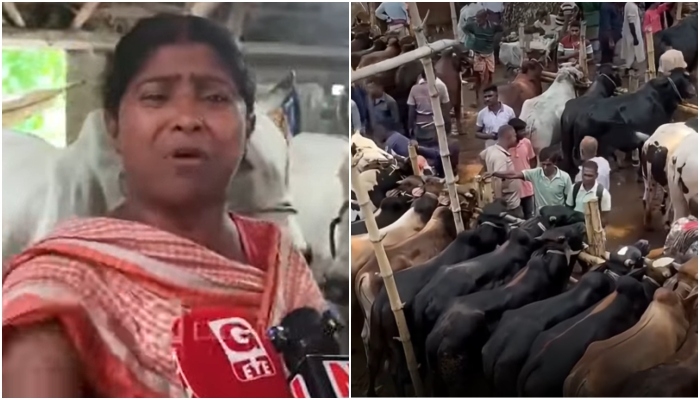
In one of the videos, a Hindu woman could be seen crying over the alleged loss due to the government's decision. "If we do not sell our cattle, how will we survive. This is our livelihood. The government should just give us poison instead of killing us like this," the woman could be heard saying.
In another similar video, a Hindu man could be seen saying, "We have no option but to die. What will we do with the cows, I mean the oxen? We will end up on the streets."
The issue has also sparked wider discussions online about trade, employment, and the effect of policy changes on ordinary working communities. From reduced market activity to strong public reactions, the matter continues to attract significant attention on social media.
It is important to note that the Muslims boycotted the purchase of cattle after Maulana Shafique Qasmi, the Imam of Kolkata’s iconic Nakhoda Masjid, on May 20, said that Muslims should not offer 'cows' for Qurbani during the festival. He instigated the Muslim community not to buy animals during this festival and instead appealed to the government to declare the cow a protected national animal.
Bengal Muslims refused to buy cow from a Hindu man as they will not slaughter cattle this Bakri Eid due to orders from Suvendu Govt.
— News Arena India (@NewsArenaIndia) May 21, 2026
pic.twitter.com/YUfuwOUTMn
“I appeal to my Muslim brothers not to offer cows. In fact, they should stop eating beef altogether. Let the Central government declare cows as a protected national animal. Unfortunately, it is our Hindu brothers who will suffer because they are the ones who breed cattle and sell the herds to Muslims during Eid. Millions of rupees exchange hands,” he said.
Also, Pirzada Jiaudin Siddiqui from Hooghly district’s Furfura Sharif - the state’s most visited Islamic shrine built around the mausoleum of Pir Abu Bakr Siddiqui - said: “Why should we eat beef? Hindus worship cows. We can eat goats and sheep instead”.
Muslims in West Bengal have played the Uno Reverse card.
— PunsterX (@PunsterX) May 21, 2026
- They've refused to buy cows
- Stopped consuming beef
- Demanded total ban on cow slaughter
- Demanded cow be declared national animal
Now Hindu cattle rearers are protesting, as they are making losses. pic.twitter.com/zKTBZuc4n3
After the BJP came to power in West Bengal, the state issued a modified public notice under the West Bengal Animal Slaughter Control Act, 1950, tightening regulations on the slaughter of cattle and buffaloes across the state. The revised notification stated that no cattle or buffalo could be slaughtered without an official fitness certificate issued by competent authorities.
According to the new notification, animals can only be slaughtered if they are certified as being over 14 years of age or permanently incapacitated due to injury, deformity, disease, or inability to work or breed. "Local civic authorities and a government veterinary officer must jointly approve the certification," the state said.
The West Bengal government has issued a modified notice for the public under the West Bengal Animal Slaughter Control Act 1950, saying no cattle or buffalo can be slaughtered without official certification, which declares the animal fit for slaughter. No open public slaughter… pic.twitter.com/cBdYrdRkvW
— ANI (@ANI) May 14, 2026
The Calcutta HC also recently declined to interfere with the West Bengal government’s notification restricting the slaughter of bulls, bullocks, cows, calves, and buffaloes ahead of Bakr Eid. A division bench comprising Chief Justice Sujoy Paul and Justice Partha Sarathi Sen observed that the notification had been issued in compliance with the court’s earlier directions.
ALSO READ: Islamist caught on CCTV vandalizing Durga temple in Murshidabad, video viral, details
Notably, the West Bengal Government imposed a ban on public slaughter of cattle and said that animals could be slaughtered if they are certified as being over 14 years of age or permanently incapacitated due to injury, deformity, disease, or inability to work or breed. However, in a bid to showcase opposition to the newly formed government, the Islamist community boycotted the purchase of cattle, deliberately forcing Bengali cattle owners to protest against the government.
Through Gau Puja, Hindus honor the cow not merely as an animal, but as a living embodiment of divine virtues and as the abode of several deities. From the Vedas to the present day, cow worship has been regarded as an act that brings spiritual merit, prosperity, and protection from negative forces. Be it due to the BJP government's decision or following a deliberate boycott by the Muslim community, the purpose of saving the cows seems to have been attained.
Kajal Bhalerao
Kajal Bhalerao is currently pursuing Mass Communication and Journalism in B.Voc.