He Bhagwan - Bhagwant Ko Buddhi De
Total Views |


The recent controversy surrounding Punjab Chief Minister Bhagwant Mann has once again brought into sharp focus a fundamental question of democratic life. Can personal habits be treated as private when they visibly intrude upon public duty? The uproar in the Punjab Assembly, where the Chief Minister was accused by the Opposition of attending proceedings under the influence of alcohol, is not merely a partisan skirmish. It is, in fact, a serious institutional moment that demands reflection on propriety, responsibility, and the ethical expectations from those in high office.
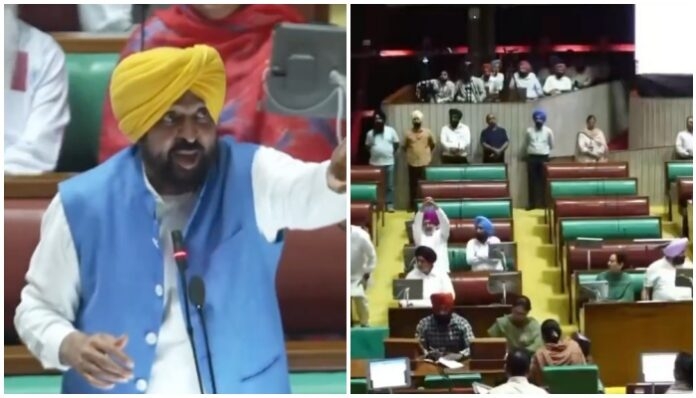
The immediate trigger was dramatic. Opposition leaders alleged that Mann appeared intoxicated during a legislative session, prompting demands for an alcohol test and leading to chaos inside the House. The matter escalated further when suggestions for an alcohol test were reportedly resisted, deepening suspicion and political confrontation. Regardless of whether the allegations are conclusively proven or denied, the optics alone are damaging. In public life, perception often carries as much weight as fact, especially when it concerns the credibility of constitutional offices.
A Chief Minister is not merely a political executive. He is the custodian of state authority. Governance at that level involves constant decision-making on matters of law and order, fiscal policy, inter-state coordination, and, in Punjab’s case, sensitive national security concerns given its status as a border state. The expectation, therefore, is not just competence, but alertness, composure, and physical fitness. Any conduct that raises doubts about these attributes naturally becomes a matter of public concern. Alcoholism can progressively impair brain function, affecting judgment, impulse control, and emotional stability. Chronic alcohol abuse alters neurotransmitter balance, leading to erratic behavior, mood swings, and cognitive decline. Over time, it may cause severe mental disorders, including paranoia and psychosis, making a person appear irrational or “insane” in extreme cases. Can we afford to have such a person in a constitutional post?
This is where the debate transcends individual behaviour and enters the realm of constitutional morality. Personal liberty, including lifestyle choices, is undoubtedly a protected value in a democracy. However, when an individual voluntarily assumes high public office, certain restraints are implicitly accepted. The line between private indulgence and public responsibility is not merely blurred it is subordinated to the latter. A Chief Minister cannot afford the luxury of habits that compromise the dignity or efficiency of the office.
The controversy is not entirely without precedent in Mann’s own public life. His political career has long been shadowed by allegations related to alcohol consumption. Critics have repeatedly raised questions, even before he assumed office, about his alleged drinking habits. In 2019, Mann publicly declared that he had given up alcohol, describing it as a personal commitment made on his mother’s advice. That declaration was significant as it acknowledged the issue and attempted to close the chapter. But, recurring allegations since then suggest that the matter has not been fully laid to rest in public perception.
There have also been politically embarrassing moments in the past where opponents accused him of inappropriate conduct linked to alleged intoxication, including criticisms in Parliament and public forums. While such claims are often contested and politically motivated, their persistence indicates that the issue has remained alive in the political discourse.
This brings us to the role of the Aam Aadmi Party (AAP). Political parties cannot evade responsibility by treating such matters as purely personal to an individual leader. Leadership selection is a conscious organisational decision. If questions regarding a candidate’s conduct were already in circulation, then elevating that individual to the highest executive office in a state carries institutional accountability. A party that claims to represent clean politics must be held to a higher standard, not a lower one.
The contradiction becomes particularly stark in Punjab. The state has long struggled with the menace of substance abuse, and successive governments have promised to tackle it with seriousness. In such a context, allegations fair or otherwise, about the Chief Minister himself appearing under the influence create a credibility deficit. As some critics have pointed out, it appears incongruous for a government to campaign for a “drug-free Punjab” while facing such accusations at the highest level.
Beyond the immediate politics, the larger issue is the absence of a clearly articulated code of conduct within political parties. India’s constitutional framework prescribes qualifications and disqualifications for public office, but it does not specifically legislate personal discipline. That responsibility must be assumed internally by political organisations. Parties must evolve norms that go beyond legal compliance to include ethical expectations, behavioural standards, and accountability mechanisms.
Such a code would not be unprecedented. Professions like the judiciary, armed forces, and civil services operate under strict codes of conduct that regulate behaviour both within and outside formal duty. Politics, despite being the most visible form of public service, often lacks such structured discipline. This gap becomes glaring when controversies like the present one emerge.
Ultimately, the question is not about moral policing or puritanism. It is about institutional integrity. A democracy functions not just on laws and elections, but on trust. Citizens must have confidence that those entrusted with power are fully capable mentally, physically, and ethically of discharging their responsibilities. When that confidence is shaken, even by perception, the damage extends beyond an individual to the office itself.
The controversy involving Bhagwant Mann, therefore, should not be dismissed as routine political mudslinging. It should serve as a moment of introspection for the individual, for his party, and for the political class at large. Public life demands a higher standard precisely because it carries a higher responsibility. When personal liberty begins to cast a shadow on public duty, it is not merely a private matter anymore. It becomes a question of governance, credibility, and the very dignity of democratic institutions.