Mamata's Playbook: Defeat, Denial, and Disruption
Total Views |


Mamata Banerjee’s refusal to step down after a decisive electoral defeat is not a show of resilience. It is a display of political immaturity and institutional disregard. After more than three decades in public life, such conduct is neither defensible nor dignified. Democratic politics rests on one foundational principle. That principle is people’s verdict, which is final. To evade that verdict through theatrics and victimhood is to undermine the very system one claims to serve.
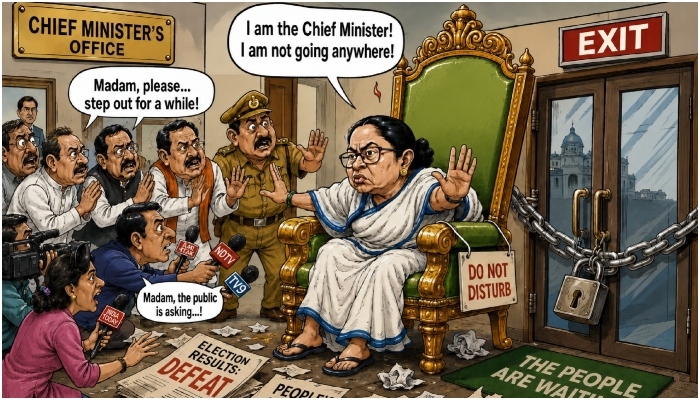
Instead of demonstrating the composure expected of a seasoned leader, Mamata Banerjee has chosen to question institutions wholesale casting aspersions on the Election Commission, central agencies, and by implication, the integrity of the electoral process itself. This is a familiar script, when the mandate is unfavorable, the system becomes suspect. But, India’s constitutional framework provides ample legal avenues for grievance redressal. If there are genuine concerns, they can and should be pursued through established judicial mechanisms. Resorting to public spectacle instead of institutional recourse signals not conviction but desperation.
History offers sharper contrasts. Leaders like Indira Gandhi faced crushing electoral defeats but did not indulge in delegitimizing the system to retain relevance. They absorbed the verdict, recalibrated politically, and returned stronger when the people so decided. That is the grammar of democratic maturity, something conspicuously absent in the present instance.
The Constitution of India leaves little ambiguity regarding the formation of government, dissolution of assemblies, and the roles of constitutional authorities such as the Governor and elected representatives. These are not grey areas open to manipulation. They are clearly codified procedures designed with checks and balances to prevent precisely the kind of overreach now being attempted. For a leader of Banerjee’s experience to feign ignorance or worse, to deliberately test these boundaries is deeply troubling.
The persistence in clinging to office despite a clear mandate against her suggests a calculated attempt to manufacture political sympathy. But this is a risky gamble. Voters are not passive spectators. They are active arbiters of power. Attempts to override or dilute their verdict often provoke not sympathy but resentment. In an era of heightened political awareness, such maneuvers can accelerate political decline rather than arrest it.
This episode must also be viewed in the broader context of non-BJP politics in India. A pattern is emerging where leadership is dominated by individuals, whose legitimacy stems more from lineage than from sustained public endorsement. Figures like Rahul Gandhi and Uddhav Thackeray exemplify this trend. Dynastic entitlement often breeds a disconnect from ground realities, making it difficult to accept political setbacks with humility. When electoral outcomes contradict their expectations, the instinct is not introspection but deflection.
_202605061531104796_H@@IGHT_400_W@@IDTH_700.jpg "Mamata Banrjee 2")
There is, however, a more concerning undercurrent. In the run-up to major national contests, segments of the opposition have increasingly resorted to eroding public trust in constitutional institutions. The Election Commission, the judiciary, and investigative agencies have all been targeted in a sustained campaign of insinuation. The objective appears less about accountability and more about creating a narrative of systemic illegitimacy one that can be weaponized when electoral outcomes are unfavorable.
Such tactics are not merely politically opportunistic. They are institutionally corrosive. Democracies do not collapse overnight they are weakened gradually when public confidence in their core institutions is systematically undermined. Calls for extra-constitutional agitation, and even comparisons with destabilizing movements in neighboring countries, reflect a dangerous flirtation with anarchy. These are not the actions of a responsible opposition. They are the symptoms of a political ecosystem struggling to remain relevant through disruption rather than persuasion. Fortunately, these efforts have repeatedly failed to gain mass traction. The reason is simple. Indian democracy is deeply rooted, not just constitutionally but culturally. The electorate has consistently demonstrated faith in the ballot as the sole legitimate instrument of political change. Attempts to bypass this mechanism have found little resonance among the people.
At the same time, the rise of Narendra Modi has fundamentally altered the expectations from political leadership. Governance is now judged through the prism of performance, delivery, and accountability. Symbolism and rhetoric, once sufficient to sustain political capital, no longer suffice. This “new grammar” of Indian politics demands results, not excuses.
Mamata Banerjee’s current stance, therefore, is not just a personal miscalculation. It is emblematic of a broader inability among sections of the opposition to adapt to this evolving political reality. Refusing to acknowledge defeat does not negate it; it only magnifies the perception of disconnect. The path forward is neither complicated nor unprecedented. Accept the verdict. Step down with dignity. Rebuild with credibility. That is how democratic leaders endure. Anything less risks reducing seasoned politicians to transient figures defined not by their achievements, but by their refusal to accept reality.