Tamil Nadu Tremors Shake INDIA Bloc
NewsBharati 07-May-2026 15:23:37 PM
Total Views |


The political undercurrents in Tamil Nadu are beginning to expose a larger national crisis inside the so-called INDIA bloc. What appears on the surface as an electoral adjustment involving the Congress, DMK and the emerging TVK has, in reality, opened another chapter of distrust, insecurity and political instability within the opposition camp. The developments in Tamil Nadu are not isolated. They reflect the structural collapse of opposition unity across India.
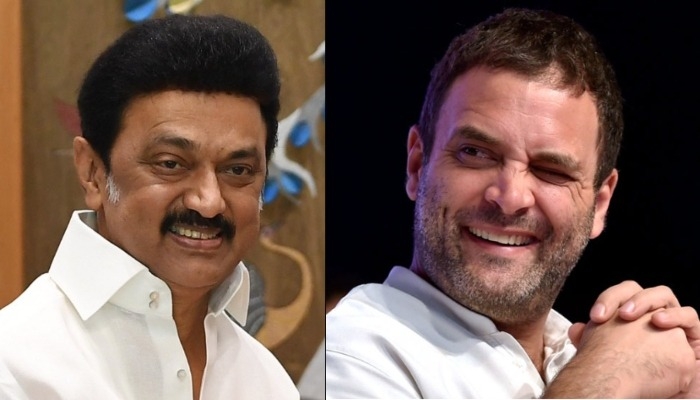
Congress’ sudden signals of flexibility towards TVK have clearly unsettled the DMK leadership. For years, the DMK treated Congress as a junior ally with limited bargaining power. But Congress now appears desperate to create alternative political channels for its survival. The irony is striking. A party that cannot independently provide political stability even in states where it survives through alliances, is now attempting to dictate terms to powerful regional players. This is precisely where the INDIA bloc begins to crack.
Regional parties joined the anti-BJP platform not because they trusted Congress ideologically or organisationally, but because they wanted a tactical arrangement against the BJP’s growing dominance. However, recent assembly elections have fundamentally altered that equation. Congress has failed to emerge as the central pole of opposition politics. In several states, it has become electorally invisible. Apart from a few smaller pockets, the party no longer commands organic mass support capable of challenging the BJP directly. That reality has created nervousness among regional parties. Why should strong regional forces sacrifice their political space for a party that cannot even protect its own base?
Tamil Nadu now demonstrates that contradiction openly. The DMK leadership understands that Congress is increasingly becoming politically unpredictable. Today it may speak one language in Chennai, tomorrow another in Delhi. Such inconsistency naturally creates fears of instability. If alliance partners themselves cannot trust Congress’ long-term intentions, how can voters trust the durability of the coalition? The Congress problem is no longer merely electoral. It is ideological, strategic and leadership-driven.
Under Rahul Gandhi, the party has consistently failed to inspire confidence among allies. Rahul Gandhi’s politics thrives on rhetoric, symbolism and selective agitation, but lacks organisational discipline and strategic clarity. Regional parties increasingly believe that Congress wants alliance benefits without accepting alliance realities. It expects deference despite its shrinking strength. This attitude is becoming unacceptable.
The recent electoral cycles have shown that regional satraps are unwilling to subordinate themselves to Congress leadership merely for the sake of anti-BJP optics. In fact, many regional leaders privately fear that Congress’ political baggage damages their own prospects. They see Congress as indecisive, confused and disconnected from changing national sentiments. The biggest concern for Congress is that it is increasingly being perceived as politically tilted towards Muslim-centric appeasement politics. Whether Congress accepts this perception or not is irrelevant. In politics, perception shapes reality. Across large sections of the country, especially in the Hindi heartland and urban India, Congress is no longer seen as a broad civilisational party.
Instead, it is increasingly viewed as a party obsessed with identity calculations and minority appeasement. This perception comes at a time for the opposition because the national mood is shifting in the opposite direction. The rise of Hindutva sentiment is no longer limited to North India. It has become a broader political-cultural force shaping electoral behaviour across regions. The BJP has successfully converted nationalism, cultural identity and welfare delivery into a durable political framework. Against this backdrop, Congress’ old-style secular posturing appears outdated and electorally ineffective. That is why the BJP continues to expand even in difficult regions.
Regional parties understand this shift better than Congress does. They know that aggressive anti-Hindu positioning or minority-centric signalling carries political risks. Therefore, many of them now try to maintain a careful balance. Congress, however, repeatedly pushes ideological positions that make allies uncomfortable. This creates friction inside the INDIA bloc. Tamil Nadu may therefore become an early warning signal of a much larger national fragmentation.
If tensions deepen between DMK and Congress over alliance management or political positioning, it could trigger fresh distrust among other regional allies as well. Leaders across India are already observing how Congress handles partners. The impression gaining ground is that Congress wants control without accountability, prominence without performance and leadership without electoral strength. Such politics cannot sustain a national coalition.
The INDIA bloc today appears less like a united political alliance and more like a temporary arrangement driven by fear of the BJP. There is no coherent ideological framework, no common governance vision and no accepted leadership structure. Every regional party is calculating its own survival. Congress, instead of reassuring partners, is worsening anxieties through inconsistency and arrogance. hat is why the future of the INDIA bloc increasingly appears non-serious.
Meanwhile, the BJP continues to benefit from opposition confusion. A fragmented opposition only strengthens the BJP’s central narrative — that there is no stable alternative to its leadership. Every public disagreement inside the INDIA bloc reinforces that perception further. Congress should have treated recent election setbacks as an opportunity for introspection and organisational rebuilding. Instead, it continues to behave as though it remains the natural leader of the opposition ecosystem. The ground reality says otherwise. Tamil Nadu’s political developments may therefore have consequences far beyond the state. They could accelerate the isolation of Congress within the opposition camp itself. And once regional parties begin openly questioning Congress’ reliability and electoral utility, the very foundation of the INDIA bloc could start collapsing from within. The warning signs are already visible

Editor's Desk
Editor's Desk