New Muslim League With Congress Cap
NewsBharati 07-May-2026 17:17:01 PM
Total Views |


The Congress party today faces a crisis far deeper than electoral decline. It faces a crisis of identity, perception and political credibility. The latest Assembly election data from Assam, Kerala, West Bengal and Tamil Nadu has once again revived a question that has haunted the party for decades. The question is - Has Congress reduced itself into a minority-dependent political formation with little appeal among the broader Hindu electorate? The figures are politically explosive.
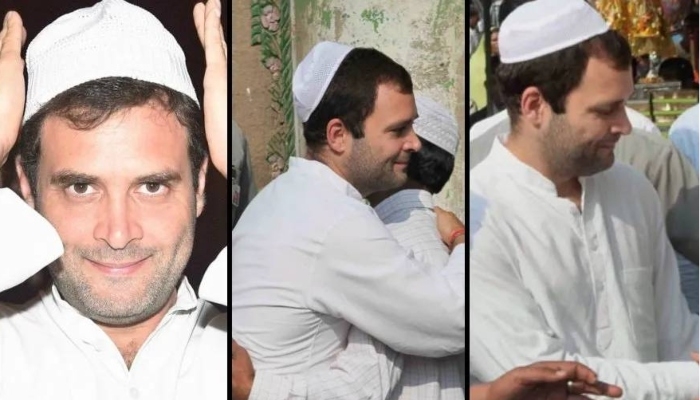
Out of the 90 newly elected Congress MLAs across four states, nearly 55 per cent belong to minority communities. In Assam, 18 out of 19 Congress MLAs are Muslims, largely from minority-dominated constituencies in Barak Valley and Lower Assam. The lone Hindu MLA came from Upper Assam, a region where the BJP continues to dominate. In West Bengal, both Congress MLAs are Muslims. In Tamil Nadu, two of the five Congress MLAs belong to Muslim and Christian communities. Kerala presents an even clearer picture. Of Congress’ 63 MLAs, 28 belong to Christian and Muslim communities, while its ally, the Indian Union Muslim League (IUML), contributes 22 Muslim MLAs. This is not merely statistical coincidence. It reflects a long-term political shift.
The BJP’s Amit Malviya called Congress the “new Muslim League” and the perception did not emerge in a vacuum. The Congress itself has spent decades nurturing identity-driven politics under the guise of secularism. The result is that large sections of the electorate no longer see Congress as a genuinely broad-based national movement. Instead, it is increasingly perceived as a party surviving on selective appeasement and minority consolidation. This perception carries dangerous historical echoes.
The tragedy of India’s Partition was rooted in communal political mobilisation and competitive minority politics. The original Muslim League thrived by convincing Muslims that they were politically insecure in a Hindu-majority India. Congress, despite leading the freedom movement, repeatedly compromised with communal bargaining during the final years before Partition. The consequences were catastrophic, resulting into partition of the nation, mass killings and permanent communal scars. Congress, after independence, gradually institutionalised a different version of vote-bank secularism. Instead of genuine equal treatment, it created a political ecosystem where minority symbolism often overshadowed broader national integration. Over time, this strategy alienated large sections of Hindus while simultaneously failing to genuinely uplift ordinary Muslims socially or economically. Even Congress leaders privately admitted this reality.
After the disastrous 2014 defeat, senior Congress leader A. K. Antony openly acknowledged that the party was increasingly seen as “pro-minority”. He warned that this perception was damaging and strengthening communal forces. His remarks were not ideological rhetoric but a brutally honest political assessment. Antony understood that perception matters in politics. Once a party begins appearing selective in its outreach, public trust weakens rapidly. But Congress learned nothing.
Instead of correcting course, the party deepened the same political tendencies. Manmohan Singh’s controversial 2006 remark that minorities, especially Muslims, should have the “first claim” on national resources became a defining political weapon for the BJP. More recently, Telangana Chief Minister Anumula Revanth Reddy declared that “Congress means Muslims and Muslims mean Congress”, further reinforcing the narrative that the party sees politics through communal arithmetic.
Congress spokespersons now argue that nationally 78 percent of its MLAs are Hindu. Technically, that may be true. But politics is not only about arithmetic; it is about concentration and dependency. The real issue is that in several crucial states, Congress increasingly survives only where minority consolidation remains strong. That creates the image of a shrinking party dependent on identity blocs rather than a national social coalition. Even analysts sympathetic to Congress admit the problem. Political observers point out that Congress failed to respect Hindu sentiments and went ahead with ridiculing it. The BJP, which was committed to the cause since its inception, recognised this sentiment and acted upon it.
Over the last decade, the BJP successfully consolidated large sections of the Hindu vote by presenting itself as the defender of civilisational identity, cultural confidence and national unity. Congress, meanwhile, appeared trapped in outdated political language rooted in selective symbolism and defensive secularism. As Hindutva sentiment expanded across regions, Congress’ positioning increasingly looked disconnected from national mood shifts. This explains why Congress continues shrinking despite temporary alliance gains. The irony is that Congress today is neither fully trusted by minorities nor accepted by the majority. Muslim voters often support Congress tactically to defeat the BJP, not out of ideological loyalty. Simultaneously, large sections of Hindu voters view Congress with suspicion because of decades of minority-centric signalling. The party is therefore trapped between dependency and distrust.
That is why the “new Muslim League” perception, whether exaggerated or not, is politically damaging. Perceptions once formed are difficult to erase.
Congress leaders now invoke the Constitution and Ambedkar whenever criticism emerges. But Ambedkar himself repeatedly warned against communal politics dominating democratic structures. India’s constitutional framework was built on citizenship, not religious mobilisation. Ironically, Congress’ own electoral behaviour increasingly contradicts that spirit.
The larger political danger for Congress is isolation.
Regional allies already distrust Congress’ leadership ambitions. Congress has already become identified primarily through minority consolidation politics, it has lost whatever remaining pan-Indian appeal. In a political climate shaped by rising nationalism and assertive Hindutva, such an image has pushed Congress into deeper irrelevance. History offers Congress a warning. Parties that become prisoners of narrow vote-bank politics eventually lose the confidence of the nation at large. As a result, Congress has become a fragmented political entity.

Satyajit Shriram Joshi
Satyajit Shriram Joshi is Pune based senior journalist.