Operation Sindoor @1: How global powers reiterated need to combat terrorism amid political outrage at home
The international support to India during Operation Sindoor was immediate and cautious. It was largely shaped by two parallel realities: one, widespread recognition of India"s right to defend itself against terrorism, and two, deep concern over escalation between two nuclear-armed neighbors.
NewsBharati 07-May-2026 12:04:39 PM
Total Views |


On April 22, 2025, an image of a pale Hindu woman silently sitting beside the lifeless body of her husband spread widely across social media, sending shock waves across the nation. The image became a powerful symbol and a portrayal of how devastating the recent terrorist attack in Jammu and Kashmir was. The attack launched by The Resistance Front (TRF), associated with a Pakistan-based terrorist group Lashkar-e-Taiba (LeT), claimed 26 lives that day. India was profoundly shaken and left momentarily at a loss for how to react. In the immediate response, all it could do was mourn, shed tears, and share in the nation’s grief.
The Hindu woman grieving seen in the image was identified as Himanshi Narwal. She was with her husband, 26-year-old naval officer Vinay Narwal, in the Kashmir valley for her honeymoon. However, her marital life didn't last even for eight days. The terrorist killed her husband Vinay just for belonging to the Hindu religion and refusing to read kalma. The celebration of their marriage and that of many others like them turned into an unimaginable tragedy, provoking India to signal that cross-border provocation would no longer go unanswered.
Today, even after 365 days, nobody in the country has forgotten the tragedy that happened to Himanshi and several other victims like her in Pahalgam and the following military operation that was launched by India against terrorists in Pakistan. On this backdrop, here is an analysis that examines the regional context, the perpetrators, the responses of both nations, the role of media amid this, and the counterterrorism measures that emerged, particularly in the aftermath of the attack.
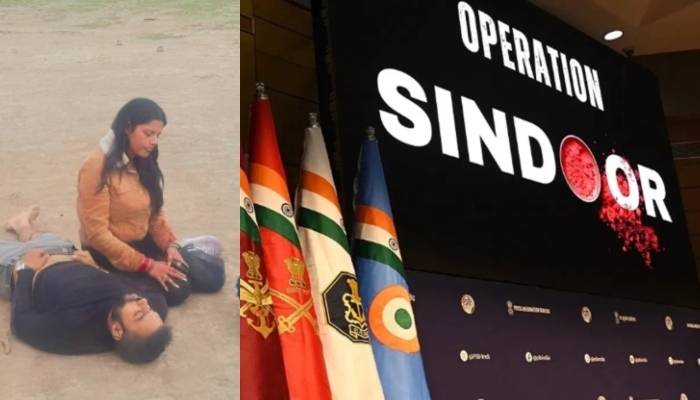
In the wake of the Pahalgam terror attack, India launched a coordinated tri-service military operation, codenamed ‘Operation Sindoor’ on May 7th, 2025. The operation lasted for around 4 days until the ceasefire was exercised on May 10th, 2025. The said military action aimed at neutralising the operational capabilities of terrorist groups responsible for repeated incursions into Indian territory. The strike was seen as inevitable, given the clear cross-border involvement in the Pahalgam attack. The official government communication confirmed links between the terrorists, who carried out the attack, and their handlers based in Pakistan.
The operation, described by Indian officials as “focused, measured and non-escalatory in nature”, targeted nine identified terrorist infrastructure sites believed to be used for planning and directing attacks against India. These sites included Markaz Subhan Allah (Bahawalpur), Markaz Taiba (Muridke), Sarjal (Sialkot), Mehmoona Joya (Sialkot), Barnala (Bhimber), Abbas (Kotli), Gulpur (Kotli), Sawai Nala (Muzaffarabad), and Syedna Bilal (Muzaffarabad).
_202605071209583888_H@@IGHT_377_W@@IDTH_700.jpg "Operation Sindoor newsbharati")
In an official statement, India clarified that no Pakistani military facilities were targeted, emphasising that the intent was to hold those responsible for the Pahalgam attack accountable. Pakistan claimed that 31 people were killed and 57 were injured in Indian strikes on terrorist infrastructure across Pakistan and Pakistan-occupied Jammu and Kashmir. However, India’s action was a precision strike on terror infrastructure, and not civilian targets.
The operation’s name, Sindoor, a red vermilion powder traditionally worn by married Hindu women on their foreheads or in the parting of their hair, carries deep symbolic significance. By naming it ‘Operation Sindoor’, the military action clearly showed tribute to the women, who lost their husbands in the Pahalgam attack, framing the strike as both an act of justice and a symbolic gesture of retribution.
The sole purpose behind the operation that lasted from 7th May, 2025 to 10th May, 2025, as stated by the authorities, was to showcase a firm stand against terrorism, ensure immediate justice to the family members of the 26 dead, and dismantle terrorist infrastructure used to plan and direct attacks against India.
The significance of the Operation Sindoor also reflected a broader shift in India’s security doctrine, from strategic restraint toward proactive deterrence. It became the third firm response in line after the 2016 surgical strikes (launched after the Uri attack) and the 2019 Balakot airstrikes (launched after the Pulwama attack), signalling openly that terrorist attacks on Indian soil would invite a visible and forceful response. It was a direct reflection of the Indian policy of `no tolerance’ towards terrorist acts.
Global powers reiterated the need to combat terrorism
The international support to India during Operation Sindoor was immediate and cautious. It was largely shaped by two parallel realities: one, widespread recognition of India's right to defend itself against terrorism, and two, deep concern over escalation between two nuclear-armed neighbors. Several major powers, including the United States, the United Kingdom, France, Russia, and several Gulf nations, called for restraint within the first 48 hours of the retaliatory attack, but also reiterated the need to combat terrorism at the same time.
This global diplomacy looked crucial as it did not put the Pahalgham terror attack and India's response to it in one bracket. Instead, these powers widely acknowledged that the trigger was terrorism against civilians. At the United Nations, officials again stressed that perpetrators, organisers, financiers, and sponsors of terrorism must be held accountable. The UN avoided endorsing the military action at that time, but New Delhi was constantly receiving indirect support from global stages that continue to see terrorism and a legitimate national security threat, attracting a firm response.
_202605071218107340_H@@IGHT_377_W@@IDTH_700.jpg "Operation Sindoor newsbharati")
India’s Permanent Representative P Harish at UN (Matrubhumi)
According to government sources, the United Kingdom was among the first to express unequivocal solidarity. Foreign Minister David Lammy stated that India had every reason to be outraged by the Pahalgam killings. Former UK Prime Minister Rishi Sunak also echoed this sentiment, stating that "no democratic state should tolerate cross-border terrorism."
Russia, while calling for restraint on both sides, condemned terrorism in all forms and expressed concern about further military escalation. The Russian Ministry of Foreign Affairs urged both India and Pakistan to avoid civilian casualties and engage through diplomatic channels.
Israel also aligned firmly with India. Its ambassador to New Delhi stated that "terrorists have no sanctuary" and stressed Israel's support for India's right to self-defence under international law. The European Union and all 27 member states issued a joint declaration backing India's position, while France, the Netherlands, and Japan issued separate but aligned statements.
Notably, countries like Turkey, Azerbaijan, and China extended open support to Pakistan, criticizing India’s strikes and calling them a violation of sovereignty.
Over the following year, the international response evolved into strategic observation rather than condemnation. Global think tanks studied Operation Sindoor as a case of calibrated retaliation below full-scale war. India's military professionalism, precision-strike capability, and tri-service coordination were increasingly noted in defence circles. By 2026, the Indian military leadership itself described the operation as a 'defining case study' in lessons on joint warfare and modern conflict, particularly involving drones and counter-drone systems.
Political outrage at home, but the government sent all party delegations to the global stages
While India attained international support and wide acknowledgement during Operation Sindoor, major politics erupted here back at home. Several opposition political parties, such as the Congress, Trinamool Congress, and Left parties, publicly expressed solidarity with the security forces and condemned terrorism. However, they simultaneously raised questions about accountability, intelligence failures, and the government’s communication strategy.
The Indian National Congress party argued that while the bravery and professionalism of the Indian military deserved national respect, the government led by PM Modi needed to explain how such a deadly attack on the civilians occurred despite heightened security in Jammu and Kashmir. The party leaders also questioned whether the intelligence warnings had been ignored and whether adequate preventive measures were in place.
Rahul Gandhi later also asserted that the armed forces were not given complete operational freedom, and also alleged that political considerations may have influenced the management of the response. Another major criticism from the opposition centered on the ceasefire process. The opposition raised questions asking why the initial announcement and diplomatic signals came from foreign capitals before being formally clarified by New Delhi. This is after the US President posted on social media, claiming to have played a major role in the mediation process. However, India dismissed the US claims and stated that there was no external mediation fostering the ceasefire.

The so-called non-existent incident of external mediation back then was framed as a failure of strategic communication. This was allegedly part of a sheer attempt to pin down the ruling government as part of domestic politics. While Congress did this, the TMC, part of the INDI Alliance, echoed the concerns regarding alleged transparency. It accused the ruling party of using Operation Sindoor for domestic political benefits, especially during election campaigns and public rallies.
The left parties, while condemning terrorism, consistently warned against prolonged military escalation and urged India to combine strong security measures with diplomatic engagement to avoid a wider regional conflict. Notably, as the months progressed, opposition criticism intensified whenever the government highlighted Operation Sindoor in campaign speeches or portrayed it as a singular political achievement. They argued that national security operations should remain above partisan politics and should not be converted into 'electoral capital'.
However, it is important to note that none of these parties challenged India’s sovereign right to defend itself or demanded reversal of the operation. They kept on pinning down the government over governance, transparency, preparedness, and the alleged politicisation of the incident. The government, on the other hand, sent a military response to the Pahalgam terror attack by dispatching several all-party delegations, including prominent opposition leaders, to global stages to present a united front against Pakistan-sponsored terrorism.
Conclusion
India has, in recent years, sought to bring normalcy back to the region of Jammu and Kashmir through development, fostering tourism, infrastructure growth, and economic opportunities. While these efforts have brought visible changes, concerns remain that political dissent continues to be tightly managed and terrorist networks may still be active beneath the surface. The Pahalgham terror attack raised several such serious questions. The fact that Hindu tourists were specifically targeted created intense public anger and strong pressure on the government to respond firmly.
As per the official statements released by the government, on May 7th 2025, the Indian armed forces struck 9 terror-linked locations in Pakistan and PoK linked to Lashkar-e-Taiba and Jaish-e-Mohammed. Notably, no Pakistani military facilities were targeted in the first wave.
During the strike, terrorists identified as Maulana Yusuf Azhar, Hafiz Mohammad Jameel, and Mohammad Hassan Khan, associated with the JeM, and Mudassar Kadian Khas and Abu Akasha, associated with LeT, were successfully eliminated. These were all on the list of ‘wanted’ by India for launching terror attacks in the past, and were eventually eliminated during Operation Sindoor.
_202605071215534367_H@@IGHT_377_W@@IDTH_700.jpg "Operation Sindoor newsbharati")
The advanced stand-off weapons used by India during the operation included SCALP missiles from England, HAMMER missiles from France, Heron Mk2 drones and technology for HAROP drones from Israel, S-400 missile defence system from Russia, AH-64 Apache helicopters and AGM-114 Hellfire missiles from the United States, loitering munitions, and kamikaze drones. Later reports also mentioned BrahMos missiles and Rafale in follow-up strikes on military infrastructure.
The country, unfortunately, can never fully deliver justice to the wives who lost their husbands in the valley, because the pain of such a loss is beyond measure. The value of ‘sindoor’ cannot be calculated by any scale or meter. Yet India ensured that those responsible for this suffering and those who dared to challenge the nation to respond were neutralized. The threats were answered in a strategic, official, and decisive manner. India stands firm in its commitment to protect its women, its civilians, and its national security.

Siddhi Somani
Siddhi Somani is known for her satirical and factual hand in Economic, Social and Political writing. Having completed her post graduation in Journalism, she is currently engaged in completing her Masters in Politics. The author meanwhile is also exploring her hand in analytics and statistics.