Kerala polls 2026: The fall of the Left and the decline of its political aura
(Kerala) The UDF’s return to power is primarily driven by consolidation of anti-incumbency votes, but its mandate is also shaped by coalition dynamics. A key factor remains its alliance with the Indian Union Muslim League (IUML), which secured 22 seats.
NewsBharati 08-May-2026 12:54:23 PM
Total Views |


The 2026 Kerala Legislative Assembly election represents another significant cycle in the state’s well-established pattern of alternating mandates between the Left Democratic Front (LDF) and the Congress-led United Democratic Front (UDF). In this round, the LDF led by CPI(M) suffered a clear defeat after two consecutive terms, while the UDF returned to power with a strong mandate. The Bharatiya Janata Party (BJP) also made a notable electoral gain, emerging as a limited but visible third force in the state’s political space.
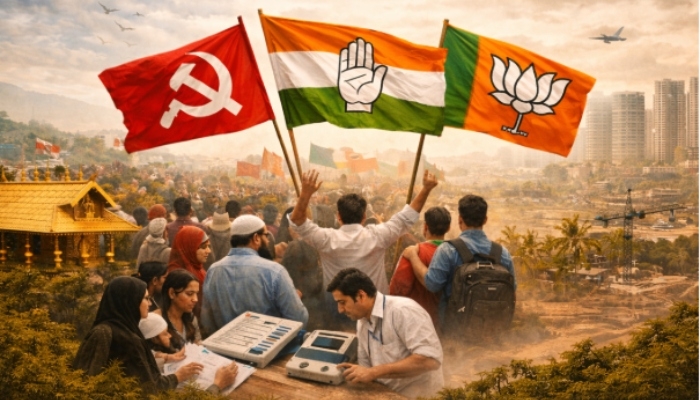
The Left’s defeat marks a significant setback for CPI(M), which has now lost its last remaining state-level governing position in India. The party has long been associated with strong ideological positioning and organized trade union influence. However, over time, its governance model has faced criticism for contributing to industrial stagnation, limited private investment, and policy rigidity. While it continues to claim alignment with working-class interests, a growing section of voters, particularly younger demographics, has shifted focus toward employment opportunities and economic mobility rather than ideological commitments.
The UDF’s return to power is primarily driven by consolidation of anti-incumbency votes, but its mandate is also shaped by coalition dynamics. A key factor remains its alliance with the Indian Union Muslim League (IUML), which secured 22 seats. IUML continues to play a critical role in UDF’s electoral arithmetic, particularly in northern Kerala. However, its political positioning has often generated debate around identity-based demands and regional administrative restructuring proposals, especially in areas like Malappuram.

Additional complexity arises from the perceived informal overlaps between IUML and smaller political actors such as the Social Democratic Party of India (SDPI), widely regarded as a political offshoot linked to the banned Popular Front of India (PFI). Instances of tactical electoral withdrawals and vote coordination have been highlighted in political discourse, raising concerns among observers about ideological boundaries within coalition politics. These developments continue to shape debates around political alignment and electoral strategy in the state.
Economic concerns were a decisive factor influencing voter behavior. Kerala continues to face high public debt, limited large-scale industrial expansion, and persistent youth migration to other states and abroad. Despite strong educational outcomes, the state has struggled to generate sufficient high-quality employment within its domestic economy. This gap between human capital and job creation has become a central political issue.
The voter turnout of 78.27 per cent reflects strong public participation and heightened political engagement. It also indicates a clear demand for accountability and performance-based governance. The electorate has consistently shown a willingness to replace governments perceived as underperforming, reinforcing Kerala’s competitive democratic environment.
The incoming UDF government now faces the challenge of translating electoral support into administrative outcomes. Key priorities include economic revival, job creation, infrastructure expansion, and fiscal management. However, coalition constraints and competing political interests within the alliance may complicate decision-making.
Overall, the election reinforces Kerala’s established pattern of alternating mandates rather than a structural political transformation. It highlights voter responsiveness to governance performance, economic concerns, and coalition dynamics. The entry of the BJP as a third force adds a new layer of competition, but the core political structure remains anchored in the LDF–UDF cycle.
The final results show the UDF winning 102 of 140 seats, while the LDF was reduced to 35 seats. Thirteen ministers lost their constituencies, reflecting strong anti-incumbency sentiment against the outgoing government. While Kerala’s political history has typically shown periodic rotation between the two major fronts, the scale of this defeat indicates deeper voter dissatisfaction with governance performance during the second LDF term.
The Left’s defeat marks a significant setback for CPI(M), which has now lost its last remaining state-level governing position in India. The party has long been associated with strong ideological positioning and organized trade union influence. However, over time, its governance model has faced criticism for contributing to industrial stagnation, limited private investment, and policy rigidity. While it continues to claim alignment with working-class interests, a growing section of voters, particularly younger demographics, has shifted focus toward employment opportunities and economic mobility rather than ideological commitments.
One of the notable electoral defeats was that of V. Sivankutty in Nemom. His public controversies, including objections to the display of a national symbol at an official event, were widely debated in the state. While individual incidents alone do not determine electoral outcomes, they contribute to a broader perception of ideological rigidity and disconnect from public sentiment.
The UDF’s return to power is primarily driven by consolidation of anti-incumbency votes, but its mandate is also shaped by coalition dynamics. A key factor remains its alliance with the Indian Union Muslim League (IUML), which secured 22 seats. IUML continues to play a critical role in UDF’s electoral arithmetic, particularly in northern Kerala. However, its political positioning has often generated debate around identity-based demands and regional administrative restructuring proposals, especially in areas like Malappuram.
These issues have raised broader discussions about coalition governance and the role of community-based political mobilisation in Kerala. Critics argue that such alignments can reinforce identity-centric politics, while supporters view them as legitimate representation within a plural democratic framework. Either way, the coalition structure remains central to the UDF’s functioning.
Additional complexity arises from the perceived informal overlaps between IUML and smaller political actors such as the Social Democratic Party of India (SDPI), widely regarded as a political offshoot linked to the banned Popular Front of India (PFI). Instances of tactical electoral withdrawals and vote coordination have been highlighted in political discourse, raising concerns among observers about ideological boundaries within coalition politics. These developments continue to shape debates around political alignment and electoral strategy in the state.
In contrast, the BJP’s performance marks its most significant electoral presence in Kerala to date. Winning three constituencies, including Nemom, Kazhakkoottam, and Chathannoor, the party has established a limited but meaningful footprint. Candidates such as Rajeev Chandrasekhar and others gained traction through a development-focused campaign narrative and voter dissatisfaction with traditional fronts. While the BJP remains a minor player in seat terms, its presence now introduces a stable third dimension in Kerala’s political competition.
ALSO READ: Kerala: BJP march gets shouted down and chased away by IUML-Congress mob
Economic concerns were a decisive factor influencing voter behavior. Kerala continues to face high public debt, limited large-scale industrial expansion, and persistent youth migration to other states and abroad. Despite strong educational outcomes, the state has struggled to generate sufficient high-quality employment within its domestic economy. This gap between human capital and job creation has become a central political issue.
The outgoing government’s inability to significantly expand private investment or industrial ecosystems further contributed to voter frustration. Younger voters, in particular, expressed dissatisfaction with limited economic opportunities and a perceived lack of policy innovation. As a result, employment, investment, and development-oriented governance became dominant electoral themes.
The voter turnout of 78.27 per cent reflects strong public participation and heightened political engagement. It also indicates a clear demand for accountability and performance-based governance. The electorate has consistently shown a willingness to replace governments perceived as underperforming, reinforcing Kerala’s competitive democratic environment.
The incoming UDF government now faces the challenge of translating electoral support into administrative outcomes. Key priorities include economic revival, job creation, infrastructure expansion, and fiscal management. However, coalition constraints and competing political interests within the alliance may complicate decision-making.
Overall, the election reinforces Kerala’s established pattern of alternating mandates rather than a structural political transformation. It highlights voter responsiveness to governance performance, economic concerns, and coalition dynamics. The entry of the BJP as a third force adds a new layer of competition, but the core political structure remains anchored in the LDF–UDF cycle.

Varada Marathe
Varada Marathe