Remembering Operation Sindoor: India’s New Doctrine Against Terror
NewsBharati 08-May-2026 14:56:25 PM
Total Views |


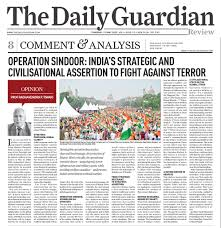
A year after 'Operation Sindoor, one has to admit that India’s decisive response through Operation Sindoor marks far more than a military action. It signals the emergence of a hardened national doctrine that refuses to tolerate terrorism exported from across the border and one that no longer believes in rewarding Pakistan’s duplicity with endless diplomatic patience. Under the leadership of Narendra Modi, India has made it unmistakably clear that terror attacks against Indian citizens will invite consequences, not condolences.
_202605081524120979_H@@IGHT_400_W@@IDTH_700.jpg "Opration Sindoor")
For decades, Pakistan perfected a dangerous strategy of nurturing terror groups, denying involvement, and hiding behind nuclear blackmail whenever India contemplated retaliation. From the shadows of the 1993 Bombay bombings to the horrors of the 2008 Mumbai attacks, from Parliament attacks to Pulwama, the pattern has remained unchanged. Terrorism has functioned as an unofficial instrument of Pakistani statecraft. The world may occasionally pretend otherwise for geopolitical convenience, but Indians know the truth because Indian blood has repeatedly paid the price.
What distinguishes Operation Sindoor is not merely the operational success but the political clarity behind it. India demonstrated that the age of strategic hesitation is over. The Modi government has steadily transformed India’s security posture from reactive to proactive. Earlier governments often limited themselves to dossiers, diplomatic notes, and emotional speeches after every terror strike. The result was predictable: terror infrastructure across the border continued to flourish with confidence. Today, the equation has changed. Terror handlers and their protectors understand that India possesses both capability and political will. That psychological shift is itself a strategic victory.
Equally significant is the message this operation sends to the global community. India is not an aggressor nation but it is a civilization-state defending its citizens from cross-border jihadist violence. No sovereign nation can be expected to absorb terror attacks indefinitely while the masterminds operate freely under state protection. When Western nations act against terror threats, they are praised for defending democracy. India deserves the same moral legitimacy.
However, amid this moment of national resolve, a deeply unfortunate spectacle also emerged from sections of India’s political class. Even before the dust had settled, some opposition politicians rushed to question the credentials, authenticity, and intent behind the operation. This reflexive skepticism has become a disturbing pattern in Indian politics: when the nation acts against external enemies, some leaders appear more eager to interrogate their own government than condemn the enemy itself.
Healthy democracy certainly permits questions. But there is a difference between accountability and political sabotage. Demanding operational details in the middle of a sensitive security environment does not strengthen democracy. It strengthens hostile propaganda. Pakistan’s media ecosystem has historically amplified statements made by Indian politicians that create confusion or weaken national morale. Every careless remark made for domestic political scoring eventually becomes ammunition in Islamabad’s information warfare.
The tragedy is that some opposition figures still fail to understand the nature of modern conflict. Today’s wars are fought not only with missiles and intelligence assets, but also through narratives, perception management, and psychological operations. When Indian politicians publicly cast doubt on military action without evidence, they inadvertently echo the talking points of those who seek to undermine India globally.
This is not the first time such behaviour has surfaced. Similar reactions were witnessed after the Balakot airstrike. Instead of uniting behind the armed forces and the government’s anti-terror resolve, sections of the political establishment demanded “proof” in a manner that appeared more accusatory than inquisitive. Such conduct demoralizes soldiers and confuses citizens. One may oppose a government politically, but national security should never become collateral damage in partisan warfare.
Prime Minister Modi’s leadership has fundamentally altered the national conversation on terrorism. The message is simple - India will not initiate conflict, but neither will it tolerate terror sanctuaries operating with impunity. This doctrine resonates deeply with ordinary Indians because it reflects accumulated national frustration after decades of suffering.
Operation Sindoor also exposes the bankruptcy of Pakistan’s global narrative. A nation struggling with economic collapse, political instability, radicalization, and institutional decay continues to invest disproportionately in anti-India terror infrastructure. Instead of building schools, industries, and democratic institutions, Pakistan’s establishment has repeatedly empowered extremist networks that ultimately consumed its own society as well. The world increasingly recognizes that terrorism in South Asia cannot be separated from Pakistan’s deep state ecosystem.
At the same time, India’s rise under Modi has given the country greater strategic confidence internationally. Today’s India is economically stronger, diplomatically influential, technologically advanced, and militarily prepared. Unlike previous eras when global powers pressured India into restraint while ignoring Pakistan’s provocations, the international mood has shifted significantly. Nations across the world now view terrorism through a far harsher lens, especially after witnessing its devastating consequences globally.
Operation Sindoor therefore represents more than retaliation. It represents the assertion of a national will. It tells terrorists that Indian patience is not weakness. It tells Pakistan that deniability has limits. And it tells India’s political class that there are moments when national unity must rise above electoral calculations. History remembers nations that defend themselves with courage. It also remembers those who stood confused when clarity was needed most. India, under Narendra Modi, has chosen clarity.

Editor's Desk
Editor's Desk