The Land of Maa Kali Rejects Fear! Understanding Bengal’s 'Shakti' Verdict in 2026
It is about the restoration of ‘Shakti’ in the very land that once taught Bharat how to worship it.
NewsBharati 08-May-2026 12:36:11 PM
Total Views |


West Bengal has stood as one of the greatest political paradoxes of modern Bharat, since a considerable period. A land that chants “Joy Maa Kali”, a civilization shaped by the spiritual force of Shakti Sadhana, and a society that once gave Bharat icons like Rani Rashmoni, Sister Nivedita’s karmabhoomi, and the women revolutionaries of the Indian freedom struggle, slowly transformed into a state where women increasingly started living under fear, silence, and political intimidation. The irony was sharper because the state itself was ruled by a woman.
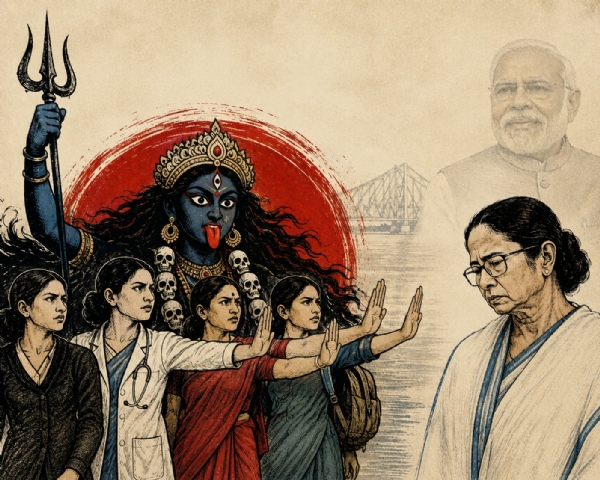
The historic victory of the BJP in the 2026 West Bengal Assembly elections is therefore being viewed as a decisive event to instill civilizational correction in Bengal and not merely a political transition. The 2026 Assembly elections in Bengal will always be remembered as a desperate and bold attempt of the people of Bengal to reclaim its wounded feminine consciousness after years of violence, humiliation, and political denial.
In his post-victory address, Prime Minister Narendra Modi repeatedly emphasized themes of women’s dignity, safety, democratic restoration, and Bengal’s cultural soul. Referring to the BJP’s rise from “Gangotri to Ganga Sagar,” Modi symbolically connected the spiritual geography of Bharat to Bengal’s civilizational awakening. But it is important to look beneath the electoral celebration, where actually lies BJP’s deeper political strategy. It seems that the BJP have understood the soul of West Bengal and thus implemented it far more effectively than its opponents, to strategize for the election.
If observed in its details, the BJP’s Bengal campaign was centered around the moral collapse of governance in a state that culturally worships feminine divinity while politically normalizing atrocities against women, which is a very important remark to make in the state.
Over the last several years, incidents involving crimes against women in Bengal repeatedly became national flashpoints. The Sandeshkhali outrage particularly shattered the carefully curated image of “Mamata Didi” as the symbolic protector of Bengal’s women in the national discourse. For many women voters, especially in rural Bengal, the issue was no longer ideological. It became existential.
This explains why Modi’s speech carefully avoided excessive triumphalism and instead adopted the tone of moral reclamation. His speech was a bold assertion of the fact that BJP’s promise of “women’s safety” was not just another electoral assurance. In fact, it was the articulation of a psychological sentiment that had already spread across Bengal’s households.
The BJP appears to have recognized something fundamental about Bengal that many political observers failed to grasp .i.e. Bengal does not just politically respond to women. But in fact Bengal emotionally responds to the idea of ‘Shakti’. And perhaps that is why the emergence of BJP’s women leaders in Bengal carries symbolism far beyond electoral arithmetic.
Among them, Agnimitra Paul has increasingly emerged as one of the most visible faces of this transformation. Her decisive victory from Asansol Dakshin in 2026 further consolidated her stature within the Bengal BJP. But Agnimitra Paul’s political rise is particularly significant because of the fact that she represents a political narrative radically different from Bengal’s existing power structure. Unlike the traditional style of Bengal’s regional politics, which has often relied on political patronage and protection networks, BJP’s women leaders have built their image as women who faced threats, ideological attacks, street-level violence, and social intimidation, yet continued to remain active in politics and public movements. In BJP’s Bengal narrative, these women are not presented as symbolic representatives and instead presented as political survivors. This distinction matters deeply in Bengal’s psychological landscape.

For years, Mamata Banerjee’s political identity revolved around the emotional invocation of “Didi.” However, by 2026, a substantial section of Bengal appeared to separate symbolic womanhood from actual women’s security. The BJP strategically widened this gap throughout its campaign.
The contrast became politically potent:
A woman-led government versus women seeking protection.
The symbolism of feminine leadership versus the lived reality of feminine insecurity.
The symbolism of feminine leadership versus the lived reality of feminine insecurity.
And the BJP perfectly weaponized this contradiction with remarkable precision. This is also why discussions around Agnimitra Paul potentially emerging as a future Chief Ministerial face carry civilizational undertones beyond party calculations.
Her rise allows the BJP to frame Bengal not simply as a state won electorally, but as a society reclaiming the spirit of ‘Shakti’ through a new political idiom .i.e. one rooted simultaneously in cultural identity, women’s assertion, and ideological nationalism.
The deeper message of Bengal’s verdict, therefore, may not be about ‘Left’ versus ‘Right’, or ‘TMC’ versus ‘BJP’ alone. It represents something much larger: the rejection of performative symbolism. For decades, Bengal’s political discourse attempted to separate its spiritual-cultural consciousness from governance. But Bengal’s civilizational memory is too deep to remain politically suppressed forever. The land of Durga Puja cannot indefinitely tolerate the humiliation of its daughters while being lectured about political morality.
And perhaps this is precisely what Narendra Modi attempted to subtly communicate in his victory speech, that Bengal’s political transformation is not merely about the rise of the Lotus.
It is about the restoration of ‘Shakti’ in the very land that once taught Bharat how to worship it.
--
Himali Nalawade
Himali Nalawade is associated with News Bharati as an Author since a considerable period. She is mostly linked with researched articles from the areas of Defence, Defence Infrastructure and Culture-Religion. Along with her Masters in Mass Communication and Journalism after her graduation in History, she has also studied Diploma in Underwater Archaeology and Diploma in Indology.