Tightening the Shackles: Maharashtra Bans Parole for Sexual Offenders
Maharashtra is currently grappling with a major administrative crisis: Parole Jumping. Shockingly, 99 convicts who were released on parole remain absconding.
NewsBharati 09-May-2026 12:42:30 PM
Total Views |


The brutal assault and murder of a three-and-a-half-year-old girl in Pune’s Nasrapur on May 1, 2026, has sent shockwaves across Maharashtra. This horrific incident has raised serious questions regarding the law and order, criminal recidivism (repeat offences), and the effectiveness of current parole and furlough regulations within the prison administration.
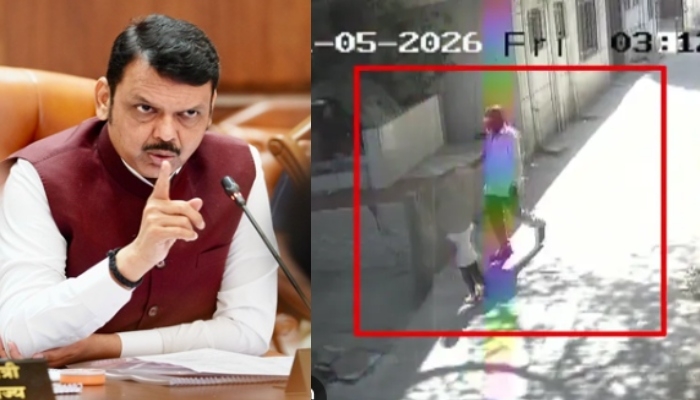
It should be noted that the accused in this case is a habitual offender with a history of serious sexual crimes. However, due to legal loopholes, he remained free to strike again. In this context, Maharashtra CM Devendra Fadnavis has issued directives to ensure the harshest punishment for such criminals as well as to draft new legislation or guidelines that strictly deny parole to those accused of sexual offences.
Reforming Parole and Furlough Rules
During a cabinet meeting on May 5, 2026, CM Fadnavis instructed the Law and Judiciary Department to formulate stringent guidelines to deny parole and furlough to sexual offenders. His directives are based on three critical observations:
- Recidivism: Statistics suggest that nearly 80% to 90% of sexual offenders commit similar crimes once released on parole.
- Women's safety: Protecting society, particularly women and children, necessitates keeping such predators behind bars.
- Deterrence: The CM noted that the current ease of obtaining parole has diminished the fear of the law among criminals.
In 2016, the Fadnavis government introduced the 'Maharashtra Prisons (Mumbai Furlough and Parole) (Amendment) Rules, 2016,' which sought to deny regular parole to those convicted of rape, murder with rape, terrorism, and human trafficking. However, the Bombay High Court struck down these rules, citing a violation of the Right to Equality (Article 14).
The "No Parole" Category and Digital Tracking
Under the new proposed directives:
Highly Dangerous Classification: Sexual offenders will be categorised as "Highly Dangerous." Parole will only be granted in extreme circumstances, such as the funeral of a primary relative, and even then, only under strict police escort.
Shakti Act Implementation: The government aims to leverage the provisions of the 'Shakti Act' to ensure investigations are completed within 15 days and trials within 30 days.
Digital Surveillance: Convicts currently out on parole under old rules will be placed under digital tracking to monitor their movements.
The Crisis of "Parole Jumping"
Maharashtra is currently grappling with a major administrative crisis: Parole Jumping. Shockingly, 99 convicts who were released on parole remain absconding.
Yerwada Prison Statistics: Pune’s high-security Yerwada Central Jail has the highest number of absconders, with 85 prisoners missing over the years.
The COVID Impact: Many prisoners released on "Emergency Parole" during the 2020 pandemic to decongest prisons have failed to return.
The lack of effective coordination between the police and prison departments has allowed these individuals to vanish, posing a severe threat to public safety.
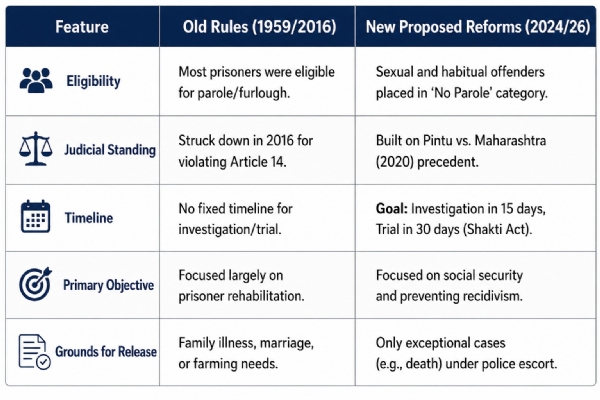
The push for a "No Parole" system for sexual offenders in Maharashtra is not an isolated legal experiment; it is part of a broader, intensifying national dialogue on criminal justice reform. As of 2026, Maharashtra is positioning itself as a pioneer, but its success or failure depends heavily on how its policies align with the legal frameworks of other states and national mandates.
Here is how other states and national laws connect with Maharashtra’s parole system
ALSO READ: Kolhapur: Gaibisab Dastagir, accused of love jihad, issues death threats to Hindu victim after out on bail, seeks withdrawl of complaint
State-Wise Comparison of Parole Rigidity
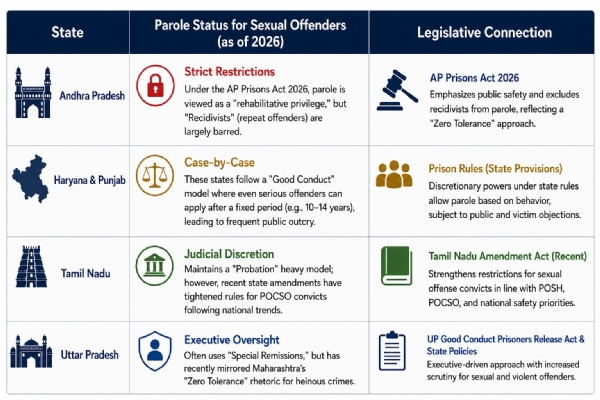
While Maharashtra is proposing a blanket ban for sexual offenders, other states have varying degrees of restrictions:
Justice for the victim in Nasrapur means more than just hanging the perpetrator; it requires building a "Safety Chain" that prevents such incidents from recurring. The decision to ban parole for sexual offenders is a foundational step in this chain. By making the legal system more Victim-Centric, Maharashtra aims to set a national precedent where the rights of the vulnerable outweigh the convenience of the criminal.

Pratiksha Lohkare
Pratiksha Lohkare is a lawyer by profession and keeps interest in writing legal perspectives.