800-year-old Lord Shiva temple demolished for school in Telangana; All you need to know

The issue escalated significantly when prominent Telangana rights lawyer Immaneni Rama Rao filed a formal complaint with the National Monuments Authority, following which both the Union Ministry of Culture and the Archaeology Department registered a case over the destruction of the temple.

NewsBharati    09-May-2026 16:22:06 PM
Total Views |
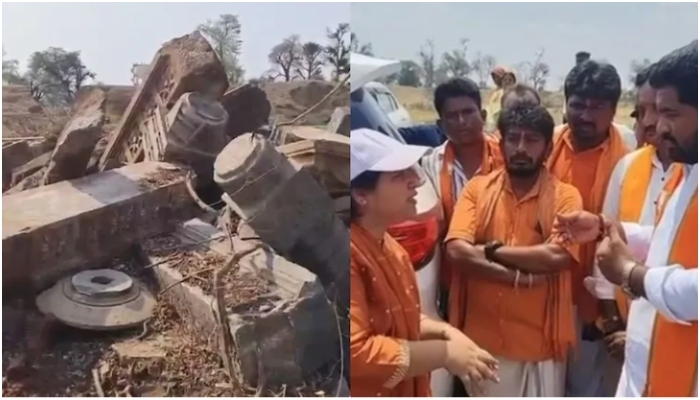
A major controversy has broken out in Telangana after an 800-year-old Shiva temple from the Kakatiya era was razed by the Congress government in Warangal district during land preparation for a government school. The demolition sparked widespread outrage among historians, heritage activists, and residents, prompting the Union Ministry of Culture and the Archaeology Department to register a formal case in connection with the incident.

The temple stood in Ashok Nagar village, Khanapur Mandal, Warangal district, and was brought down on May 6th as part of land-clearing efforts ahead of the construction of a Young India Integrated Residential School, a flagship project under the state government's education program. Historians have attributed the structure to the reign of Kakatiya king Ganapatideva, placing its age at close to eight centuries.
  
Telangana temple newsbharati

The demolition has drawn sharp condemnation from various quarters, with critics accusing the authorities of sacrificing Telangana's rich cultural legacy at the altar of development. The issue escalated significantly when prominent Telangana rights lawyer Immaneni Rama Rao filed a formal complaint with the National Monuments Authority, following which both the Union Ministry of Culture and the Archaeology Department registered a case over the destruction of the temple.
 
ALSO READ: Review of 2018 Sabrimala Verdict: Petitioners question ‘insult’ of Indian oriental Dharmas, demand complete independence 

The complaint called for legal action under Section 30 of the Telangana Heritage Act against officials who greenlit the demolition without obtaining mandatory clearances from the Archaeology and Endowments Departments. It further alleged that the state government had failed to constitute the Heritage Conservation Committee as required under the law. The complaint also pointed out that the ancient structure could have been preserved in place or carefully relocated, rather than being demolished outright.

The National Monuments Authority is now set to scrutinize the entire episode and assess whether heritage conservation regulations were breached. Meanwhile, serious questions are also being raised over the deployment of heavy machinery at the site, with activists alleging that the temple was completely flattened during levelling operations carried out for the proposed school project. As the controversy intensified, the Warangal district administration issued a clarification following a joint inspection on May 6th, involving officials from the Revenue, Archaeology, and Education Infrastructure departments alongside local revenue authorities.


The administration denied any intentional demolition, stating that the area was densely covered with bushes and trees, and that "remnants of an old dilapidated structure" were only noticed during routine vegetation clearance. Officials maintained that no dismantling was carried out by the executing agency, and that the land was government-owned and not classified as endowment land. The Archaeology Department further noted that the temple was neither notified nor listed among protected monuments or archaeological sites.

However, the explanation has done little to pacify historians and activists, who maintain that the temple was well known locally and warranted protection regardless of its official listing status. In the wake of the public backlash, Warangal District Collector Dr. Satya Sharada and Narsampet MLA Donthi Madhava Reddy visited the site and pledged to the local community that the temple would be reconstructed.
 

Collector Satya Sharada described ancient monuments as "rare heritage assets" and affirmed that the administration would collaborate with historians and archaeology experts to restore the structure. She acknowledged that the temple did not feature in official Archaeology Department records, but added that, given its believed Kakatiya-era origins, steps would be taken to preserve and rebuild it.


MLA Donthi Madhava Reddy defended the choice of location for the school project, citing the site's open space and greenery, and claimed that officials conducting the clearance work had simply overlooked the ancient structure. He assured residents that the Shiva temple would be rebuilt at the same spot alongside the proposed school, and also announced that an idol of Goddess Saraswati would be installed at the reconstructed shrine.

The demolished structure carried significant historical weight, most notably due to a rare seven-line Telugu inscription dating to February 1231 AD found within it. The inscription referenced Kakatiya ruler Ganapatideva with royal titles such as "Maharaja" and "Rajadhirajulu," meaning king of kings. Historians noted that the temple stood within the historic "Kota Katta" mud fort zone, a region associated with ancient Kakatiya-era defensive structures. Heritage experts pointed out that the temple had already been documented by the Heritage Department as far back as 1965, and that the structure itself occupied less than half an acre within the larger 20 to 30-acre plot earmarked for the school project.
 

S. Haragopal, convener of Kotha Telangana Charithra Brundam, highlighted that the temple housed valuable stone inscriptions linked to the Kakatiya dynasty, and warned that the granite pillars and inscriptions now lay buried under the rubble left by the demolition. Adding another troubling dimension to the incident, some reports suggested that the sanctum sanctorum had been excavated during the process, fuelling suspicions that the demolition may have been accompanied by attempts to search for hidden treasure beneath the structure. The incident has snowballed into a significant political controversy in Telangana, with opposition leaders and heritage protection groups coming out strongly against the Congress government over the destruction of the historical structure.


BJP District General Secretary Rana Pratap Reddy condemned the demolition and demanded that the temple be rebuilt in its original form, accusing the government of razing the structure without obtaining the necessary clearances from the Archaeology Department.

Former BRS MLA Peddi Sudarshan Reddy also trained his guns on the government, alleging that it had trampled over Telangana's cultural heritage in the name of development. He called for strict action against the contractor responsible for the demolition and questioned whether the required official approvals had been secured before the structure was brought down.