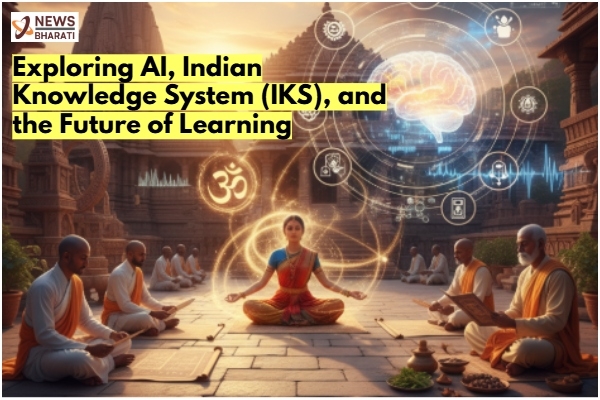
Beyond answers, towards understanding: Exploring AI, Indian Knowledge System (IKS), and the future of learning
The Indian knowledge traditions have long understood learning not as passive reception, but as an active, disciplined, and transformative process. The one that involves dialogue (śravaṇa), reflection (manana), a process of thoughtful contemplation over time (Chintana), and internalization (nididhyāsana).
NewsBharati 01-Jun-2026 15:03:40 PM
Total Views |


The rapid emergence of artificial intelligence has given rise to one of the most significant shifts in the history of human learning. For the first time, machines are not merely assisting physical labour; they are increasingly performing cognitive functions traditionally associated with human intelligence. Traditionally, learning was understood as a movement across levels:
When we see this in unison with the Indian Knowledge System, a deeper philosophical counterpoint to this ‘culture’ of instant answers gains momentum. The Indian knowledge traditions have long understood learning not as passive reception, but as an active, disciplined, and transformative process. The one that involves dialogue (śravaṇa), reflection (manana), a process of thoughtful contemplation over time (Chintana), and internalization (nididhyāsana). These stages mirror what modern cognitive sciences now recognize as the sustained engagement and not the immediate output of understanding and teaching-learning processes. In contrast, Artificial Intelligence compresses this process of transaction time involving attention, effort, and reflection. It delivers conclusions (sometimes) without actually requiring the learner to inhabit the process.
This finds a striking echo in the Bhagavad Gita:
Here, the word kāalena (‘over time’) suggests that knowledge is not instant. It matures through reflection over time. The Artificial Intelligence challenges this temporal structure by making knowledge appear immediate; what is lost in this accelerated process is precisely what the verse emphasizes, i.e., the internal realization. In fact, the AI interface skilfully encourages the opposite. Due to its algorithms, it rewards speed, closure, and a continuous output for knowledge and scholarship generation. For the user, it may look like a ‘Learning Continuum’, but in reality, the user moves from one mediated and collated answer to another without rarely pausing long enough for contemplation (Chintan). In this sense, AI risks producing what may be called epistemic immediacy without epistemic profundity.
Another verse from the Bhagavad Gita (2.41) hones this contrast:

The AI–Human Thinking Process
The modern AI environment, with its endless outputs, suggestions, and generated possibilities, can easily lead to this scattering of knowledge and thus learning for the learners. Without chintana, the mind may tend to move rapidly across ideas without settling into any. What appears as intellectual and information abundance can be cognitive dispersion or a dispersed cloud, not leading to precipitation of knowledge.
The classical sequences from the Upanishads that form one of the foundational bases of learning, viz. the Śravaṇa, the Manana, and the Nididhyāsana, implicitly depend on an intermediate space of Chintana. AI can assist with Śravaṇa (providing information) and even simulate aspects of Manana (offering reasoning). But it may not be in a position to replace the reflective interval where knowledge is tested, questioned, and made one’s own insight-based.
BORROWED INTELLIGENCE: Challenge Or Stimulus For Learning?
_202606011520210929_H@@IGHT_400_W@@IDTH_700.jpg "Indian Knowledge System")
LEARNING WITHOUT FRICTION:
In addition, there is another aspect of normative dimension, which refers to the values, rules, beliefs, and ethical standards of education. It acts as a moral compass or a prescriptive yardstick used to evaluate behaviours, policies, and outcomes in society. AI systems present information with some sort of a ‘degree of authority’ that can obscure these limitations.
For young students who are still developing their critical faculties, distinguishing between reliable knowledge, make-believe content, and plausible output becomes a challenge. Thus, the importance of cultivating not just digital skills, but an understanding of how knowledge is shaped, validated, and contested, becomes a locus in the present education systems. This may become even more challenging for the teachers.
The true success of education in the AI age will not be measured by how efficiently students use machines, but by whether they continue to think independently in a world increasingly designed to think for them. The coming decades may produce a strange paradox: a world overflowing with information, yet increasingly uncertain about meaning; a civilization capable of generating infinite answers, yet struggling to ask profound questions. Perhaps, the answer lies in connecting the dots between the new age approaches of learning and the Indian Knowledge Systems.
From Information (What Is Given),
To Knowledge (What Is Understood),
To Wisdom (What Is Internalized & Lived).
This progression required effort, time, and reflection. It is assumed that knowing is not immediate. Artificial intelligence does not simply change the way and means of how we access knowledge. It changes very much the transactional processes under which knowledge is acquired and made meaningful. In traditional foundational learning, knowledge that unfolds over time is principally based on tark (logic) and doubts against the logic, i.e., vitark. It requires attention, effort, and reflection over a period of time. It is this very space where Chintana occurs.
When we see this in unison with the Indian Knowledge System, a deeper philosophical counterpoint to this ‘culture’ of instant answers gains momentum. The Indian knowledge traditions have long understood learning not as passive reception, but as an active, disciplined, and transformative process. The one that involves dialogue (śravaṇa), reflection (manana), a process of thoughtful contemplation over time (Chintana), and internalization (nididhyāsana). These stages mirror what modern cognitive sciences now recognize as the sustained engagement and not the immediate output of understanding and teaching-learning processes. In contrast, Artificial Intelligence compresses this process of transaction time involving attention, effort, and reflection. It delivers conclusions (sometimes) without actually requiring the learner to inhabit the process.
This finds a striking echo in the Bhagavad Gita:
न हि ज्ञानेन सदृशं पवित्रमिह विद्यते |
तत्स्वयं योगसंसिद्ध: कालेनात्मनि विन्दति || 38||
Meaning: There is nothing as purifying as divine knowledge. One who has attained purity of mind through prolonged practice of Yoga receives such knowledge within the heart, in due course of time.
Here, the word kāalena (‘over time’) suggests that knowledge is not instant. It matures through reflection over time. The Artificial Intelligence challenges this temporal structure by making knowledge appear immediate; what is lost in this accelerated process is precisely what the verse emphasizes, i.e., the internal realization. In fact, the AI interface skilfully encourages the opposite. Due to its algorithms, it rewards speed, closure, and a continuous output for knowledge and scholarship generation. For the user, it may look like a ‘Learning Continuum’, but in reality, the user moves from one mediated and collated answer to another without rarely pausing long enough for contemplation (Chintan). In this sense, AI risks producing what may be called epistemic immediacy without epistemic profundity.
Another verse from the Bhagavad Gita (2.41) hones this contrast:
व्यवसायात्मिका बुद्धिरेकेह कुरुनन्दन |
बहुशाखा ह्यनन्ताश्च बुद्धयोऽव्यवसायिनाम् || 41||
Meaning: O descendant of the Kurus, the intellect of those who are on this path is resolute, and their aim is one-pointed. However, the intellect of those who are irresolute is many-branched. In other words, the focused intellect is steady, whilst the unfocused mind is scattered in many directions.
The AI–Human Thinking Process
The modern AI environment, with its endless outputs, suggestions, and generated possibilities, can easily lead to this scattering of knowledge and thus learning for the learners. Without chintana, the mind may tend to move rapidly across ideas without settling into any. What appears as intellectual and information abundance can be cognitive dispersion or a dispersed cloud, not leading to precipitation of knowledge.
This is not an argument against AI. It is an emphasis on how AI must be positioned within the process of acquiring knowledge. If AI is used only to generate answers, it risks weakening the reflective capacities, which are required for knowledge, growth, and learning. On the other hand, if AI is used as a stimulus for chintana (as something to question, reinterpret, and engage with), it can augment a deeper understanding.
The classical sequences from the Upanishads that form one of the foundational bases of learning, viz. the Śravaṇa, the Manana, and the Nididhyāsana, implicitly depend on an intermediate space of Chintana. AI can assist with Śravaṇa (providing information) and even simulate aspects of Manana (offering reasoning). But it may not be in a position to replace the reflective interval where knowledge is tested, questioned, and made one’s own insight-based.
BORROWED INTELLIGENCE: Challenge Or Stimulus For Learning?
An argument without having developed the intellectual support, the one that can sustain independent thinking, may lead to a new phenomenon in education and learning, i.e., ‘The Borrowed Intelligence’. When students rely on AI-generated outputs, they are in effect drawing upon an external thinking and reasoning system. The resulting work may appear intelligent, but in essence, the underlying understanding may remain limited. This creates an illusion of mastery, which, in other words, may give rise to a sense of competence that may not always be matched by internal capabilities. The implications are not merely academic. If individuals are increasingly dependent upon the external systems for thinking, their capacity to question, interpret, and judge may weaken. At this juncture, it may also not be wise to discard an AI-based learning model as it would be one-dimensional to frame this as a decline from a learning point of view. It can be argued that ‘Borrowed Intelligence’ can also function as a cognitive amplifier, which can enable some individuals to engage with complexity that would otherwise be inaccessible. The issue, therefore, is not the presence of AI, but the terms of engagement.
LEARNING WITHOUT FRICTION:
While discussing AI and its role in education, it can be stated with certainty that the stakes are particularly high in the domain of learning and education development. Learning in early life is inherently effortful. Children ask questions, they experiment, they sometimes experience, they fail, and then they try again. This process is not incidental. It is incremental and is thus central to cognitive growth. Developmental psychology has long emphasized the role of active engagement in building intelligence. AI alters this environment. A child with access to such intelligent systems can obtain answers immediately, often without encountering the confusion that precedes understanding. While this may accelerate certain forms of learning, it risks diminishing other forms of learning.
In addition, there is another aspect of normative dimension, which refers to the values, rules, beliefs, and ethical standards of education. It acts as a moral compass or a prescriptive yardstick used to evaluate behaviours, policies, and outcomes in society. AI systems present information with some sort of a ‘degree of authority’ that can obscure these limitations.
For young students who are still developing their critical faculties, distinguishing between reliable knowledge, make-believe content, and plausible output becomes a challenge. Thus, the importance of cultivating not just digital skills, but an understanding of how knowledge is shaped, validated, and contested, becomes a locus in the present education systems. This may become even more challenging for the teachers.
The true success of education in the AI age will not be measured by how efficiently students use machines, but by whether they continue to think independently in a world increasingly designed to think for them. The coming decades may produce a strange paradox: a world overflowing with information, yet increasingly uncertain about meaning; a civilization capable of generating infinite answers, yet struggling to ask profound questions. Perhaps, the answer lies in connecting the dots between the new age approaches of learning and the Indian Knowledge Systems.

Saunand Somasi
Two decades (Twenty Two years) of award winning experience in Education industry with expertise Education Policy, Planning & Management, Program Development, General Administration, Research & Development along with establishment of IGNOU regional & study centres at remote locations. Chaired and Co-chaired sessions on International and National platforms with UNICEF, UNESCO, AICTE, Commonwealth Youth Programme (CYP), NCERT and KVS.