How Modi reframed the global conversation on terrorism
Modi’s repeated assertion that “terrorism is terrorism, there are no good or bad terrorists” marked a clear doctrinal shift. It challenged the long-standing tendency to draw moral equivalence in global discussions.
NewsBharati 12-Jun-2026 17:48:38 PM
Total Views |


Twenty-five years in public life marks a significant milestone for Narendra Modi, especially when you look at how India’s stance on terrorism has evolved during this period. His tenure reflects a firm, consistent position that has only grown more assertive over time. From his days in the Chief Minister’s Office in Gujarat to representing India on the global stage, Modi’s journey has reshaped not just how India sees itself, but also how the world listens to India. Nowhere is this shift more evident than in the global conversation on terrorism.
For decades, much of the world chose comfort over clarity on this issue. Even after the shock of the 9/11 attacks in the United States, global powers hesitated to openly address the ideological roots of terrorism. Terms like “extremism” and “non-state actors” became convenient substitutes, soft language that often masked harder truths, largely driven by political considerations. India, despite being one of the worst victims of terror, often followed a similar pattern: absorbing attacks, issuing strong statements, and then moving on.
That script began to change with decisive political leadership. Narendra Modi altered the way India responds to terrorism, both in tone and substance.
Under his leadership, India moved away from cautious phrasing and began speaking with greater clarity and confidence. Terrorism was no longer framed as a byproduct of poverty or instability; it was identified as a deliberate, ideologically driven assault on society. Modi’s repeated assertion that “terrorism is terrorism, there are no good or bad terrorists” marked a clear doctrinal shift. It challenged the long-standing tendency to draw moral equivalence in global discussions.
What made this shift stand out was where and how it was articulated. At platforms like the United Nations General Assembly, the United Nations Security Council, and forums such as the G20, India’s voice became sharper and more direct. Phrases like “terror ecosystem,” “state-sponsored terrorism,” and “radicalisation pipelines” entered mainstream diplomatic vocabulary.
At the core of this change was a willingness to confront what many others avoided; the ideological dimension of terrorism. While much of the Western world remained cautious, often constrained by political correctness, India began stating what it had long experienced: that terrorism, especially in its most dangerous global forms, draws strength from radical interpretations that cannot be ignored. At the same time, Modi consistently underlined that India’s position was not about targeting any one faith, but about refusing to overlook the misuse of faith as a weapon.
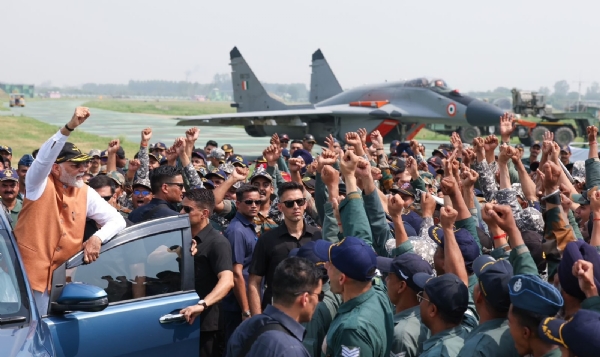
This clarity at the global level was matched by a shift within India itself. A country once conditioned to strategic restraint began rediscovering its confidence. And this wasn’t just rhetorical, it translated into action. From surgical strikes to the Balakot airstrike, India signaled a clear departure from passivity. The psychological shift was just as significant as the operational one.
The terror attack in Pahalgam, followed by the response through Operation Sindoor, stands as a recent example of this evolving doctrine. The response was not just about retaliation; it was about sending a clear message. Swift, precise, and unapologetic, it reflected years of strategic clarity and growing confidence. There was no attempt to soften the nature of the threat or hide behind diplomatic ambiguity. India acted, and spoke, with conviction.
At the institutional level too, this approach reshaped India’s role globally. At the UNSC, India pushed consistently for stronger counter-terror frameworks, including renewed attention to the long-pending Comprehensive Convention on International Terrorism. Indian diplomacy gradually moved from cautious participation to a more assertive, agenda-setting role. Issues like terror safe havens, funding networks, and radicalisation were highlighted as urgent global challenges.
The effects of this shift are visible today. While the global discourse still carries elements of caution, there is a noticeable openness to addressing uncomfortable realities. Countries that once avoided specificity are now more willing to talk about radicalisation and ideological extremism. In many ways, India has helped push this shift, expanding what can be openly discussed without immediate defensiveness.
Of course, this approach has not been without criticism, including within India. Modi’s stance is often described as polarisng or overly simplistic. But such critiques tend to overlook a basic truth: meaningful solutions require honest diagnosis. Avoiding the problem does not make it disappear; it allows it to persist.
As Narendra Modi completes 25 years in public life, his imprint on this issue stands out clearly. He has reshaped how terrorism is discussed globally, pushing for precision in an area long clouded by ambiguity and, at times, deliberate silence.
In doing so, he ensured that the voice of a nation long scarred by terrorism would no longer be muted, but heard, clearly and unapologetically, across the world.
--
Himali Nalawade
Himali Nalawade is associated with News Bharati as an Author since a considerable period. She is mostly linked with researched articles from the areas of Defence, Defence Infrastructure and Culture-Religion. Along with her Masters in Mass Communication and Journalism after her graduation in History, she has also studied Diploma in Underwater Archaeology and Diploma in Indology.