The final question of belonging: A marriage, a funeral, and the power of religion
NewsBharati 15-Jun-2026 13:40:10 PM
Total Views |


“Let me see some tenderness connected with a death.”
In A Christmas Carol, Charles Dickens placed these words in the mouth of Ebenezer Scrooge at the moment of his moral awakening. Faced with the reality of mortality, Scrooge sought neither wealth nor status, neither recognition nor power. He sought tenderness. For in death, perhaps more than in life, tenderness becomes the final measure of our character.
The facts of the case raise legal, social, and religious questions. Yet beyond all these lies a more fundamental one. Why does religion often remain the most enduring marker of identity, even after love, marriage, family ties, and ultimately life itself have run their course? Why does faith continue to define belonging long after other markers of identity have faded into the background? Modern societies often speak the language of individual choice. We choose our professions, our cities, our political beliefs, and increasingly, our partners. Yet religion remains one of the few identities that continues to be collectively negotiated. We may believe we belong to ourselves, but religion often reminds us that communities also claim a stake in who we are.
_202606151346397875_H@@IGHT_297_W@@IDTH_700.jpg "Parsi woman Muslim man news")
The incident also reveals something many modern societies are reluctant to acknowledge. Religion continues to shape our lives far more deeply than we admit. We often imagine ourselves as autonomous individuals making independent choices. Yet our identities are woven from family, culture, tradition, and faith. Religion influences whom we marry, how we celebrate, how we grieve, and how we are remembered. The Indian Constitution sought to create a society in which multiple faiths could coexist with equal dignity. Indian secularism was never intended to be the absence of religion; it was intended to be the peaceful coexistence of many religions. The law therefore permits individuals of different faiths to marry while retaining their respective religious identities. Yet this incident reveals a gap between constitutional pluralism and social acceptance.
What, then, does this teach us? It reminds us that religion remains one of the most powerful forces shaping human identity and community. The same traditions capable of inspiring extraordinary compassion can also become rigid when doctrine is separated from context and empathy. It also reminds us that funeral rites are about more than theology. They are about gratitude, remembrance, closure, and peace. Ultimately, the question raised by this incident is not whether religion matters. Evidently, it does. The more important question is what we believe religion is for. If religion is merely a system for drawing boundaries, then this story is unsurprising. But if religion is, at its core, a guide to living ethically with others and parting from them with dignity, then this incident should leave us uneasy. The dead no longer require our approval. What they require, instead, is the character of the living.
Perhaps, then, the true test of any religion lies not in how rigorously it defines who belongs, but in how generously it teaches us to honour human dignity, to cherish a life while it is lived, and to respect it when it has come to an end.
In A Christmas Carol, Charles Dickens placed these words in the mouth of Ebenezer Scrooge at the moment of his moral awakening. Faced with the reality of mortality, Scrooge sought neither wealth nor status, neither recognition nor power. He sought tenderness. For in death, perhaps more than in life, tenderness becomes the final measure of our character.
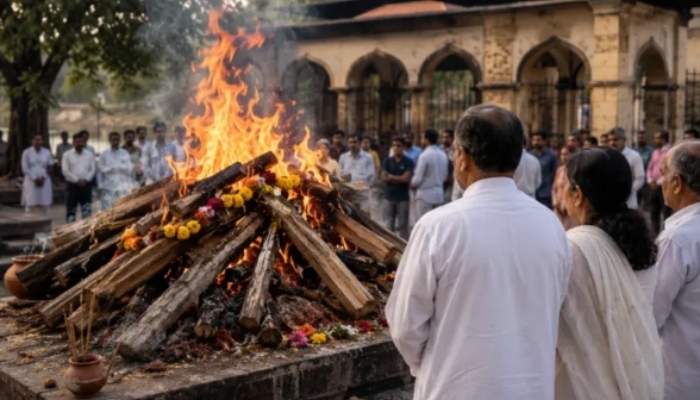
A recent news report from Gujarat tells a story that is both deeply personal and profoundly unsettling. A Parsi woman who married a Muslim man decades ago, yet chose to retain her Parsi identity rather than convert to her husband’s faith, was reportedly denied funeral rites by both the Parsi and Muslim communities after her death. Eventually, her mortal remains were cremated according to Hindu rituals through the intervention of well-wishers. Constitutional jurisprudence has increasingly recognised the right to die with dignity. A dignified burial or cremation is not merely a ritual obligation. It is society’s final acknowledgement that a human life mattered. However, in this case, what should have been a solemn farewell became a negotiation. What should have been an occasion for remembrance became a contest over belonging.
Image credits: VSK Telangana
For many who choose their life partners against the wishes of family or community, love comes at a price. Popular culture often romanticises such choices as acts of courage and self-determination. Yet the reality is often less poetic and more painful. The cost is frequently borne in silence. For women especially, choosing a partner outside familial expectations may mean strained relationships, social exclusion, emotional isolation, and the gradual erosion of ties that once seemed permanent. Parents stop calling. Relatives stop visiting. Invitations cease. Festivals become quieter. The punishment is rarely dramatic; it is often administered through absence. In this case, the consequences appear to have stretched across decades. The woman lived her life according to her convictions, yet even in death the shadow of that choice lingered.
The facts of the case raise legal, social, and religious questions. Yet beyond all these lies a more fundamental one. Why does religion often remain the most enduring marker of identity, even after love, marriage, family ties, and ultimately life itself have run their course? Why does faith continue to define belonging long after other markers of identity have faded into the background? Modern societies often speak the language of individual choice. We choose our professions, our cities, our political beliefs, and increasingly, our partners. Yet religion remains one of the few identities that continues to be collectively negotiated. We may believe we belong to ourselves, but religion often reminds us that communities also claim a stake in who we are.
At a time when some question whether religion should exist at all, while others dream of a universal spiritual identity transcending all differences, it is worth remembering why religions emerged in the first place. Long before constitutions, courts, and nation-states existed, religions helped human beings make sense of suffering, morality, community, and death. They answered questions that every generation has asked. Why do good people suffer? What happens after death? How should one live? In that sense, religion was never merely about God. It was about belonging.
A place of worship is a place where individuals become part of a larger story. Religion gives people a shared memory, a common vocabulary of values, and a sense of continuity across generations. It comforts the grieving, restrains human excesses, inspires charity, and reminds people that life possesses meaning beyond immediate self-interest. Perhaps this is why religion often proves stronger than law, stronger than ideology, and sometimes even stronger than blood relations. It speaks not merely to the mind but to identity itself. Religion grapples with existential questions. Who are we? Why are we here? What happens after death? These questions seek to address common human anxieties: the fear of death and the hope that life possesses meaning, beyond its final breath. Funeral rites, therefore, are not administrative procedures. They are sacred acts through which communities affirm both the value of the deceased and the truths they hold about existence itself. The dispute in this case was not merely about a body and its final goodbye. It was about competing understandings of belonging.
That is why this episode is so striking. It demonstrates how religion can be both extraordinarily noble and deeply rigid. In the hands of compassionate individuals, religion inspires duty, service, forgiveness, and moral courage. It provides hope when reason fails and companionship when loneliness overwhelms. Yet every religious tradition faces a perennial danger: when rules become detached from the ethical principles that gave birth to them, religion risks becoming an exercise in classification rather than compassion. The problem, therefore, is not religion itself. The problem is what happens when identity eclipses empathy.
The incident also reveals something many modern societies are reluctant to acknowledge. Religion continues to shape our lives far more deeply than we admit. We often imagine ourselves as autonomous individuals making independent choices. Yet our identities are woven from family, culture, tradition, and faith. Religion influences whom we marry, how we celebrate, how we grieve, and how we are remembered. The Indian Constitution sought to create a society in which multiple faiths could coexist with equal dignity. Indian secularism was never intended to be the absence of religion; it was intended to be the peaceful coexistence of many religions. The law therefore permits individuals of different faiths to marry while retaining their respective religious identities. Yet this incident reveals a gap between constitutional pluralism and social acceptance.
What, then, does this teach us? It reminds us that religion remains one of the most powerful forces shaping human identity and community. The same traditions capable of inspiring extraordinary compassion can also become rigid when doctrine is separated from context and empathy. It also reminds us that funeral rites are about more than theology. They are about gratitude, remembrance, closure, and peace. Ultimately, the question raised by this incident is not whether religion matters. Evidently, it does. The more important question is what we believe religion is for. If religion is merely a system for drawing boundaries, then this story is unsurprising. But if religion is, at its core, a guide to living ethically with others and parting from them with dignity, then this incident should leave us uneasy. The dead no longer require our approval. What they require, instead, is the character of the living.
Perhaps, then, the true test of any religion lies not in how rigorously it defines who belongs, but in how generously it teaches us to honour human dignity, to cherish a life while it is lived, and to respect it when it has come to an end.

Dr Divita Kothekar
Assistant professor, Maharashtra National Law University, Nagpur