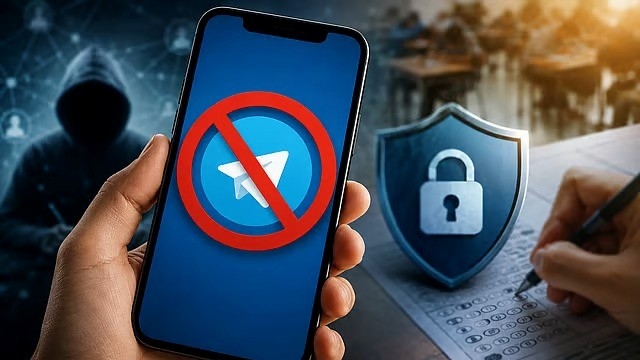
In an extraordinary move that triggered a nationwide debate, the Central government temporarily blocked access to messaging platform Telegram across India ahead of the NEET-UG 2026 re-examination scheduled for June 21.
The action came after the National Testing Agency (NTA) warned that organised fraud networks were using Telegram channels to target anxious students with fake question papers, fabricated leaks and fraudulent promises of guaranteed success.
The temporary restriction, imposed until June 22, marked the first time a platform of Telegram's scale had faced such action in India. Soon after the order, access to Telegram was disrupted across multiple telecom networks, while the application's listing reportedly disappeared from app stores in India.
According to the NTA, the move was intended to prevent cheating rackets and restore confidence in an examination already under intense scrutiny following allegations of irregularities in the original NEET examination conducted on May 3.
NTA Says Telegram became a hub for fraud networks
The NTA maintained that its concerns were not directed at Telegram as a technology platform but at the way organised scam networks had allegedly weaponised its features.
According to officials, fraudsters had been operating hundreds of channels claiming to possess leaked NEET question papers. Students were promised advance access to examination papers in exchange for large sums of money.
Authorities said some channels demanded amounts ranging from Rs 14,000 to Rs 25,000, while others allegedly charged several lakh rupees. In some cases, students and parents were reportedly asked to pay as much as Rs 10 lakh for what operators claimed were genuine examination papers.
The agency repeatedly stressed that no authentic paper leak had occurred and that the channels were exploiting fear and uncertainty among candidates.
"We had to take this drastic step because the platform was continuously being misused by scamsters and fraudsters who were sharing fake question papers as genuine papers and trying to fool students and parents into paying for them," NTA Director General Abhishek Singh said.
With over 22 lakh students appearing for NEET annually, the agency argued that protecting students from large-scale fraud justified extraordinary intervention.
Telegram feature at centre of controversy
One of the most contentious issues highlighted by investigators was Telegram's message-editing functionality.
According to the NTA, fraudsters exploited the ability to edit older messages while retaining their original timestamps.
Investigators said scammers would upload question papers after an examination had concluded and then modify previously posted messages to make it appear as though the paper had been shared before the exam.
Screenshots of these edited posts were then circulated on social media as purported evidence of paper leaks.
The result was a flood of misinformation that created panic among students and further weakened confidence in the examination process.
Officials argued that even when no actual leak had occurred, fabricated evidence created the impression that the examination system had been compromised.
The NTA claimed that nearly 200 such channels had already been identified and blocked.
Telegram founder Pavel Durov responds
Telegram founder Pavel Durov responded to Indian government's decision, arguing that the action punished millions of legitimate users rather than the criminals responsible for the scams.
According to Durov, more than 15 crore Telegram users in India were affected by the temporary restriction.
"The leaks just moved to other apps," Durov said, suggesting that banning Telegram would not eliminate the underlying problem.
He also highlighted Telegram's efforts to combat exam-related fraud.
According to Durov, the platform had removed hundreds of channels involved in sharing examination-related scams and had introduced measures to make edited messages more visible to users.
"We removed hundreds of channels sharing leaked exam materials and related scams in India. We're also making the edited label more visible to prevent backdating scams," he said.
Beyond Telegram
Even as authorities focused on Telegram-based fraud networks, investigators uncovered another disturbing vulnerability within the NEET ecosystem.
Ahmedabad Police arrested a 19-year-old man from Bihar, identified as Naveen Yadav, for allegedly diverting refund payments meant for NEET candidates into his personal bank account.
According to investigators, Yadav exploited weak security controls and compromised student accounts using brute-force techniques.
Police alleged that he targeted more than 350 candidates and successfully gained access to approximately 150 accounts.
After accessing student profiles, he reportedly altered banking details linked to refund requests, causing payments of Rs 1,700 per student to be redirected into accounts under his control.
The case raised serious questions about cybersecurity protections surrounding one of India's largest examinations.
Following the incident, authorities reportedly strengthened authentication systems and introduced additional safeguards.
Teen ethical hacker reveals security flaws in NEET systems
The examination system faced another challenge when a 16-year-old ethical hacker from Dubai disclosed serious vulnerabilities affecting both NEET and JEE Advanced digital infrastructure.
Rylen Anil said he discovered the flaws within a few hours of testing the systems and immediately reported them to the Indian Computer Emergency Response Team (CERT-In).
According to Anil, the vulnerabilities potentially exposed sensitive student and parent information.
He alleged that weaknesses in administrative systems and cloud storage configurations could have allowed unauthorised access to admit cards, result records and personal details.
Importantly, Anil did not misuse the information and instead followed responsible disclosure practices by informing authorities.
His findings were acknowledged by technical teams associated with the examination systems, and corrective measures were reportedly implemented.
The episode nevertheless intensified concerns about the digital security architecture supporting India's most important entrance examinations.
A crisis of trust, not Just technology
The controversy surrounding Telegram, fake paper networks and cybersecurity vulnerabilities ultimately points to a deeper problem: the growing trust deficit surrounding high-stakes examinations.
For millions of Indian families, NEET is far more than an entrance test.
Every year, parents invest enormous amounts in coaching, study materials, hostel accommodation and preparation programmes in the hope of securing a medical seat. Many families make significant financial sacrifices, while students spend years preparing for a single examination.
With nearly 22 lakh candidates competing for a limited number of seats, the pressure is immense.
This pressure creates fertile ground for fraudsters who prey on anxiety and uncertainty.
Whether through fake paper leaks, manipulated screenshots, refund scams or cyber vulnerabilities, every controversy chips away at confidence in the system.
The NTA argues that the Telegram restriction was aimed at protecting students and preserving the credibility of the examination. Critics, however, question whether platform-level restrictions address the underlying vulnerabilities that allow such frauds to flourish.
The real challenge
The debate is no longer only about Telegram or even NEET itself.
It is about whether India's examination ecosystem can remain secure, transparent and trusted at a time when digital fraud networks are becoming increasingly sophisticated.
The temporary Telegram ban may have disrupted some scam operations ahead of the re-test. However, the larger challenge lies in ensuring robust cybersecurity, preventing misinformation, safeguarding student data and restoring public faith in a system that millions of young Indians depend upon for their future.
For students and parents preparing for one of the most important examinations of their lives, trust is as important as the examination itself. And rebuilding that trust may prove far more difficult than blocking any single platform.