Rahul Gandhi's birthday ritual revives questions about Congress' culture of sycophancy
Total Views |


Politics often thrives on symbolism, but symbolism can also expose contradictions. The birthday celebrations of the Leader of the Opposition, Rahul Gandhi, in Varanasi have sparked precisely such a debate. A video shared by PTI showed Youth Congress workers pouring milk over Rahul Gandhi's photograph in the Ganga as part of a symbolic ritual to mark his birthday. Some Congress workers also compared Rahul Gandhi to the sage Parashurama.
The visuals have inevitably invited comparisons with the long-standing criticism by sections of the Congress ecosystem and left-liberal commentators of Hindus performing milk abhishekams in temples. For years, many public commentators associated with liberal politics have questioned temple rituals involving milk, arguing that it should instead be used to feed the poor.
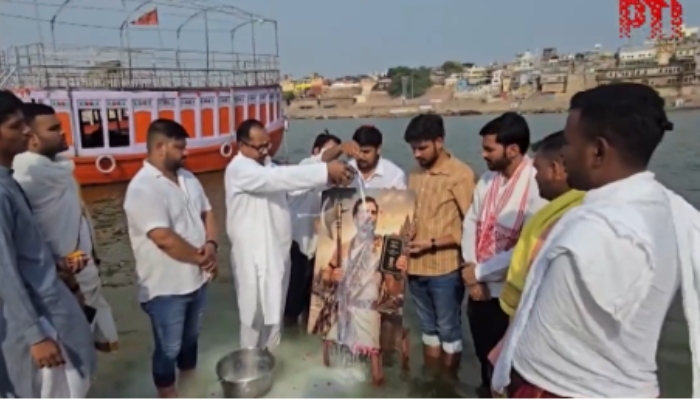
Leader equated with Parshuram and given milk abhishekam in the Ganga
Whether one agrees with that argument or not, the Varanasi celebration raises a legitimate question: if pouring milk over religious idols is criticised as wasteful, should the same standard apply when milk is poured over the photograph of a political leader?
ALSO READ: INC ignores global surge, plays politics over commercial LPG price hike; here's what the rates are as on May 2 across India
VIDEO | Varanasi: Youth Congress workers celebrate Lok Sabha Leader of Opposition Rahul Gandhi’s birthday with symbolic rituals, including pouring milk over his photograph in the Ganga River.#RahulGandhi #VaranasiNews
— Press Trust of India (@PTI_News) June 19, 2026
(Full video available on PTI Videos -… pic.twitter.com/57oraDhpqZ
The episode also revives an older debate about personality cults in Indian politics. Congress has often accused its political rivals of encouraging hero worship. Yet, its own history contains striking examples of elevating leaders to near-divine status. During the Emergency era, Congress President Dev Kant Barooah ‘infamously’ declared,, "India is Indira and Indira is India," a slogan that came to symbolise the concentration of political power around Indira Gandhi.
_202606191316186261_H@@IGHT_400_W@@IDTH_700.jpg "Rahul Gandhi birthday")
Congress workers honouring Indira Gandhi during Emergency in 1975. Photo credit: HT archive
Coined at the height of Indira Gandhi's political dominance, the slogan came to represent the centralisation of authority during the controversial 1975–1977 Emergency. Historians and political commentators have frequently cited it as one of the clearest examples of the personality cult and political sycophancy that surrounded her leadership, reflecting a climate in which the identity of the nation was closely identified with that of a single individual.
Sonia Gandhi, too, has on several occasions been portrayed by enthusiastic supporters in devotional imagery, including depictions as Goddess Durga. One such instance occurred in June 2007, when a poster portraying Congress President Sonia Gandhi as Goddess Durga in Moradabad, Uttar Pradesh, triggered widespread controversy.
The painting, displayed at the local Congress office, drew considerable attention. According to district Congress president A. S. Soni, it had been created by a local artist who hung it as a sample during the Assembly elections and offered to produce similar paintings if party workers wished.
When asked why the painting remained on display despite the controversy, Soni reportedly responded, "There is no objection to it since it is a work of art." On the second occasion, Congress workers in Telangana equated Sonia Gandhi to Devi.
In 2014, when a new state of Telangana was formed, Congress leaders across the district did the unthinkable – they constructed a temple dedicated to her in Mallial town.