Better Divorced Than Dead: The Truth India Refuses to Hear
A daughter may be educated, independent, and financially successful, yet many families still subconsciously view marriage as a transfer of responsibility. Once married, she is expected to adapt to a new family, a new home, and often a new set of expectations. Returning to her parents is frequently seen as a last resort rather than a natural option.
NewsBharati 02-Jun-2026 17:33:48 PM
Total Views |


It starts with a frantic, breathless scroll through a WhatsApp chat.
We look at the words typed by a 26-year-old girl to her mother late at night. A girl who had the world at her feet, an MBA graduate, a former Miss Pune, an actor-model with everything to live for, confessing that she was "badly stuck," suffocating under a mountain of psychological abuse. And then we see the reply. The quiet, heartbreakingly familiar refrain of an Indian mother trying to keep the peace: “Stay calm. Everything will be fine.”
But on Tuesday, May 12, everything wasn't fine. Twisha Sharma was found dead in her matrimonial home in Bhopal, barely five months after saying "I do."
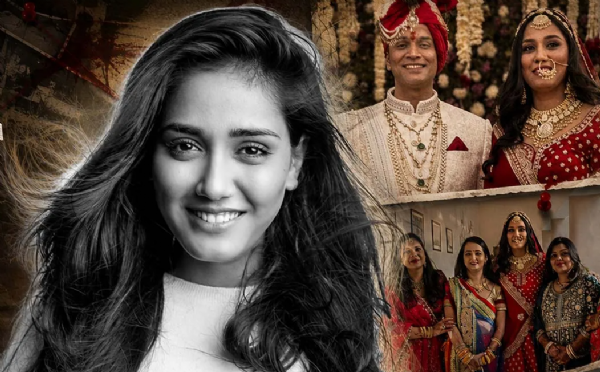
As the shockwaves of her death rippled across the nation, it was a judge who finally shattered the polite, comfortable silence of our living rooms. Looking past the dense, cold legalese of the courtroom, Solicitor General Tushar Mehta, while presenting Twisha Sharma’s side, uttered a line that didn't just make headlines; it pierced straight through the collective conscience of every Indian parent:
“BETTER TO HAVE A DIVORCED DAUGHTER THAN SEEING HER LIFELESS, COLD FACE.”
That single statement from the courtroom didn't just rattle the legal system; it exposed a raw, bleeding nerve across the nation. It laid bare the unspoken, heavy rules that still govern what it means to be a woman in India. It demands that we ask the one uncomfortable question we always try to run away from: Why do we keep letting this happen?
There is no cruelty in those words. In fact, they often come from a place of deep love. Yet they also reveal something unsettling. Generations of Indian parents have been conditioned to believe that adjustment is the first solution to marital distress. Patience is encouraged. Compromise is expected. Endurance is admired.
The question is why.
India has changed dramatically over the past few decades. Girls today are more educated than ever before. Women are leading corporations, flying fighter aircraft, conducting scientific research, and shaping public policy. Parents proudly celebrate their daughters' achievements and opportunities. The visible indicators of progress are everywhere.
Yet beneath this progress survives a much older idea, one that many Indians may no longer say aloud but continue to practice unconsciously. The idea of the daughter as “Paraya Dhan”.
Today, that ‘transaction’ doesn't always look like cash stuffed in a suitcase. In educated, urban circles, it masquerades as "gifts given out of love": luxury cars, high-end real estate, corporate backing. But the moment the demands aren't met, or the moment the daughter asserts her independence, the psychological warfare begins.
A daughter may be educated, independent, and financially successful, yet many families still subconsciously view marriage as a transfer of responsibility. Once married, she is expected to adapt to a new family, a new home, and often a new set of expectations. Returning to her parents is frequently seen as a last resort rather than a natural option.
This is where the Twisha Sharma case becomes larger than itself. When Twisha’s mother told her to "stay calm," it wasn’t because she didn't care.
When Twisha finally gathered the courage to tell her mother that her husband had crossed every boundary of dignity by questioning the paternity of her child and casting doubt on her character, she expected support, outrage, or at least understanding. Instead, she was advised to ignore it. The response left her shattered. “Kaisi aurat ho aap?” she asked in disbelief. It was not just a daughter's anger, it was the cry of a woman who felt abandoned at the very moment she needed someone to stand firmly by her side.
🚨Chats between Twisha Sharma and her mother revealed she was repeatedly expressing stress over her married life, her husband doubted and suspected her too https://t.co/WKMocnV0DN pic.twitter.com/kuuIVxIQ8S
— The Tatva (@thetatvaindia) May 18, 2026
It was the visceral, generational panic of an Indian parent kicking in. Because, in our society, a divorced daughter is often viewed as a communal failure, a permanent stain on the family's "honor." Parents spend a lifetime saving for a wedding, not just financially, but socially. The fear of what log kya kahenge (what people will say) is a psychological chokehold.
So, we tell our daughters to bend. We tell them to swallow the humiliation. We tell them to wait out the storm, praying that time will fix a monster. We teach our girls how to fly, but the moment they face a turbulent marriage, we clip their wings and tell them to stay grounded in the fire.
This is the reason why, when news broke of a family celebrating their daughter’s divorce, the widespread societal criticism. India outlawed dowry through the Dowry Prohibition Act in 1961. More than six decades have passed since then. Yet according to data from the National Crime Records Bureau, thousands of dowry-related deaths continue to be registered every year.
The persistence of these numbers tells us something important. The law changed. The mindset did not change fast enough. And at the absolute center of this stagnant mindset is a deeply entrenched cultural phenomenon: the "Raja Beta" (Royal Son) syndrome. What makes this conversation even more important is that it transcends religion. Whenever a high-profile case involving a woman emerges, public discourse quickly descends into familiar trenches. Communities begin defending themselves. Political groups begin assigning blame. Social media turns personal tragedies into ideological battlegrounds.
The reality is uncomfortable but undeniable. Women face domestic violence in Hindu homes. Women face domestic violence in Muslim homes. Women face domestic violence in Christian homes. The forms may vary. The cultural contexts may differ. The social pressures may be expressed differently.
The woman at the centre of the tragedy is often left carrying burdens created by systems much larger than herself.
Perhaps that is why the Twisha Sharma case has touched such a raw nerve. Because every parent who read those messages imagined their own daughter. Every mother imagined receiving that phone call. Every father imagined hearing that cry for help.
And every family was forced to confront a terrifying possibility: What if the daughter asking for support believes she has nowhere to go? That is where Tushar Mehta's statement acquires its real significance."Better to have a divorced daughter than to see her lifeless, cold face."
The next time an Indian daughter reaches out from the darkness of an abusive marriage, our vocabulary must change. The response can no longer be a desperate plea to "stay calm and adjust." The only acceptable, civilized response must be: "Pack your bags. The door is open. Come home."
Shivani Shinde
Shivani Shinde has completed her graduation in Journalism and Mass Communication and is pursuing her Masters further. She keeps interest in writing on Science and Technology and Entertainment.