NCERT drops 'Secular' from new class 9 textbook, introduces emergency chapter for first time
The revised textbook, Understanding Society: India and Beyond - Part 1, has been developed under the National Education Policy (NEP) 2020 and the National Curriculum Framework for School Education (NCF-SE) 2023.
Total Views |


The NCERT has introduced a major overhaul of its Class 9 Social Science curriculum under the National Education Policy (NEP) 2020, removing the Preamble and references to "secularism" from the new textbook while introducing a dedicated chapter on the 1975-77 Emergency for the first time. The revised 220-page textbook will be taught from the 2026-27 academic session and replaces separate books on history, geography, political science and economics.
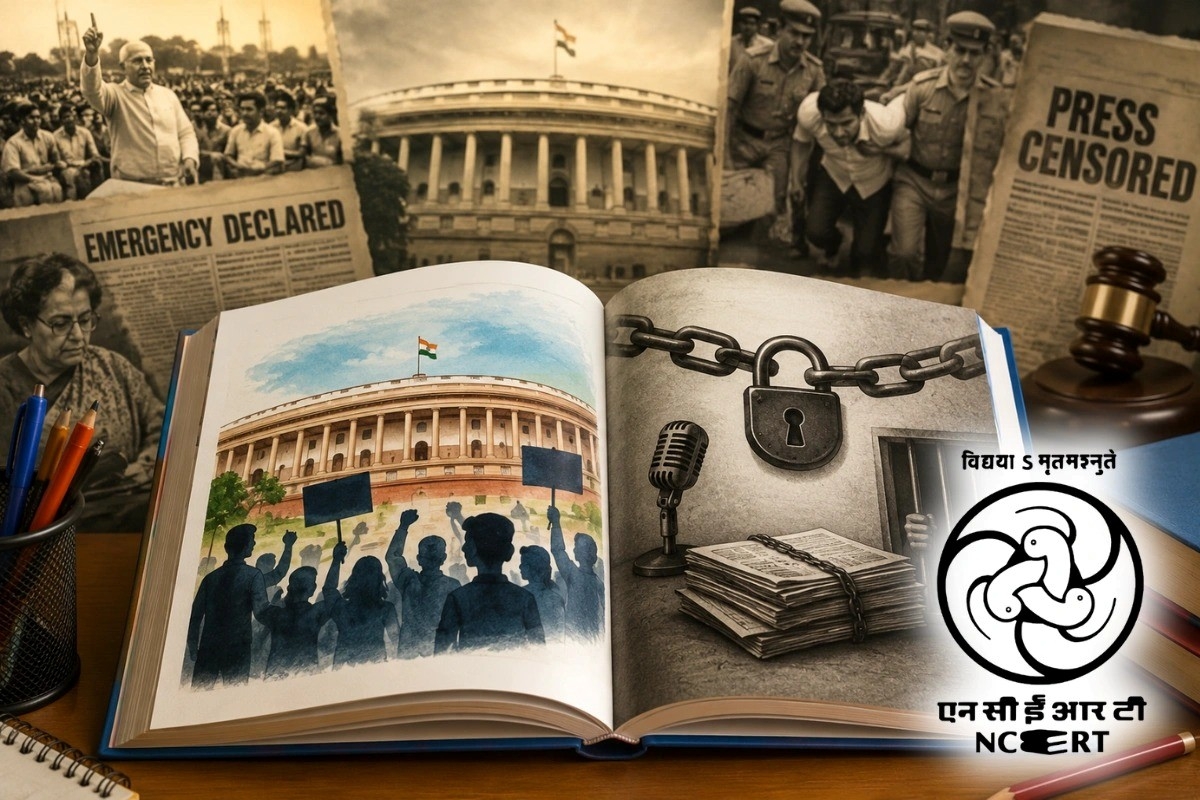
In a major revision of the school curriculum, the National Council of Educational Research and Training (NCERT) has removed the Preamble to the Constitution and references to "secularism" from its new Class 9 Social Science textbook while introducing a detailed chapter on the 1975-77 Emergency for the first time.
The revised textbook, Understanding Society: India and Beyond - Part 1, has been developed under the National Education Policy (NEP) 2020 and the National Curriculum Framework for School Education (NCF-SE) 2023. It will be introduced from the 2026-27 academic session and replaces separate textbooks on history, geography, political science and economics with a single integrated volume.
Preamble Missing From Revised Textbook
One of the most significant changes is the omission of the Preamble to the Constitution, which featured prominently in the earlier Class 9 political science textbook, Democratic Politics-I.
NCERT Class 9 book adds Emergency, drops Preamble and Secularism@MeSanjayy ✍🏻 https://t.co/3hHoDeruUV
— Hindustan Times (@htTweets) June 26, 2026
The previous edition dedicated an entire chapter to the Constitution and described the Preamble as the philosophical foundation of India's constitutional framework. It also explained the meaning of the constitutional terms "Sovereign", "Socialist", "Secular", "Democratic" and "Republic", providing students with an introduction to the guiding principles of the Indian state.
In the revised textbook, these explanations have been removed. References to secularism, including the earlier description that the Indian state has no official religion and treats all religions equally, are also absent.
Instead, the Constitution is presented as a "robust, flexible, transformative and responsive" document that focuses on liberty, equality, justice, fraternity and Fundamental Rights. The textbook discusses the Constitution primarily through its framing, democratic institutions and constitutional rights.
Emergency Introduced in Class 9 Curriculum
For the first time, NCERT has included a dedicated chapter on the Emergency imposed between 1975 and 1977.
NCERT has introduced the 1975–77 National Emergency in the Grade 9 Social Science syllabus#ITVideo #NCERT #Education #Emergency #SocialScience | @SnehaMordani @AishPaliwal pic.twitter.com/KQO1o1IWjh
— IndiaToday (@IndiaToday) June 25, 2026
The chapter, titled Challenges to Democratic Practices in India, explains that a National Emergency was declared in June 1975 on the grounds of "internal disturbance". It states that during the Emergency, several Fundamental Rights were suspended, press censorship was imposed, opposition leaders and political activists were arrested, democratic institutions came under severe strain and citizens' civil liberties were significantly curtailed.
The inclusion marks the first detailed discussion of the Emergency in the revised Class 9 Social Science curriculum.
Election Commission Chapter Revised
The revised textbook also changes the treatment of the Election Commission of India.
While the earlier textbook extensively discussed the Commission's independence and constitutional powers, including its authority to enforce the Model Code of Conduct, conduct free and fair elections and order re-polling where necessary, the new edition places greater emphasis on the Commission's constitutional role in supervising, directing and controlling elections.
It also includes a new section on the Special Intensive Revision (SIR) of electoral rolls.
Education Minister Welcomes Changes
Union Education Minister Dharmendra Pradhan welcomed the inclusion of the Emergency chapter, saying future generations must be made aware of what he described as the "dark deeds" committed during that period.
#WATCH | Delhi | On NCERT introducing a section on Emergency in Class IX textbook, Union Education Minister Dharmendra Pradhan says, "This is correct. NCERT has done the right thing. Future generations should know and understand the dark deeds of the Emergency so that such a… pic.twitter.com/QLtR30mWvZ
— ANI (@ANI) June 25, 2026
The curriculum revision is part of the broader overhaul being implemented under NEP 2020 and NCF-SE 2023, aimed at restructuring school education through integrated and multidisciplinary learning.
The 220-page textbook will be used by Class 9 students across schools following the NCERT curriculum from the 2026-27 academic session.