When Comrades Discover Democracy
The Republic seems to be functioning. The elections continue. The critics continue. The Constitution continues.
NewsBharati 26-Jun-2026 13:13:00 PM
Total Views |


There are political ironies. Then there are Communist ironies. And then there is the Communist Party of India (Marxist) suddenly becoming the self-appointed guardian of democracy. The occasion? The anniversary of the 1975 emergency.
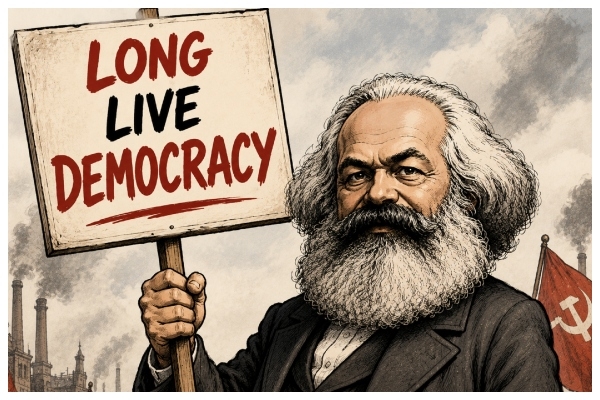 One almost expected Karl Marx to rise from his grave and ask, "Comrades, since when?" An Emergency, declared or undeclared, has certain unmistakable symptoms. Newspapers are silenced. Political criticism disappears. Opposition leaders vanish into prisons merely for disagreeing. Fear replaces debate. Now look around.
Communists lecturing India on democracy is rather like a fish delivering a lecture on mountain climbing. Marxism, after all, was never conceived as a celebration of liberal democracy. Karl Marx himself did not conceal his admiration for the "dictatorship of the proletariat." The objective was never political pluralism but ideological victory. Elections were acceptable only until the revolution succeeded. Thereafter, dissent became a counter-revolution.
Wherever orthodox Communism gained complete power, opposition parties rarely enjoyed long and healthy lives. Whether in the Soviet Union, China or elsewhere, political competition generally ended with the victory of one party and the disappearance of meaningful alternatives. But today's comrades wish to be seen as the custodians of democratic values.
That transformation deserves an award for creative reinvention. Even India's own experience raises uncomfortable questions. In states where the left enjoyed prolonged dominance, political violence became an enduring subject of public debate. Kerala and West Bengal witnessed decades of bitter clashes in which ideological opponents often paid a heavy price. Rival political workers, particularly from competing ideological streams, frequently alleged intimidation and violence.
Successive governments, including the Modi government, have not attempted to remove them. Perhaps, instead of condemning the emergency every June, the comrades should organise a thanksgiving meeting for preserving two expressions they continue to cherish. Meanwhile, India's democratic machinery stubbornly refuses to cooperate with the Emergency narrative.
General elections arrive on schedule. State elections arrive on schedule. Governments win. Governments lose. Opposition parties rule several states. The judiciary continues to scrutinise executive actions. Parliament remains noisy, sometimes excessively so. Political parties hold rallies. Journalists ask uncomfortable questions. Cartoonists survive. Stand-up comedians continue their profession. And opposition leaders regularly predict the collapse of democracy while doing so under television cameras broadcasting nationwide. It is difficult to locate the emergency.
Perhaps it exists only in carefully drafted party resolutions. The real emergency, unfortunately for the CPI(M), appears to be internal. It is an ideological emergency. A relevant emergency. A cadre emergency.
But electoral decline cannot be blamed on constitutional dictatorship. Losing public support is not an assault on democracy. It is democracy functioning exactly as intended. Perhaps that is the most difficult lesson for parties accustomed to treating ideological certainty as electoral entitlement.
Democracy is an unforgiving examiner. It distributes neither sympathy marks nor revolutionary bonus points. Instead of searching for imaginary emergencies, the comrades might profit from searching for lost credibility. Instead of issuing dramatic warnings about dictatorship, they might ask why ordinary Indians increasingly ignore their sermons.
Instead of discovering democracy only when election results become disappointing, they could rediscover the electorate itself. India certainly remembers the emergency of 1975. It remains one of the darkest chapters in the Republic's history. But invoking that painful memory demands historical seriousness, not political hyperbole. Every disagreement with the government is not an emergency. Every electoral setback is not authoritarianism. Every criticism of Communist politics is not an assault on democracy.
The diagnosis? According to CPI(M) General Secretary M. A. Baby, India is supposedly living through an "undeclared Emergency" under the Narendra Modi government.
Every morning begins with television studios criticising Prime Minister Narendra Modi. Every afternoon social media overflows with memes, abuses and conspiracy theories targeting him. Every evening opposition leaders hold press conferences accusing the government of everything from inflation to climate change. Newspapers carry columns attacking the government. International media routinely publish stories questioning India's democracy.
ALSO READ: India Is Not A Dharmashala
If this is an undeclared Emergency, it is perhaps the only one in history where the supposed dictator patiently tolerates being criticised twenty-four hours a day without demanding applause. Mr. Baby may have mistaken prime-time television for an underground resistance movement. But the larger comedy lies elsewhere.
Communists lecturing India on democracy is rather like a fish delivering a lecture on mountain climbing. Marxism, after all, was never conceived as a celebration of liberal democracy. Karl Marx himself did not conceal his admiration for the "dictatorship of the proletariat." The objective was never political pluralism but ideological victory. Elections were acceptable only until the revolution succeeded. Thereafter, dissent became a counter-revolution.
History did not improve upon the theory.
Wherever orthodox Communism gained complete power, opposition parties rarely enjoyed long and healthy lives. Whether in the Soviet Union, China or elsewhere, political competition generally ended with the victory of one party and the disappearance of meaningful alternatives. But today's comrades wish to be seen as the custodians of democratic values.
That transformation deserves an award for creative reinvention. Even India's own experience raises uncomfortable questions. In states where the left enjoyed prolonged dominance, political violence became an enduring subject of public debate. Kerala and West Bengal witnessed decades of bitter clashes in which ideological opponents often paid a heavy price. Rival political workers, particularly from competing ideological streams, frequently alleged intimidation and violence.
Were those glorious demonstrations of democratic pluralism? Or was democracy considered admirable only when it did not threaten Communist dominance?
Curiously, if any political formation should remember the emergency with a certain sense of historical gratitude, it is the Communists. After all, it was during the emergency that the words "Socialist" and "Secular" found their way into the preamble through the 42nd Constitutional Amendment. Those additions remain intact even today.
Successive governments, including the Modi government, have not attempted to remove them. Perhaps, instead of condemning the emergency every June, the comrades should organise a thanksgiving meeting for preserving two expressions they continue to cherish. Meanwhile, India's democratic machinery stubbornly refuses to cooperate with the Emergency narrative.
ALSO READ: Historic Spike: India sweeps Australia 3-0 to storm into first-ever AVC men's volleyball cup semi-finals
Perhaps it exists only in carefully drafted party resolutions. The real emergency, unfortunately for the CPI(M), appears to be internal. It is an ideological emergency. A relevant emergency. A cadre emergency.
An electoral emergency. The party that once claimed to speak for workers now struggles to speak to voters. Entire generations have grown up without ever seeing the left as a serious national alternative. Its ideological vocabulary sounds increasingly borrowed from another century while India's political conversation has moved elsewhere. That is undoubtedly painful.
But electoral decline cannot be blamed on constitutional dictatorship. Losing public support is not an assault on democracy. It is democracy functioning exactly as intended. Perhaps that is the most difficult lesson for parties accustomed to treating ideological certainty as electoral entitlement.
Democracy is an unforgiving examiner. It distributes neither sympathy marks nor revolutionary bonus points. Instead of searching for imaginary emergencies, the comrades might profit from searching for lost credibility. Instead of issuing dramatic warnings about dictatorship, they might ask why ordinary Indians increasingly ignore their sermons.
Instead of discovering democracy only when election results become disappointing, they could rediscover the electorate itself. India certainly remembers the emergency of 1975. It remains one of the darkest chapters in the Republic's history. But invoking that painful memory demands historical seriousness, not political hyperbole. Every disagreement with the government is not an emergency. Every electoral setback is not authoritarianism. Every criticism of Communist politics is not an assault on democracy.
So, dear comrades, perhaps it is time to retire the imaginary emergency siren.
The Republic seems to be functioning. The elections continue. The critics continue. The Constitution continues. The only thing requiring immediate rescue appears to be the CPI(M)'s own political relevance. That, unlike the fictional emergency, is a crisis everyone can actually see.
Satyajit Shriram Joshi
Satyajit Shriram Joshi is Pune based senior journalist.