'Churches' protest against FCRA under the guise of National Prayer; DMK, AITC, join Congress, CPIM in demanding rollback; all you need to know
Total Views |


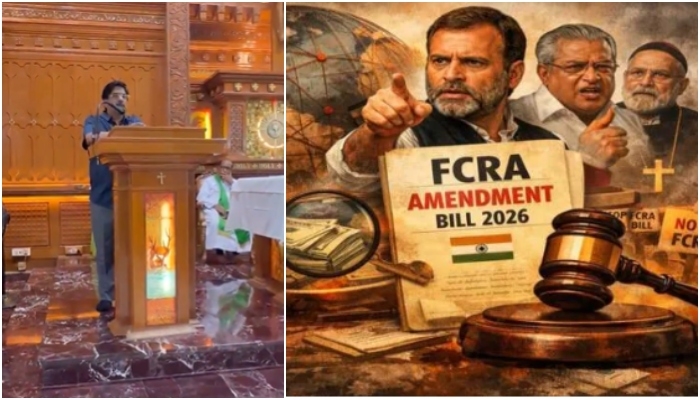
On Sunday, June 29, prayer gatherings took place in 'churches' throughout India to draw attention to growing opposition against the Foreign Contribution Regulation Act (Amendment) Bill (FCRA), 2026. These sessions were held under the guise of the National Prayer, called by the Joint Action Forum on Minorities (JAFM), which also demanded that the Union BJP government withdraw the proposed FCRA amendment.
Messages of solidarity came from a wide range of religious and community leaders across India, including representatives from the Jharkhand Minority Commission, the National Council of Churches in India, Assemblies of God Church, the Kuki Christian Leaders' Forum, the National YWCA, and many others, alongside bishops, pastors, legal experts, and civil society representatives.
Congress, CPIM calling for rollback
CPI(M) Rajya Sabha MP John Brittas wrote to Home Minister Amit Shah, raising what he described as "serious constitutional concerns" and urging immediate withdrawal of the amendments. While acknowledging that regulating foreign contributions is a legitimate state function, Brittas cautioned that such regulation must not be 'weaponised' to stifle charitable, educational, and faith-based organisations.
Parent Foreign Contribution (Regulation) Act, 2010, not altered; just the rules tightened
It is important to note that the recent amendment proposed by the Indian government in no way alters the main FCRA itself, the Foreign Contribution (Regulation) Act, 2010. However, the Rules, which are the subordinate, delegated laws formed under the parent Act, are what have been changed.
This section lists 16 permitted activities that religious organisations can carry out using foreign contributions, which include, construction and maintenance of places of worship, preservation of sacred scriptures, supporting institutions studying religious philosophy, pilgrim amenities, dharamshalas and langars, religious education and meditation retreats, devotional music and theatre, documentation of indigenous faith practices, protection of sacred relics and heritage sites, archiving of religious rituals, inter-faith dialogue, religious publications and research, religious libraries and museums, faith-based counselling and de-addiction centres, training in traditional sacred crafts, and burial or cremation ground maintenance. However, any of these activities undertaken with the intention of performing proselytisation has been specifically excluded.
Opposition parties, missionaries protecting proselytisation networks?
A crucial distinction that must be understood is that the recent government notification does not amend the parent legislation, the Foreign Contribution (Regulation) Act, 2010, in any manner whatsoever. What has been revised are the Rules, which are subordinate or delegated legislation framed under the authority of the parent Act. These Rules serve as the operational framework that governs how the provisions of the Act are implemented on the ground.
Opposition parties and missionary organisations raising objections to these changes must recognise this fundamental difference. The core Act remains entirely intact and unchanged. What the government has done is tighten the procedural rules, particularly those governing foreign funding channelled into activities associated with proselytisation. This is well within the executive's legitimate rule-making authority under the Act and does not constitute any overreach or alteration of the law as passed by Parliament. In essence, the criticism that the government is dismantling the FCRA framework is misplaced.
The amendments are targeted, subordinate, and procedural in nature, aimed at bringing greater accountability and transparency to the receipt and utilisation of foreign contributions, especially in the context of religious conversion activities. Those opposing these rules would do well to engage with the amendment's actual text rather than misrepresent its scope and intent.
By demanding a rollback of the FCRA Amendment Rules, Congress and CPI(M) are, knowingly or otherwise, providing a political shield to foreign-funded proselytisation networks operating across India. These rules specifically tighten oversight on religious conversion activities financed from abroad. The Opposition's resistance, therefore, raises serious questions about whose interests they are truly representing. rephrase
As per the reports, churches across all denominations participated in the observance. JAFM chairperson P Wilson attended one such prayer service at St Vincent's Ascension Church in Chennai, where he drew a sharp parallel between the FCRA Bill and the Enemy Property Act of 1968. He alleged that just as the earlier law was used to seize properties of those who migrated after independence, the FCRA Bill similarly treats minorities as adversaries and threatens their assets.
The DMK MP also announced that a nationwide signature campaign is underway, with a major protest scheduled for July 3 against the Bill. A virtual meeting was also held later that evening, bringing together opposition politicians from various parts of the country. Several Members of Parliament, including Kanimozhi, Derek O'Brien, D Ravi Kumar, Christopher Tilak, AA Rahim, and Kalanidhi Veersamy, united in their opposition to the FCRA (Amendment) Bill, 2026.
As part of the National Day of Fasting and Prayer, @PWilsonDMK Member of Parliament and Chairman of the Joint Action Forum on Minorities (JAFM), today participated in the prayer service held at St. Vincent’s Ascension Church, Nelson Manickam Road, Chennai – 600029.
— Joint Action Forum on Minorities (@Jacfoms) June 28, 2026
Addressing… pic.twitter.com/u9z68X52mY
Messages of solidarity came from a wide range of religious and community leaders across India, including representatives from the Jharkhand Minority Commission, the National Council of Churches in India, Assemblies of God Church, the Kuki Christian Leaders' Forum, the National YWCA, and many others, alongside bishops, pastors, legal experts, and civil society representatives.
Congress, CPIM calling for rollback
It is important to note that earlier, on June 26, the Congress and CPI(M) separately wrote to Prime Minister Narendra Modi and Union Home Minister Amit Shah, calling for the rollback of the recently notified Foreign Contribution (Regulation) Amendment Rules, 2026. Both the opposition parties contended that the amendments would gravely hamper the functioning of NGOs, minority institutions, and voluntary organisations nationwide.
In his letter to the Prime Minister, Congress general secretary and Public Accounts Committee chairperson K C Venugopal termed the amendments a "systemic assault" on civil society, alleging that the government is using executive powers to tighten its grip over non-governmental organisations after facing pushback in Parliament. He warned that compelling NGOs to select activities from a government-approved list and confining their work to pre-designated geographic areas would severely limit their capacity to respond to emergencies and community needs.
Wrote to PM Modi demanding the immediate withdrawal of the latest amendments to the FCRA Rules. These amendments severely cripple the autonomy and hamper the regular functioning of civil society organisations, especially those run by minority institutions.
— K C Venugopal (@kcvenugopalmp) June 25, 2026
Once more, after the… pic.twitter.com/n2X8qzlOZN
CPI(M) Rajya Sabha MP John Brittas wrote to Home Minister Amit Shah, raising what he described as "serious constitutional concerns" and urging immediate withdrawal of the amendments. While acknowledging that regulating foreign contributions is a legitimate state function, Brittas cautioned that such regulation must not be 'weaponised' to stifle charitable, educational, and faith-based organisations.
Parent Foreign Contribution (Regulation) Act, 2010, not altered; just the rules tightened
It is important to note that the recent amendment proposed by the Indian government in no way alters the main FCRA itself, the Foreign Contribution (Regulation) Act, 2010. However, the Rules, which are the subordinate, delegated laws formed under the parent Act, are what have been changed.
As per the official gazette, if any religious NGO registered under FCRA wants to change its area of operation or alter any purpose from its already available registration certificate, it must seek government approval. Notably, the Central Government can then approve or reject the application after due inquiry.
This section lists 16 permitted activities that religious organisations can carry out using foreign contributions, which include, construction and maintenance of places of worship, preservation of sacred scriptures, supporting institutions studying religious philosophy, pilgrim amenities, dharamshalas and langars, religious education and meditation retreats, devotional music and theatre, documentation of indigenous faith practices, protection of sacred relics and heritage sites, archiving of religious rituals, inter-faith dialogue, religious publications and research, religious libraries and museums, faith-based counselling and de-addiction centres, training in traditional sacred crafts, and burial or cremation ground maintenance. However, any of these activities undertaken with the intention of performing proselytisation has been specifically excluded.
Opposition parties, missionaries protecting proselytisation networks?
A crucial distinction that must be understood is that the recent government notification does not amend the parent legislation, the Foreign Contribution (Regulation) Act, 2010, in any manner whatsoever. What has been revised are the Rules, which are subordinate or delegated legislation framed under the authority of the parent Act. These Rules serve as the operational framework that governs how the provisions of the Act are implemented on the ground.
Opposition parties and missionary organisations raising objections to these changes must recognise this fundamental difference. The core Act remains entirely intact and unchanged. What the government has done is tighten the procedural rules, particularly those governing foreign funding channelled into activities associated with proselytisation. This is well within the executive's legitimate rule-making authority under the Act and does not constitute any overreach or alteration of the law as passed by Parliament. In essence, the criticism that the government is dismantling the FCRA framework is misplaced.
The amendments are targeted, subordinate, and procedural in nature, aimed at bringing greater accountability and transparency to the receipt and utilisation of foreign contributions, especially in the context of religious conversion activities. Those opposing these rules would do well to engage with the amendment's actual text rather than misrepresent its scope and intent.
By demanding a rollback of the FCRA Amendment Rules, Congress and CPI(M) are, knowingly or otherwise, providing a political shield to foreign-funded proselytisation networks operating across India. These rules specifically tighten oversight on religious conversion activities financed from abroad. The Opposition's resistance, therefore, raises serious questions about whose interests they are truly representing. rephrase