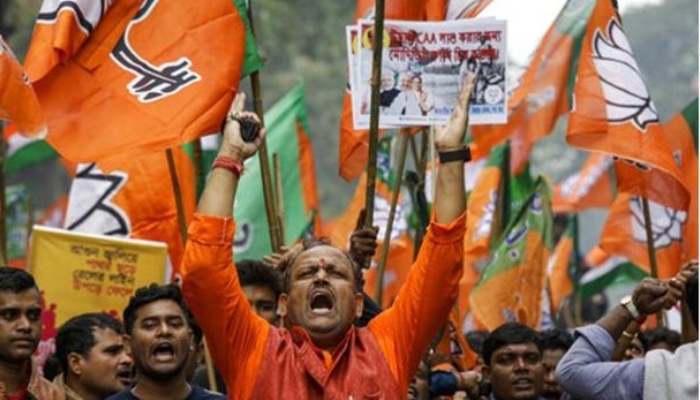
The angry and aggressive Hindu: 'Abb Hindu ko Gussa kyun atta hai?'
Nehru was eager to reform Hindu society but chose not to touch Muslim Personal Law, leaving it under the control of conservative clerics whom he could not control
NewsBharati 03-Jun-2026 16:23:58 PM
Total Views |


Pehle sathth saal ki- yaad karo kurbani
We got freedom on 15th August 1947 at the stroke of midnight, that is, the night of 14th August and the morning of 15th. Indian astrologers calculated that between 11:51 PM and 12:15 AM, a highly favourable window opened up under the Abhijit Muhurta and the Taurus (Vrishabha) Lagna, a fixed zodiac sign symbolizing stability, which they believed would help the new democracy survive.
Auspicious or not, our democracy was hijacked as the new government took charge under the leadership of Pandit Nehru. He wanted to rule till eternity. It appears that he learnt the formula of ‘divide and rule’ very well from our erstwhile rulers- the Brits.
The critical view of analysts
Many political analysts and historians therefore place the actual birth of systematic electoral appeasement in the decades following 1947. In this view, Congress transitioned from an umbrella nationalist movement to a political party that relied heavily on a "vote-bank" strategy—combining minority groups and specific caste coalitions.
Critics argue that Nehru was eager to reform Hindu society (passing the Hindu Code Bills in the 1950s to reform marriage, succession, and adoption laws) but chose not to touch Muslim Personal Law, leaving it under the control of conservative clerics whom he could not control. Critics claim this double standard was the true starting point of political appeasement. Gandhi was hell-bent on giving Rs 50 Crore to Pakistan, and we did. Today we stand at 78 years of Independence. Out of these, 55 years were under the Congress government that ruled India.
A young nation, with millions coming from across the ill-defined borders, was very much pliant and mouldable, who looked up to Nehru and his party as saviours of India- God-like. They would have worshipped anyone else in his position, which was an exalted position. Therefore, everything was named after Nehru or Gandhi- later, cloned ones too. Hospitals, stadiums, airports, roads, schemes, Planetariums, Jawaharlal Nehru University, colleges, National Memorials, National Projects et al. Bal Bhawan, Children’s Day as 14th November. No one had the guts or gumption or even a thought about opposing it. ‘Baap ka Raaj thaa’. They occupied the best of properties in Lutyens Delhi. ‘chchaa gaye boss’.
Ek bana Chacha doosra bangaya Bapu.
The nation moves nevertheless
Aam admi- the common man was struggling to make both ends meet- ‘Roti, Kapda aur makan’ were the quintessential for survival of a family. The whole nation was surviving like being on daily wages.
The song ‘jo mill gaya usi ko mukkadar samajh liya’ a song sung by Mohammad Rafi was apt for an average Indian. Where was the time to understand the political chessboard of divide and rule? And the nation was fed on the song ‘hummlaye hain toofan sey kishtee nikalke…’ and this was enough for people to put full faith in the Congress-led government under Nehru. Therefore, the government of the day had almost a free run. Some argue that Indians were kept poor on purpose. So that they had no time to think about this manipulation. We were kept deprived with quota raj- we had only two cars, Fiat and Ambassador, for donkey’s years. People went to Singapore to buy frying pans till the late seventies. Nehru positioned Business houses as looters; making money was a taboo.
_202606031629211580_H@@IGHT_400_W@@IDTH_700.jpg "Hindu voters angry")
Things were pushed too hard for too long
Not anymore. ‘Aapka keemti vote app ka sanjivani vote hai’. Hindu has to now vote for his survival.
Appeasement was pushed with a bulldozer spirit, and there was no opposition political or otherwise to check it. Congress created a massive water-tight vote bank, like a federal bank- which voted together- no questions asked. Obviously, no one will let go of this golden goose, and this fitted very well with the democratic values that the nation was born with. Sikhs were less than 2% of the population, and even today Christians are just 2.4%, and these hardly mattered. Therefore, in a way, Hindus were marginalised in their own homeland. With polygamy enshrined and unshakable, the government knew that the Muslim population would grow organically- which was a no-brainer.
The winds of change
We got independence in 1947, and we got TV in the mid-sixties. Daily transmission began in 1965 as a part of Akashvani (formerly All India Radio AIR). Television service was later extended to Mumbai (formerly Bombay) and Amritsar in 1972. Up until 1975, only seven Indian cities had television services. Narrative entirely controlled by the government. As the nation progressed and people got access to unfiltered information through private TV Channels, it was no longer possible to hide behind this cloak of ‘good boy image’. The social media revolution changed the landscape of information totally.
Yet the politicians kept pushing the same old narrative, and in 2014 the Congress was finally pushed back, and even Sadguru said, ‘Today an Indian is ruling India’. There was a push by the government to liberate Kashmir, and Hindu ‘Astha’ got traction through temples and Melas. New generations were told about our history and culture, and today youth is hungry to know how we got freedom, which was kept as a fiefdom of a few.
A population of 100 Crore Hindus was shaken out of seventy years of slumber as if the cataract curtain was cracked and we got a new vision. Oh my God; we never knew this, was the exclamation. Podcast was the new phenomenon on the horizon, and it caught the imagination of the people. Several ‘nation-first type’ programs popped up, which was a quantum leap from two-dimensional news to three-sixty-degree, three-dimensional opinion exchange in real time.
Obviously, when you get to know the truth, you are bound to get angry. Hindus got enlightened and angry- the ultimate cocktail. It is the second "Tryst with destiny" for Bharat- as Hindu has learnt a hard lesson the hard way.
We got freedom on 15th August 1947 at the stroke of midnight, that is, the night of 14th August and the morning of 15th. Indian astrologers calculated that between 11:51 PM and 12:15 AM, a highly favourable window opened up under the Abhijit Muhurta and the Taurus (Vrishabha) Lagna, a fixed zodiac sign symbolizing stability, which they believed would help the new democracy survive.
Auspicious or not, our democracy was hijacked as the new government took charge under the leadership of Pandit Nehru. He wanted to rule till eternity. It appears that he learnt the formula of ‘divide and rule’ very well from our erstwhile rulers- the Brits.
It was as if by design, Nehru put this in ‘double quick time mode’ from day one. He realised that the ‘leftover of Muslims’ after partition- which was sizeable even then- could be exploited against Hindus who were, as such, divided because of the caste system. You must grant him the wisdom of understanding these finer nuances- which his legacy carried further.
The critical view of analysts
Many political analysts and historians therefore place the actual birth of systematic electoral appeasement in the decades following 1947. In this view, Congress transitioned from an umbrella nationalist movement to a political party that relied heavily on a "vote-bank" strategy—combining minority groups and specific caste coalitions.
Critics argue that Nehru was eager to reform Hindu society (passing the Hindu Code Bills in the 1950s to reform marriage, succession, and adoption laws) but chose not to touch Muslim Personal Law, leaving it under the control of conservative clerics whom he could not control. Critics claim this double standard was the true starting point of political appeasement. Gandhi was hell-bent on giving Rs 50 Crore to Pakistan, and we did. Today we stand at 78 years of Independence. Out of these, 55 years were under the Congress government that ruled India.
Since the time of the Partition of the country, millions of Hindus and Sikhs left their entire life savings and were forced to make a ‘choice of survival’ to cross over to India. ‘Marta kya na Karta’ was the situation, and the entire one generation toiled hard to make a little place for themselves- they were too dazzled to even understand what divisive politics was, and so was the rest of the newly born nation, which was busy celebrating freedom.
ALSO READ: Scheme for women, Scam by men: 173 men, including illegal infiltrators take benefit of Laskhmir Bhandar, details
A young nation, with millions coming from across the ill-defined borders, was very much pliant and mouldable, who looked up to Nehru and his party as saviours of India- God-like. They would have worshipped anyone else in his position, which was an exalted position. Therefore, everything was named after Nehru or Gandhi- later, cloned ones too. Hospitals, stadiums, airports, roads, schemes, Planetariums, Jawaharlal Nehru University, colleges, National Memorials, National Projects et al. Bal Bhawan, Children’s Day as 14th November. No one had the guts or gumption or even a thought about opposing it. ‘Baap ka Raaj thaa’. They occupied the best of properties in Lutyens Delhi. ‘chchaa gaye boss’.
Ek bana Chacha doosra bangaya Bapu.
The nation moves nevertheless
Aam admi- the common man was struggling to make both ends meet- ‘Roti, Kapda aur makan’ were the quintessential for survival of a family. The whole nation was surviving like being on daily wages.
The song ‘jo mill gaya usi ko mukkadar samajh liya’ a song sung by Mohammad Rafi was apt for an average Indian. Where was the time to understand the political chessboard of divide and rule? And the nation was fed on the song ‘hummlaye hain toofan sey kishtee nikalke…’ and this was enough for people to put full faith in the Congress-led government under Nehru. Therefore, the government of the day had almost a free run. Some argue that Indians were kept poor on purpose. So that they had no time to think about this manipulation. We were kept deprived with quota raj- we had only two cars, Fiat and Ambassador, for donkey’s years. People went to Singapore to buy frying pans till the late seventies. Nehru positioned Business houses as looters; making money was a taboo.
With all this, how could a Hindu think about his ‘wajood’ (existence, being, or presence)
Things were pushed too hard for too long
Not anymore. ‘Aapka keemti vote app ka sanjivani vote hai’. Hindu has to now vote for his survival.
Appeasement was pushed with a bulldozer spirit, and there was no opposition political or otherwise to check it. Congress created a massive water-tight vote bank, like a federal bank- which voted together- no questions asked. Obviously, no one will let go of this golden goose, and this fitted very well with the democratic values that the nation was born with. Sikhs were less than 2% of the population, and even today Christians are just 2.4%, and these hardly mattered. Therefore, in a way, Hindus were marginalised in their own homeland. With polygamy enshrined and unshakable, the government knew that the Muslim population would grow organically- which was a no-brainer.
Under the garb of ‘love all, accommodate all and world is one family, we need to embrace people of all faiths, colours etc.’ Hindus sat on the high horse of morality, justice and preached each other of good conduct- even if some people are bad, you can’t behave like them; we have to be tolerant else what is the difference between them and us? Was a question good Hindus would throw at each other like passing the parcel. Hindus fooled Hindus for far too long. The political system of power through the ballot was conducive to this mass mental manipulation by the politicians, and a citizen could do nothing about it.
We got independence in 1947, and we got TV in the mid-sixties. Daily transmission began in 1965 as a part of Akashvani (formerly All India Radio AIR). Television service was later extended to Mumbai (formerly Bombay) and Amritsar in 1972. Up until 1975, only seven Indian cities had television services. Narrative entirely controlled by the government. As the nation progressed and people got access to unfiltered information through private TV Channels, it was no longer possible to hide behind this cloak of ‘good boy image’. The social media revolution changed the landscape of information totally.
Yet the politicians kept pushing the same old narrative, and in 2014 the Congress was finally pushed back, and even Sadguru said, ‘Today an Indian is ruling India’. There was a push by the government to liberate Kashmir, and Hindu ‘Astha’ got traction through temples and Melas. New generations were told about our history and culture, and today youth is hungry to know how we got freedom, which was kept as a fiefdom of a few.
A population of 100 Crore Hindus was shaken out of seventy years of slumber as if the cataract curtain was cracked and we got a new vision. Oh my God; we never knew this, was the exclamation. Podcast was the new phenomenon on the horizon, and it caught the imagination of the people. Several ‘nation-first type’ programs popped up, which was a quantum leap from two-dimensional news to three-sixty-degree, three-dimensional opinion exchange in real time.
Obviously, when you get to know the truth, you are bound to get angry. Hindus got enlightened and angry- the ultimate cocktail. It is the second "Tryst with destiny" for Bharat- as Hindu has learnt a hard lesson the hard way.
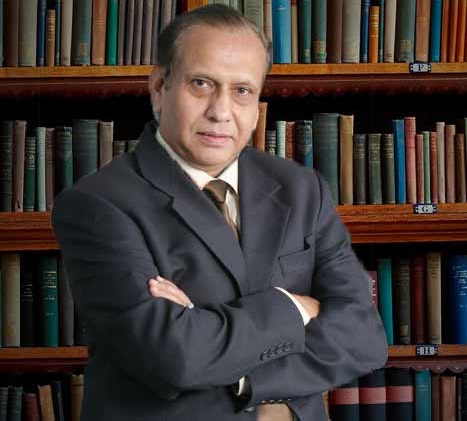
Virender Kapoor
A thinker, educationist and an inspirational guru. Kapoor is an Indian who wears many hats. An educationist of repute, he was the Director of a prestigious management Institute under the Symbiosis umbrella. He has emerged as a leading think tank in human behavior, motivation and success. As a celebrity author, his name appears with the likes of Thomas Friedman and Dale Carnegie. He has authored more than 30 books as of now which are on Amazon worldwide and several of his books are in the pipeline.