Maa Behen: Talks misogyny, without uttering it; signifies feminism, without promoting it
Three women. Three different ways society has decided to punish them for existing on their own terms
NewsBharati 08-Jun-2026 14:09:34 PM
Total Views |


Let's be upfront about something. The first half of Maa Behen will make you uncomfortable. Not because it's poorly made, but because it dares to show women unapologetically taking up space. Madhuri Dixit's Rekha walks into a room in a sleeveless blouse and owns every inch of it. Triptii Dimri's Jaya is loud, unfiltered, and thoroughly done with performing propriety for people who've already made up their minds about her. And Dharna Durga's Sushma drifts through the chaos with the kind of carefree energy that 'polite society always mistakes for recklessness'. If you squirm watching them, Good. That discomfort is the point. And the film knows it. Definitely.
Director Suresh Triveni doesn't spell anything out in neon letters. Maa Behen is not a lecture. It doesn't sit you down and explain misogyny to you with charts and citations. It simply shows you what it looks like when women refuse to shrink, and then shows you exactly what the world does to those women in return.
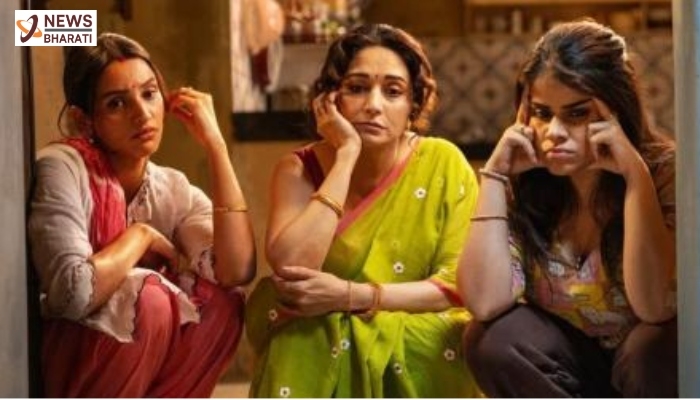


Three women. Three different ways society has decided to punish them for existing on their own terms.
But here is what makes Maa Behen more than just a well-meaning feminist film, it is a slap across the face of everyone sitting in quiet guilt. It is the one that talks about misogyny, without even talking about it, and it is the one that signifies feminism without even promoting it.
The men who did what Gupta Ji did and told themselves it was the woman's fault for being so, what's the word they always use? Available.
The families who treated a daughter-in-law like a malfunctioning appliance and slept fine at night.
The neighbours who built entire moral reputations on the backs of women they envied, or desired, or simply could not control.
Madhuri Dixit is extraordinary here, effortlessly charismatic, and underneath that, quietly devastated in the moments that count. Triptii Dimri continues to prove she is one of the sharpest performers of her generation, bringing a rawness to Jaya that makes her impossible to look away from. And Dharna Durga is a genuine revelation; she gives Sushma layers that the script perhaps doesn't fully map out, but that she finds anyway.
Maa Behen is not a perfect film. But it is a necessary one. It disguises its sharpest edges in chaos and dark comedy, then cuts you when you're not looking, which, when you think about it, is exactly how misogyny works too.
Watch it. And maybe while you do, ask yourself where your discomfort is actually coming from.
Maa Behen is now streaming on Netflix.
Director Suresh Triveni doesn't spell anything out in neon letters. Maa Behen is not a lecture. It doesn't sit you down and explain misogyny to you with charts and citations. It simply shows you what it looks like when women refuse to shrink, and then shows you exactly what the world does to those women in return.
Because the second half strips everything back.
Madhuri's Rekha has been widowed young, raising daughters in a colony that has decided, collectively, enthusiastically, that a woman who dresses well and lives alone must be a woman of questionable character. Enter Gupta Ji, a man who spent years publicly shaming Rekha, calling out her necklines and her independence from across the street, performing moral outrage for the neighbours. And yet, it is this same Gupta Ji who enters her home uninvited, crosses every boundary she has, and proves, without the film having to say a word, that his condemnation was never about her character. It was about his own. He wanted something he couldn't have, so he built a reputation around her to punish her for it. The film does not excuse this. Not for a second.
Then there's Jaya, Triptii Dimri's character, whose marriage is a study in quiet cruelty. Her husband Manas and his family treat her fertility as a personal failing, a defect to be managed and whispered about. The fact that the medical issue lies with him is almost irrelevant to them, because the story was already written. In their world, when something goes wrong in a marriage, the woman accounts for it. Jaya's body, her choices, her presence in her own home, all of it is up for family debate. The film doesn't ask you to feel sorry for Manas. It doesn't give him a redemption arc to soften the edges. What he and his family do is what they do, and Maa Behen leaves it sitting there for you to look at.
I've always loved Tripti dimri but watching her in Maa behen just made me realise how deeply artistic she if for her craft to literally overshadow Madhuri Dixit, while Alia Bhatt told karan johar to cut Madhuri Dixit scenes with her in kalank so she gets all the spotlight pic.twitter.com/YPdTeCK69m
— ~Ravi 🦭 (@sunrahahnatu) June 7, 2026
Next in line, there's Sushma, perhaps the quietest indictment of all. Dharna Durga, the social media fame, plays her with a kind of brightness that hides something hollow underneath. Sushma's loneliness is not dramatic. It doesn't announce itself. It's the loneliness of someone who learned early that being the fun one, the easygoing one, the one nobody worries about, is simply another way of being invisible. Nobody asks Sushma if she's okay because she's always performing okay. The film lets that loneliness breathe without resolving it neatly.
Three women. Three different ways society has decided to punish them for existing on their own terms.
But here is what makes Maa Behen more than just a well-meaning feminist film, it is a slap across the face of everyone sitting in quiet guilt. It is the one that talks about misogyny, without even talking about it, and it is the one that signifies feminism without even promoting it.
The men who did what Gupta Ji did and told themselves it was the woman's fault for being so, what's the word they always use? Available.
The families who treated a daughter-in-law like a malfunctioning appliance and slept fine at night.
The neighbours who built entire moral reputations on the backs of women they envied, or desired, or simply could not control.
This film looks all of them in the eye. It does not offer the comfort of a societal excuse. Society didn't do it. You did it. And you've been hiding behind "log kya kahenge" long enough.
Madhuri Dixit is extraordinary here, effortlessly charismatic, and underneath that, quietly devastated in the moments that count. Triptii Dimri continues to prove she is one of the sharpest performers of her generation, bringing a rawness to Jaya that makes her impossible to look away from. And Dharna Durga is a genuine revelation; she gives Sushma layers that the script perhaps doesn't fully map out, but that she finds anyway.
Maa Behen is not a perfect film. But it is a necessary one. It disguises its sharpest edges in chaos and dark comedy, then cuts you when you're not looking, which, when you think about it, is exactly how misogyny works too.
Watch it. And maybe while you do, ask yourself where your discomfort is actually coming from.
Maa Behen is now streaming on Netflix.

Siddhi Somani
Siddhi Somani is known for her satirical and factual hand in Economic, Social and Political writing. Having completed her post graduation in Journalism, she is currently engaged in completing her Masters in Politics. The author meanwhile is also exploring her hand in analytics and statistics.