Reconsidering the Legacy of Francis Xavier: The History of how Christian missionaries first landed in India
NewsBharati 09-Jun-2026 11:41:25 AM
Total Views |


In the cultural and spiritual landscape of Goa, few figures occupy as prominent a place as Francis Xavier. For many, he is Goencho Saib, a protector, a saint, and a symbol of enduring faith whose relics continue to draw lakhs of devotees. This image, sustained through centuries of devotion and collective memory, carries deep meaning and deserves to be acknowledged with sensitivity and respect.
Yet, as with all historical figures who acquire both religious and public significance, Xavier’s legacy also invites a wider conversation, one that distinguishes between faith-based reverence and historically grounded understanding. This distinction becomes particularly relevant when such figures transcend the boundaries of a single community and acquire a broader cultural, and at times state-recognised, stature.
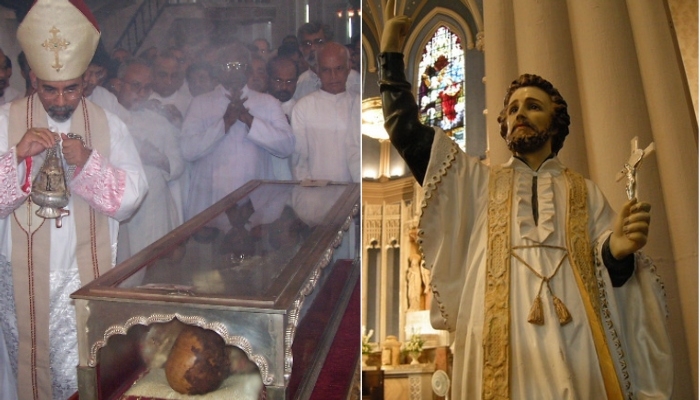
A Figure of Faith and of History
Francis Xavier arrived in India in 1542, not merely as an individual missionary but as part of a larger institutional framework. His mission was authorised by the Papacy and facilitated by the Portuguese Crown, under a system where religious and political authority were closely aligned. This was not incidental; it was intrinsic to the functioning of early modern European expansion.
These writings are not merely incidental details. They provide insight into the intellectual and theological climate of the time, one in which plurality was often viewed not as a value to be preserved, but as a condition to be corrected.
Institutional Religion and Cultural Transformation
The implications of this worldview extended beyond individual conversion. Over time, they became embedded in institutional structures that shaped everyday life. Policies introduced in subsequent decades affected language, dress, domestic practices, and modes of worship within Goa. Scholars such as A. K. Priolkar and Teotonio R. de Souza have documented how these processes contributed to significant cultural transformations.
Equally telling is the pattern of migration associated with this period. Communities of Goan origin today reside across Karnataka, Maharashtra, and parts of Kerala, many of whom continue to maintain ties to ancestral deities whose temples remain in Goa. While migration is a complex phenomenon with multiple causes, regional historiography generally recognises that changes in the socio-religious environment were among the factors that contributed to such movements.
_202606091215246952_H@@IGHT_400_W@@IDTH_700.jpg "Francis Xavier")
The Construction of a Sacred Image
If the historical record presents complexity, the enduring image of Xavier as a universally benevolent figure raises its own questions. How did this image take shape, and how has it been sustained?
Scholars such as Pamila Gupta have explored this through the idea of the “Relic State,” where religious symbols become intertwined with political authority and collective identity. Xavier’s canonisation in 1622 and the preservation of his remains contributed significantly to the development of a powerful devotional tradition. Over time, narratives of incorruptibility and miracles became central to his public persona.
Modern scholarship suggests that these narratives must also be understood within their historical context. The preservation of Xavier’s body has been linked to environmental conditions and subsequent conservation efforts. Accounts of miracles, whether involving healing, protection, or symbolic events, are often interpreted by historians as part of a wider tradition of devotional storytelling that accompanied the spread of institutional religion.
For believers, these narratives hold spiritual meaning. For historians, they offer insight into how sanctity is constructed and sustained over time.
A Comparative Perspective
In contrast, in Japan, where he operated without the backing of colonial authority, his approach was markedly different. There, conversion required sustained dialogue, cultural adaptation, and engagement with local intellectual traditions. The pace was slower, and the outcomes more limited.
This contrast is instructive. It does not diminish Xavier’s commitment, but it highlights the role of context. Where institutional support and political backing existed, missionary activity could proceed with speed and scale; where it did not, it relied on persuasion and negotiation.
Faith, Power, and Historical Context
It is important to recognise that the world in which Francis Xavier lived was fundamentally different from our own. The idea of religious freedom as it is understood today had not yet taken institutional form within European thought, and missionary activity was often framed as a universal religious obligation.
However, this framework stood in clear contrast to many indigenous traditions across India and other parts of Asia, where religious practice was typically non-proselytising and plural in orientation. In the Indian context, particularly within Hindu philosophical traditions, the emphasis historically lay on coexistence rather than conversion. The encounter between these differing approaches was therefore not one of equivalence. A pronounced asymmetry of intent, resources, and institutional backing shaped it. In regions such as Goa, where missionary activity operated alongside and was supported by Portuguese political authority, this imbalance became even more pronounced.
_202606091215507265_H@@IGHT_400_W@@IDTH_700.jpg "Francis Xavier")
Modern Ethical and Constitutional Perspective
Modern India is founded on principles very different from those that shaped the early modern world. The Constitution guarantees freedom of religion, respect for diversity, and protection of cultural identity. These values are also reflected in contemporary Catholic teaching. The Second Vatican Council’s declaration Dignitatis Humanae (1965) affirms that no individual should be compelled to act against their beliefs, marking a clear departure from earlier theological positions.
This evolution is significant. It reflects an acknowledgment, within the Church itself, that earlier approaches to evangelisation must be understood in context, and that present-day engagement must be rooted in dignity, freedom, and dialogue.
Why This Conversation Matters
In a society as diverse as India, public discourse benefits from a careful and balanced engagement with history. This is particularly important when historical figures become part of shared cultural narratives beyond their original religious context.
For the wider public, this discussion serves as a reminder that historical figures are rarely one-dimensional. They are shaped by the ideas, institutions, and power structures of their time.
Toward a More Nuanced Understanding
To revisit the legacy of Francis Xavier, therefore, is not to question devotion, but to expand understanding. It is to recognise that alongside the image of the saint stands the figure of a missionary operating within a powerful institutional and political framework.
Such an approach does not diminish history; it restores its depth. It allows us to appreciate both the spiritual significance of Xavier for many believers and the historical realities of his work.
Conclusion
A mature society does not shy away from examining its past. It engages with it thoughtfully, balancing respect for belief with a commitment to truth. Francis Xavier remains an important figure in India’s cultural and religious history, but like all such figures, he must be understood in his entirety.
For those guided by faith, his legacy will continue to inspire. For those guided by historical reasoning, it offers a more complex narrative, one that reflects the interplay of religion, power, and society in a formative period of India’s past.
Between these perspectives lies the possibility of meaningful dialogue, a space where faith is respected, history is examined, and understanding is allowed to grow. To engage honestly with history is not to diminish faith; it is to deepen our understanding of both.
Yet, as with all historical figures who acquire both religious and public significance, Xavier’s legacy also invites a wider conversation, one that distinguishes between faith-based reverence and historically grounded understanding. This distinction becomes particularly relevant when such figures transcend the boundaries of a single community and acquire a broader cultural, and at times state-recognised, stature.
The purpose of such reflection is not to diminish belief, but to deepen understanding.
A Figure of Faith and of History
Francis Xavier arrived in India in 1542, not merely as an individual missionary but as part of a larger institutional framework. His mission was authorised by the Papacy and facilitated by the Portuguese Crown, under a system where religious and political authority were closely aligned. This was not incidental; it was intrinsic to the functioning of early modern European expansion.
Historical records, including Xavier’s own letters, reveal a missionary deeply committed to his faith, but also operating within a worldview that prioritised religious uniformity. In his correspondence with King John III of Portugal, he urged stronger mechanisms to ensure adherence to Christian doctrine, expressing concern about those who continued to practise earlier traditions after conversion.
ALSO READ: ‘Making children hate Hindu dharma’: Chhattisgarh Govt school headmistress suspended after probe into conversion activities
These writings are not merely incidental details. They provide insight into the intellectual and theological climate of the time, one in which plurality was often viewed not as a value to be preserved, but as a condition to be corrected.
Institutional Religion and Cultural Transformation
The implications of this worldview extended beyond individual conversion. Over time, they became embedded in institutional structures that shaped everyday life. Policies introduced in subsequent decades affected language, dress, domestic practices, and modes of worship within Goa. Scholars such as A. K. Priolkar and Teotonio R. de Souza have documented how these processes contributed to significant cultural transformations.
Equally telling is the pattern of migration associated with this period. Communities of Goan origin today reside across Karnataka, Maharashtra, and parts of Kerala, many of whom continue to maintain ties to ancestral deities whose temples remain in Goa. While migration is a complex phenomenon with multiple causes, regional historiography generally recognises that changes in the socio-religious environment were among the factors that contributed to such movements.
These developments cannot be attributed to Xavier alone. However, they form part of a broader historical trajectory within which his mission was situated, a trajectory in which religious change often intersected with cultural and social reconfiguration.
The Construction of a Sacred Image
If the historical record presents complexity, the enduring image of Xavier as a universally benevolent figure raises its own questions. How did this image take shape, and how has it been sustained?
Scholars such as Pamila Gupta have explored this through the idea of the “Relic State,” where religious symbols become intertwined with political authority and collective identity. Xavier’s canonisation in 1622 and the preservation of his remains contributed significantly to the development of a powerful devotional tradition. Over time, narratives of incorruptibility and miracles became central to his public persona.
Modern scholarship suggests that these narratives must also be understood within their historical context. The preservation of Xavier’s body has been linked to environmental conditions and subsequent conservation efforts. Accounts of miracles, whether involving healing, protection, or symbolic events, are often interpreted by historians as part of a wider tradition of devotional storytelling that accompanied the spread of institutional religion.
For believers, these narratives hold spiritual meaning. For historians, they offer insight into how sanctity is constructed and sustained over time.
A Comparative Perspective
An important dimension of Xavier’s work emerges when we compare his missionary experience across regions. In India, particularly in areas under Portuguese influence, conversions were often rapid and on a large scale. Xavier himself wrote of baptising entire communities within short spans of time.
In contrast, in Japan, where he operated without the backing of colonial authority, his approach was markedly different. There, conversion required sustained dialogue, cultural adaptation, and engagement with local intellectual traditions. The pace was slower, and the outcomes more limited.
This contrast is instructive. It does not diminish Xavier’s commitment, but it highlights the role of context. Where institutional support and political backing existed, missionary activity could proceed with speed and scale; where it did not, it relied on persuasion and negotiation.
Faith, Power, and Historical Context
It is important to recognise that the world in which Francis Xavier lived was fundamentally different from our own. The idea of religious freedom as it is understood today had not yet taken institutional form within European thought, and missionary activity was often framed as a universal religious obligation.
However, this framework stood in clear contrast to many indigenous traditions across India and other parts of Asia, where religious practice was typically non-proselytising and plural in orientation. In the Indian context, particularly within Hindu philosophical traditions, the emphasis historically lay on coexistence rather than conversion. The encounter between these differing approaches was therefore not one of equivalence. A pronounced asymmetry of intent, resources, and institutional backing shaped it. In regions such as Goa, where missionary activity operated alongside and was supported by Portuguese political authority, this imbalance became even more pronounced.
The alignment of religious mission with state power created conditions in which the spread of faith was not merely a matter of individual conviction, but was significantly influenced by structural advantage. Recognising this asymmetry is essential to understanding the historical reality, not as a neutral meeting of traditions, but as a complex and often unequal interaction between differing worldviews.
Modern Ethical and Constitutional Perspective
Modern India is founded on principles very different from those that shaped the early modern world. The Constitution guarantees freedom of religion, respect for diversity, and protection of cultural identity. These values are also reflected in contemporary Catholic teaching. The Second Vatican Council’s declaration Dignitatis Humanae (1965) affirms that no individual should be compelled to act against their beliefs, marking a clear departure from earlier theological positions.
This evolution is significant. It reflects an acknowledgment, within the Church itself, that earlier approaches to evangelisation must be understood in context, and that present-day engagement must be rooted in dignity, freedom, and dialogue.
Why This Conversation Matters
In a society as diverse as India, public discourse benefits from a careful and balanced engagement with history. This is particularly important when historical figures become part of shared cultural narratives beyond their original religious context.
For members of the Christian and Catholic community, such reflection need not be seen as a challenge to faith. Faith remains a deeply personal and enduring aspect of identity. At the same time, engaging with historical complexity can strengthen that faith by situating it within a broader and more nuanced understanding.
For the wider public, this discussion serves as a reminder that historical figures are rarely one-dimensional. They are shaped by the ideas, institutions, and power structures of their time.
Toward a More Nuanced Understanding
To revisit the legacy of Francis Xavier, therefore, is not to question devotion, but to expand understanding. It is to recognise that alongside the image of the saint stands the figure of a missionary operating within a powerful institutional and political framework.
Such an approach does not diminish history; it restores its depth. It allows us to appreciate both the spiritual significance of Xavier for many believers and the historical realities of his work.
Conclusion
A mature society does not shy away from examining its past. It engages with it thoughtfully, balancing respect for belief with a commitment to truth. Francis Xavier remains an important figure in India’s cultural and religious history, but like all such figures, he must be understood in his entirety.
For those guided by faith, his legacy will continue to inspire. For those guided by historical reasoning, it offers a more complex narrative, one that reflects the interplay of religion, power, and society in a formative period of India’s past.
Between these perspectives lies the possibility of meaningful dialogue, a space where faith is respected, history is examined, and understanding is allowed to grow. To engage honestly with history is not to diminish faith; it is to deepen our understanding of both.

Abhimanyu Bharti
Abhimanyu Bharti