Hate in the Halls of Learning: America's Campus Antisemitism Reckoning
Sharp Increase in Antisemitic Incidents on America"s Prestigious Campuses Ignites National Debate on Free Speech
Total Views |


Something has gone badly wrong on America's most vibrant and globally renowned campuses and the numbers make it hard to look away. The Anti-Defamation League (ADL), which has tracked anti-Jewish incidents since 1979, recorded 1,694 such incidents on college campuses in 2024, an 84 percent jump from the year before and nearly one in five of all antisemitic incidents in the country. Across the United States, the ADL counted 9,354 incidents in 2024, the highest total in the four decades it has kept records.
The moment that crystallised public anger came on December 5, 2023. Before the House Education and the Workforce Committee, the presidents of Harvard, the University of Pennsylvania and MIT were asked a plain question by Congresswoman Elise Stefanik: does calling for the genocide of Jews violate your university's code of conduct? Instead of a clear "yes," Harvard's Claudine Gay and Penn's Liz Magill answered that it "depends on the context." The exchange became, by the committee's account, the most-watched congressional testimony in history, with over a billion views. Within days, Magill resigned, Gay stepped down in January 2024 amid separate plagiarism findings.
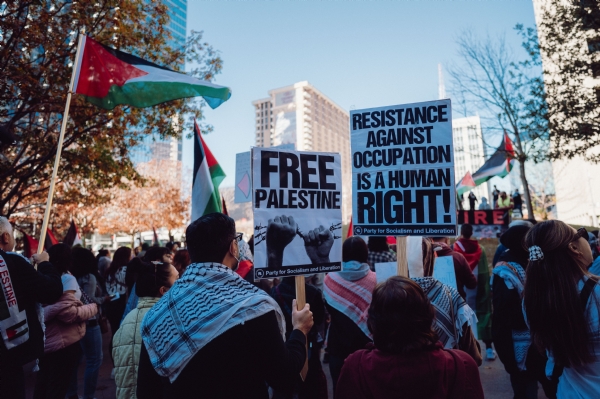
The reckoning did not stop there. In April 2024, Columbia's then-president Nemat Shafik faced the same committee as her campus became, in the ADL's words, the epicentre of campus antisemitism during that spring's protest encampments, where Jewish students reported being harassed and blocked from parts of their own campus.
Much of the friction turns on slogans that their defenders call political free speech and their critics call something darker. During the December hearing, Stefanik pressed Gay on students chanting "from the river to the sea" and "intifada," arguing the latter amounts to a call for genocide against Jews. The ADL classifies "from the river to the sea, Palestine will be free" as antisemitic and genocidal and for the first time a majority of 2024 incidents almost 58 percent were tied to Israel or Zionism. At protests, the ADL documented demonstrators waving flags of US-designated terrorist groups and celebrating the October 7 attacks as "resistance."
Congress has kept the pressure on. A House committee investigation covering eleven universities from Harvard and Columbia to Berkeley and UCLA concluded that schools had largely failed to discipline students and faculty involved in antisemitic conduct. The scrutiny appears to have moved the needle. The ADL reports that antisemitic incidents on campuses fell sharply in 2025 as encampments wound down, though levels remained roughly three times higher than in 2021.
Someone in India would ask how this affects India or Indians. Lets remember a lot of Indian students study in such campuses. We have already seen examples of radical and extremist thoughts and actions from so Indians, either in campuses or in the streets of the US. The famous Indian American Riddhi Patel, a student of STEM and not Social Sciences who threatened to “murder” the members of Bakersfield City Council where the council was meeting to discuss protests amidst the conflict in Gaza.
Another incident involving Indian couple Kurush Mistry and Shailja Gupta who were covering posters of kidnapped Israelis (especially children and women by Hamas Terrorists) with signs bearing the message, "Occupiers face consequences.” These are just a few instances of a larger problem. The US campuses and their academia on a whole, of which Indian students and citizens form a large part, have increasingly become a breeding ground for all kinds of extremist thoughts and ideology which should concern Indians back home. Especially to keep an eye on their children studying in western universities. Nobody would have imagined till some decades ago, that the US campuses today would sound and feel like 1930’s Nazi Germany.
For observers in India, none of this is entirely unfamiliar. India has long argued, in international forums and at home, that open democracies must draw a firm line between legitimate dissent and the glorification of extremism and that campuses and civil-society spaces can be exploited to launder hatred under the banner of activism. The American experience is now testing whether elite institutions built on the ideal of free inquiry can protect one group of students without abandoning that ideal for everyone else. The data suggests the question is far from settled.