Land Jihad at Kolkata Airport
NewsBharati 14-Jul-2026 14:37:48 PM
Total Views |


The controversy surrounding the mosque near the runway of Kolkata's Netaji Subhas Chandra Bose International Airport is religious in nature. It is about the authority of the Indian State. Can strategic national infrastructure be held hostage because governments used to have no political will to enforce the law? Can aviation safety be compromised in the name of religious sensitivity? These are uncomfortable questions, but they can no longer be avoided.
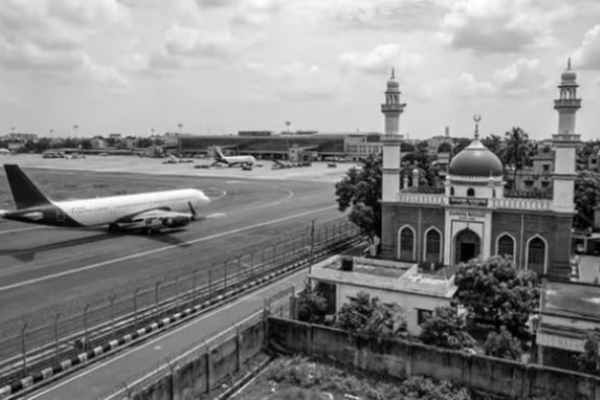 Airports are among the most sensitive strategic installations in any country. They are governed by some of the strictest security protocols in the world. Every inch of land adjoining a runway is regulated. Construction around airports is subject to restrictions on height, land use, access and other activities to ensure the safety of aircraft operations and the security of airport infrastructure. These restrictions exist because airports are potential targets for terrorism, sabotage, drone attacks and other security threats. No unauthorized structure can be permitted to dilute these safeguards. National security cannot become negotiable.
Kolkata Airport is the principal aviation gateway to eastern and northeastern India. It serves millions of passengers annually and occupies a vital place in India's civil aviation network. Expansion has become inevitable with growing passenger traffic. The obvious question therefore is: why did successive governments fail to resolve this issue decades ago? The airport has undergone repeated modernization and expansion. Governments changed. Airport authorities changed. Political parties changed. But nobody displayed the courage to enforce the law. Administrative paralysis eventually became political appeasement.
An equally important question follows naturally. Had the structure been a temple, would governments have displayed the same hesitation? The answer is obvious but the perception among a large section of society is unmistakable that governments apply different standards depending upon the religious identity of the encroachment. Nothing erodes public confidence more rapidly than selective enforcement of the law.
The politics of appeasement has repeatedly converted administrative problems into national controversies. Instead of acting when an encroachment first appears, governments postpone action year after year. As time passes, the structure acquires emotional, political and religious protection. Every subsequent government becomes more reluctant than its predecessor. Ultimately, the State begins negotiating with illegality instead of enforcing the law. That is neither secularism nor constitutional governance. It is administrative surrender.
The Kolkata controversy should therefore be viewed as part of a larger national problem. Across India, public infrastructure projects have been delayed because of unauthorized religious structures standing on railway land, highway corridors, government property and other public assets. Similar concerns have been raised regarding mosques and mazars near defence establishments, important roads, bridges and other strategically sensitive locations. Every such encroachment increases project costs, delays development and weakens public confidence in governance.
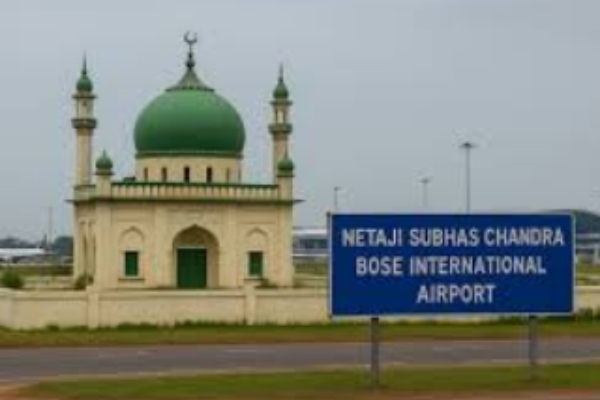
The guiding principle should be simple: public land belongs to the nation. No encroachment should acquire legitimacy merely because it has survived for decades or because political parties fear electoral consequences. The Constitution does not recognise adverse possession through religious sentiment.
Kolkata Airport must become the turning point. If governments continue postponing difficult decisions, similar controversies will surface across the country. Strategic infrastructure cannot remain hostage to vote-bank politics. National security demands consistency, courage and equal application of the law.
If the allegations of recurring pattern of "land jihad" - occupying public land and later insulating it behind religious sentiment, governments have both a constitutional and moral obligation to confront it decisively. A nationwide survey, legal verification of every religious structure on public land and the removal of unauthorized encroachments should become a national priority. Kolkata should not be remembered merely as another airport dispute. It should be remembered as the moment India finally reaffirmed that the rule of law is superior to every form of illegal occupation, irrespective of the identity of the encroacher.
The Kolkata episode has revived what many critics describe as "land jihad" a pattern in which public land is first occupied, legally or illegally, and subsequently converted into a mosque. Once the structure acquires religious significance, every attempt to remove it is resisted on humanitarian, historical or communal grounds. Gradually, the original question whether the land itself was ever lawfully occupied disappears from public discourse. What begins as an encroachment eventually becomes politically untouchable. The pattern deserves serious scrutiny because it concerns governance, not merely religion.
ALSO READ: Rahul Gandhi: A lapata LOP
An equally important question follows naturally. Had the structure been a temple, would governments have displayed the same hesitation? The answer is obvious but the perception among a large section of society is unmistakable that governments apply different standards depending upon the religious identity of the encroachment. Nothing erodes public confidence more rapidly than selective enforcement of the law.
The politics of appeasement has repeatedly converted administrative problems into national controversies. Instead of acting when an encroachment first appears, governments postpone action year after year. As time passes, the structure acquires emotional, political and religious protection. Every subsequent government becomes more reluctant than its predecessor. Ultimately, the State begins negotiating with illegality instead of enforcing the law. That is neither secularism nor constitutional governance. It is administrative surrender.
The Kolkata controversy should therefore be viewed as part of a larger national problem. Across India, public infrastructure projects have been delayed because of unauthorized religious structures standing on railway land, highway corridors, government property and other public assets. Similar concerns have been raised regarding mosques and mazars near defence establishments, important roads, bridges and other strategically sensitive locations. Every such encroachment increases project costs, delays development and weakens public confidence in governance.
Equally disturbing is the absence of reliable official data. India has no nationwide census of mosques. There is no comprehensive database identifying which mosques stand on privately owned land, which are registered under Waqf authorities, which possess municipal approvals and which comply with planning laws. Estimates suggest that India has between two and three lakh mosques, while only about 1.2 lakh are reflected in Waqf records. The gap itself demonstrates the urgent need for proper documentation. No responsible government can manage public land without first knowing its legal status.
The answer lies neither in selective demolition nor political rhetoric. It lies in uniform enforcement of the law. The Union and state governments should immediately undertake a nationwide survey of all religious structures located on public land, particularly those situated on airport premises, defence establishments, railway property, highways, forests, riverbanks and other strategic assets. Every structure must undergo legal verification. Ownership records, land titles, municipal permissions and planning approvals should be examined transparently. Wherever unauthorized occupation is established, the law must take its course without fear or favour.
Kolkata Airport must become the turning point. If governments continue postponing difficult decisions, similar controversies will surface across the country. Strategic infrastructure cannot remain hostage to vote-bank politics. National security demands consistency, courage and equal application of the law.
If the allegations of recurring pattern of "land jihad" - occupying public land and later insulating it behind religious sentiment, governments have both a constitutional and moral obligation to confront it decisively. A nationwide survey, legal verification of every religious structure on public land and the removal of unauthorized encroachments should become a national priority. Kolkata should not be remembered merely as another airport dispute. It should be remembered as the moment India finally reaffirmed that the rule of law is superior to every form of illegal occupation, irrespective of the identity of the encroacher.

Editor's Desk
Editor's Desk