Indian Railways set to launch first hydrogen fuel cell train
Total Views |


Mumbai, July16 : Indian Railways is set to launch India's first Hydrogen Fuel Cell Trainset, marking a major step towards clean and sustainable rail transport. The train generates its own electricity onboard using hydrogen fuel cells, producing only water vapour and heat as by-products, making it a near-zero emission mode of transport.
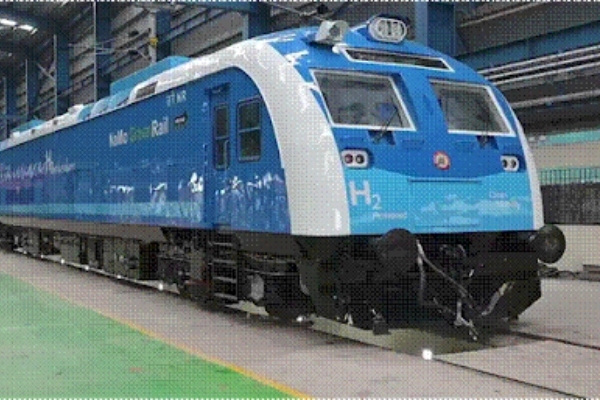
The launch follows Indian Railways' achievement of over 99% electrification of its Broad Gauge network, significantly reducing dependence on diesel. Unlike conventional electric trains that draw power from overhead lines, the hydrogen train generates electricity through a chemical reaction between hydrogen and oxygen inside a Proton Exchange Membrane (PEM) fuel cell.
The train has been designed as a 10-coach passenger train with a capacity of around 2,600 passengers, making it one of the largest hydrogen-powered passenger trainsets globally. It will initially operate on the 89-km Jind–Sonipat section of Northern Railway in Haryana. The train has an operational speed of 75 kmph and a design speed of 110 kmph. Each of its two driving power cars generates 1,200 kW (1,600 horsepower) of power.
ALSO READ: Maharashtra's new Political grammar is beyond Pawar
To support the project, Indian Railways has established India's largest railway hydrogen refuelling facility at Jind. The plant produces hydrogen through electrolysis, compresses it to 500 bar, and dispenses it at 350 bar. The facility can store nearly 3,000 kg of hydrogen, enough to support regular train operations.
India's First Hydrogen Fuel Cell Train Set to Redefine Sustainable Rail Mobility with Capacity of Around 2,600 Passengers
— PIB India (@PIB_India) July 16, 2026
The Smokeless Magic of Hydrogen Helps Build a Greener Indian Railways as It Powers the New-Era Train
With Multi-layer Safety Systems Detecting Hydrogen… pic.twitter.com/gpmrzZxRpm
Given hydrogen's highly flammable nature, the train and refuelling station are equipped with advanced safety systems, including hydrogen leak detectors, flame and smoke sensors, continuous ventilation and automatic hydrogen shut-off mechanisms. The project follows international safety standards such as NFPA-2 and the ISO 19880 Series, while also complying with the norms of the Petroleum and Explosives Safety Organisation (PESO). The complete hydrogen ecosystem was independently assessed by TÜV SÜD, Germany before operational clearance.