Who allowed a drone over Delhi's high-security red zone? CJP's 'Sansad Chalo' protest sparks serious security questions
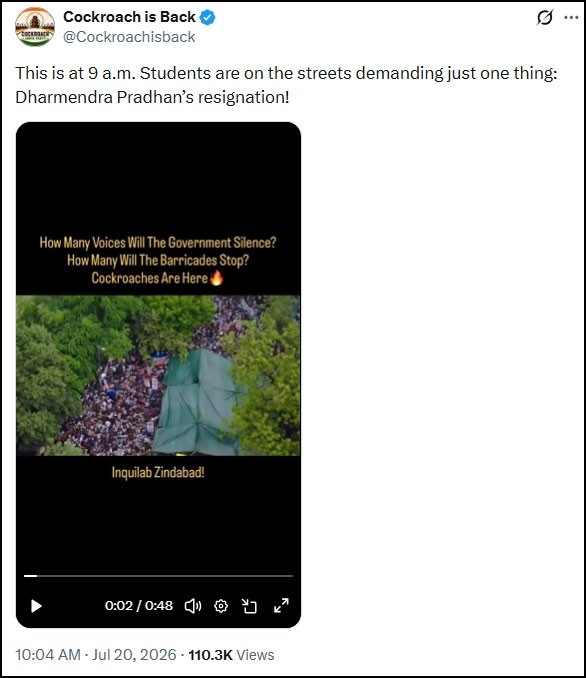
Drone footage released by the Cockroach Janta Party (CJP) from its "Sansad Chalo" protest at Delhi"s Jantar Mantar has triggered serious questions after it emerged that the venue falls within multiple no-drone red zones under the Government of India"s Digital Sky platform.
Total Views |


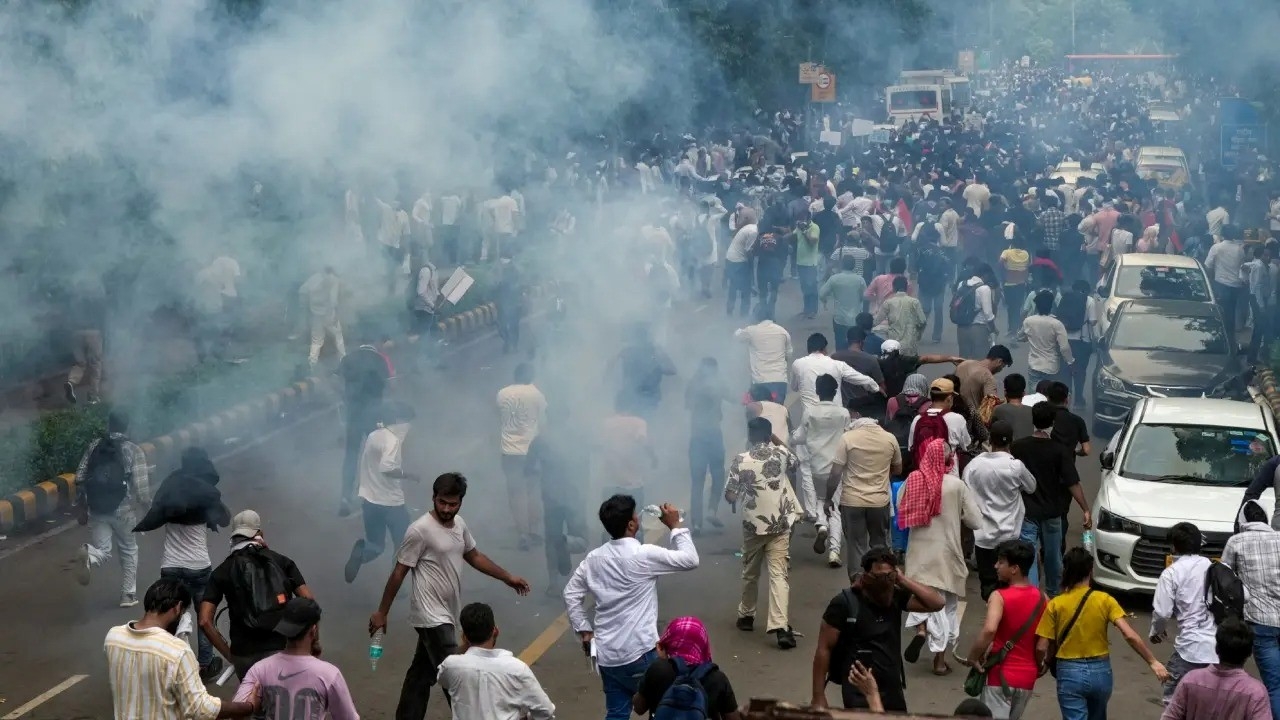
What was projected as a show of strength by the Cockroach Janta Party (CJP) through dramatic aerial visuals of its 'Sansad Chalo' protest has instead snowballed into a major controversy, with serious questions being raised over whether the organisation violated India's drone regulations by flying an unmanned aircraft inside one of Delhi's most heavily restricted airspaces.
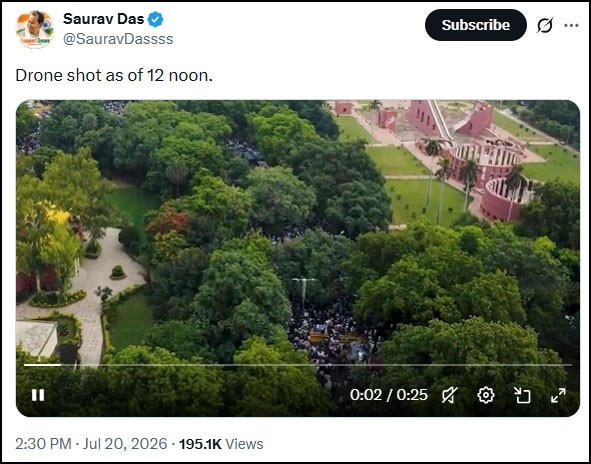
Several drone videos of the gathering at Jantar Mantar were shared throughout July 20 by CJP and its spokesperson Saurav Das. The footage, which was also circulated to national and international media organisations, showcased thousands of protesters assembled ahead of the party's planned march towards Parliament.
Curious. Since drones are prohibited in Delhi’s high security zones and doubly so when Parliament is in session, where did this drone video come from? Unless someone violated the law.@iamnarendranath was first to use this video. Perhaps he could tell us more? https://t.co/yt7mjWFW08
— Kanchan Gupta 🇮🇳 (@KanchanGupta) July 20, 2026
However, the aerial visuals have shifted the spotlight away from the protest itself and onto a far more serious issue: How was a drone allowed to fly over Jantar Mantar, a location that falls inside multiple red zones where drone operations are prohibited without prior permission from the Central Government?
The controversy is further compounded by the fact that Delhi Police had reportedly not granted permission for the protest itself. If organisers allegedly ignored one layer of legal requirements, questions are now being raised over whether they also bypassed India's stringent drone regulations.
Jantar Mantar lies inside a no-drone red zone
A review of the Government of India's Digital Sky airspace map shows that Jantar Mantar is located inside overlapping red zones. Under the Drone Rules, 2021, these are categorised as "No-Drone Zones", where civilian drone operations can take place only after obtaining explicit approval from the Central Government.
Unlike green zones, where drones can generally operate without prior permission, or yellow zones that require Air Traffic Control clearance, red zones represent the country's most sensitive airspace, covering strategic government buildings, Parliament precincts, security establishments and other protected locations.
If no prior approval was obtained, the drone flight over the protest could amount to a violation of India's drone regulations.

Questions CJP must answer
The incident has raised several important questions.
Who operated the drone?
Was the drone registered on the Digital Sky platform?
Did the operator possess the required Remote Pilot Certificate, wherever applicable?
Most importantly, did the organisers obtain mandatory Central Government permission before flying a drone over a notified red zone?
Until these questions are answered with documentary proof, the legality of the drone operation remains under scrutiny.
Even small camera drones cannot fly without permission
One of the biggest misconceptions about India's drone rules is that lightweight camera drones are exempt from restrictions.
The Drone Rules make no such exception.
Whether a drone weighs less than 250 grams or several kilograms, it cannot legally fly inside a red zone without prior permission from the Central Government.
Similarly, the purpose of the flight does not change the law. Recording a political rally, producing promotional content, capturing media footage or documenting a public gathering does not exempt an operator from obtaining statutory approvals.
Simply put, carrying a camera does not make a drone exempt from red-zone restrictions.
Why authorities treat such flights seriously
Security agencies have repeatedly warned that modern commercial drones are no longer mere recreational devices.
Equipped with GPS navigation, live video transmission, autonomous flight capability and payload-carrying capacity, commercially available drones can be used for surveillance, reconnaissance or transporting prohibited objects in addition to photography.
Authorities cannot determine the operator's intentions merely by observing a drone in flight. This is why India's drone regulations are based on where a drone is flown, rather than why it is being flown.
The concern becomes even greater when such flights take place close to Parliament, Central government offices and other sensitive installations.
Operation Sindoor changed India's drone security outlook
India's security posture towards drones became significantly stricter after Operation Sindoor highlighted how commercial drone technology can be adapted for military purposes.
During the conflict, Pakistan allegedly used drones and missiles to target Indian military installations, while India deployed advanced unmanned systems, including loitering munitions, for precision strikes.
The conflict reinforced why unidentified drones over sensitive locations cannot simply be dismissed as harmless flying cameras.
Against this backdrop, any unauthorised drone activity over a high-security zone naturally raises security concerns.
Drone rules leave little scope for interpretation
Rule 22 of the Drone Rules, 2021, clearly bars drone operations in red zones without prior Central Government permission.
The rules also require every operator to verify the latest Digital Sky map before each flight because airspace classifications are dynamic and may change depending on security requirements.
Authorities have consistently maintained that prior approval is mandatory regardless of the drone's weight, altitude or intended use.
The law therefore examines whether a drone was authorised to fly—not the purpose for which it was flown.
What action can be taken?
Violation of India's drone regulations can attract penalties of up to ₹1 lakh.
Authorities also have the power to suspend or cancel drone-related approvals and certifications.
In more serious cases, the Bharatiya Vayuyan Adhiniyam, 2024, provides for imprisonment of up to two years, a fine of up to ₹1 crore, or both, if an aircraft is operated in a manner that endangers persons or property.
Whether those provisions apply would depend on the findings of the competent authorities.
Security question that demands answers
The controversy has now moved beyond political optics.
If CJP had obtained lawful approval to operate the drone, it can end the controversy by making the permission public, disclosing the drone's registration details, identifying the operator and confirming compliance with the Drone Rules.
If no such permission exists, the incident raises troubling questions about how an unauthorised drone was allegedly flown inside one of Delhi's most sensitive no-drone zones at a time when security around Parliament remains on high alert.
The issue is no longer confined to a political protest or a viral social media video.
It is about whether India's drone laws are being enforced uniformly, whether security protocols in the national capital were breached, and whether authorities will investigate the alleged violation with the seriousness such incidents warrant.