Who is pulling strings behind CJP Protest? Food orders from Qatar, Khalistani support, Islamist links and political mobilisation put alleged 'Student movement' under scanner
What began as a student-led agitation over NEET-UG 2026 has grown into a politically charged movement now facing scrutiny over its widening support base, including alleged Khalistani endorsements, Islamist-linked digital amplification, and overseas funding.


The organisation initially demanded the resignation of Union Education Minister Dharmendra Pradhan, action against the alleged coaching mafia, and broader education reforms. However, its protests have moved far beyond academic grievances, with opposition leaders, infringe elements, alleged activist groups and ideological organisations joining demonstrations that culminated in clashes with police during the July 20 'Chalo Sansad' march.
_202607231436449497_H@@IGHT_400_W@@IDTH_700.jpg "CJP")
Now the centre of the protest, Sonam Wangchuk has claimed that he will withdraw his fast in three conditions- Compensation for families of students who allegedly died by suicide after the NEET paper leak. Parliamentary discussion on the exam controversy, accountability and the Education Minister's resignation. Written assurance that no protester will face legal, punitive or retaliatory action.
The latest demand has raised fresh questions about the true objective of the agitation. While the protests were projected as being driven by concerns over examination irregularities, they later witnessed the participation of several opposition leaders ahead of the Monsoon Session.
Many claim that, Sonam Wangchuk’s decision to join the Jantar Mantar sit-in is a broader pattern of him engaging with high-profile public causes. While his background and funding channels are dubious, some view his presence in a purely exam-related protest as an unexpected extension of his activism.
Well-funded protest infrastructure raises questions
Unlike ordinary student demonstrations, the agitation displayed an extensive support ecosystem.
Leaked coordination documents and publicly shared Google Docs listed legal volunteers across multiple cities, doctors on standby, first-aid centres, evidence collection teams, mental-health counsellors, donation channels and media coordination groups.
While organisers described these as expressions of solidarity, many questioned how such a sustained logistical operation was financed and coordinated.
🇧🇩 Food is being sent from Bangladesh for the protesters at Jantar Mantar. pic.twitter.com/43CFha9csp
— Spider Update (@SpiderAlert24) July 22, 2026
Several social media influencers simultaneously uploaded nearly identical videos encouraging participation, prompting allegations of paid promotional campaigns rather than organic mobilisation.
Have you noticed Instagram flooded with CJP reels lately?
— Revolutionary Monk (@RevolutionMonk) July 21, 2026
Even if you don’t follow or interact with any CJP accounts, these reels keep appearing in your feed.
That’s because CJP has a network of state-wise social media coordinators who actively collaborate with Instagram… pic.twitter.com/28TQsuhpNN
Leaders from the Aam Aadmi Party, Samajwadi Party and other opposition groups publicly backed the demonstrations, while activist Sonam Wangchuk joined the agitation through a hunger strike. The movement increasingly shifted focus from educational reforms to direct political confrontation with the Narendra Modi government.
Allegations of foreign and extremist interest
The agitation has also generated controversy over claims that foreign organisations and extremist elements attempted to exploit the unrest.
Among the allegations:
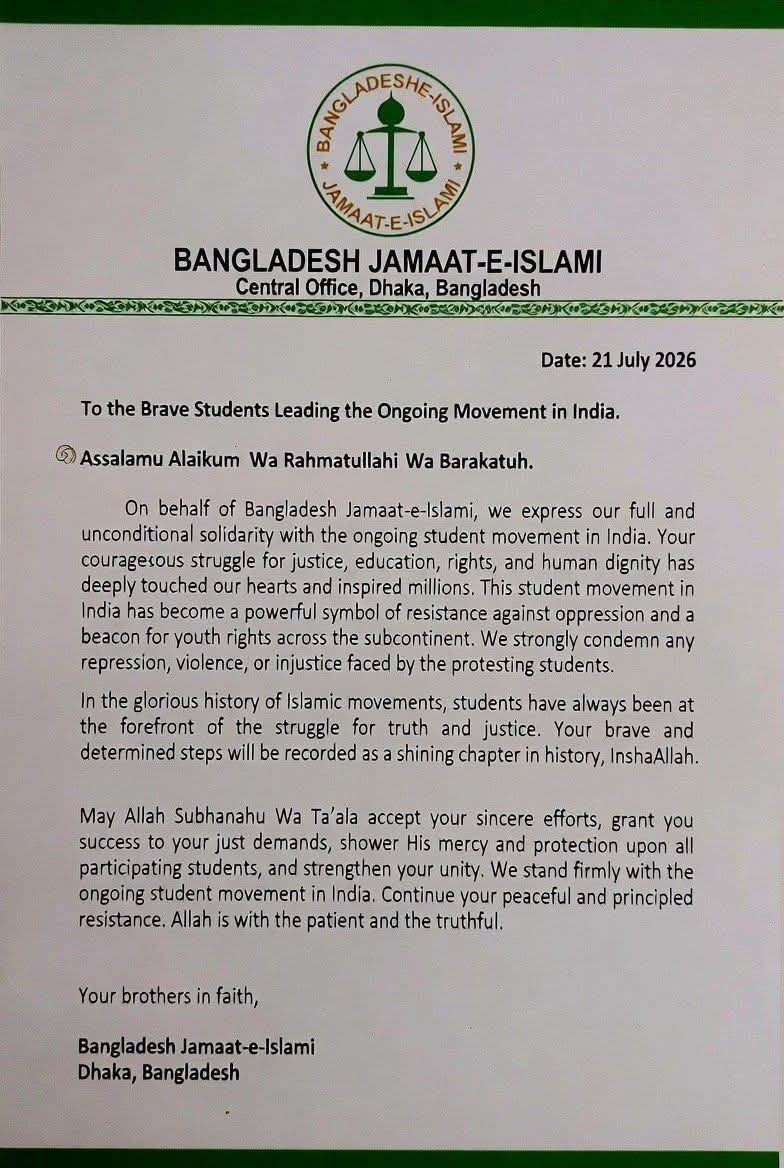
Bangladesh Jamaat-e-Islami Letter: A viral letter dated July 21, 2026, expressing solidarity surfaced. However, Bangladesh Jamaat-e-Islami officially denounced it as forged, citing misspellings, incorrect formats, and malicious propaganda. Intelligence agencies were verifying; no confirmation of authenticity.
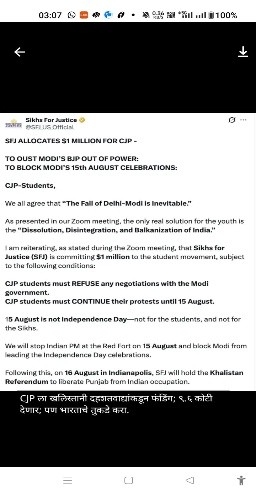
• Sikhs for Justice (SFJ) and Gurpatwant Singh Pannun: A post/claim attributes 1 million dollar allocation to CJP for protests, Zoom meetings, and goals like disrupting August 15 celebrations or "disintegration of India." Pannun is designated a terrorist by India. No independent confirmation of funding or meetings; such claims amplify concerns over foreign interference but remain unverified as of late July 2026.
Big news : In this video, American Khalistani terrorist Gurpatwant Singh Pannun claims that he had a zoom meeting with cockroach Janata party leaders.
— Mr Sinha (@Mrsinha) July 22, 2026
He further said that the fall of Delhi and Modi is invitable.
He said that the fall of Modi is not a permanent solution but… pic.twitter.com/VgXXpbjPCY
Another toolkit?
Documents circulated among CJP supporters reveal an extensive protest support network, including detailed instructions on what participants should carry, how to respond to police action, where to seek legal assistance and whom to contact in case of detention. The documents include lists of volunteer lawyers in Delhi and Mumbai, medical professionals, first-aid providers, mental health support, evidence collection teams, and donation channels such as water and relief assistance. They also recommend protective gear, including gas masks, and provide guidance on dealing with tear gas and documenting incidents during the protests.
Highly Important.
— Office Of Vijay Patel (@VijayGajeraO) July 22, 2026
I have been able to infiltrate a planned TOOLKIT, and it's extremely shocking to see the detailed planning and information about helpers.
I request you all to share it maximum.
Let's start to expose.👇
The level of planning has drawn attention, many argue that such elaborate preparations go well beyond those of a spontaneous student demonstration. They contend that the availability of legal teams, medical support and post-detention assistance indicates organisers anticipated large-scale confrontation with law enforcement. Political leaders, including former Delhi Chief Minister Arvind Kejriwal, also publicly assured protesters that legal assistance would be available if arrests were made.
Many have drawn comparisons between these documents and protest "toolkits" that circulated during political movements in countries such as Nepal and Bangladesh, arguing that the structure, coordination and logistical planning appear similar.
The algorithmic push
In the past few days, several social media users have claimed that content related to the Cockroach Janta Party (CJP) protests is being aggressively pushed across Meta platforms, particularly Instagram, regardless of users' browsing preferences. Many users alleged that videos supporting the agitation appeared repeatedly on their feeds despite not following CJP accounts, consuming political content, or even on newly created accounts, raising questions about whether the movement benefited from coordinated algorithmic amplification.
@PMOIndia @narendramodi @AmitShah @HMOIndia
— 🇮🇳Mohini🇮🇳 (@mohini23451) July 22, 2026
Over the past few days we have seen that there has been a systematic manipulation of algorithms for pushing the CJP narrative on social media platforms of @Meta particularly on @instagram there appears to be an funded campaign for…
Among those raising concerns was X user Mohini, who wrote, "Over the past few days, we have seen systematic manipulation of algorithms to push the CJP narrative on Meta's social media platforms. On Instagram in particular, there appears to be a funded campaign to spread anarchy and unrest among the younger generation."
The movement relied heavily on Instagram, encrypted messaging applications and online collaboration tools.
Pre-prepared protest kits included legal assistance, instructions for dealing with police, medical contacts, gas-mask recommendations, evidence submission forms and coordinated messaging strategies. While organisers described these as standard safety measures, many argued that the level of planning resembled professionally managed protest operations rather than spontaneous student demonstrations.
Investigative reports have also highlighted allegations that influencers were offered payments to post scripted content promoting participation. The coordinated nature of the campaign has fuelled calls for investigations into funding sources and digital amplification networks.
International advocacy adds new dimension
The protests also received support from organisations abroad.
The Indian American Muslim Council (IAMC), along with the Boston South Asian Coalition, organised a solidarity demonstration at Harvard Square in Massachusetts ahead of the July 20 protests. The rally criticised the Indian government's handling of examination controversies and called for accountability.
While overseas demonstrations are not unusual, many argue that international advocacy by politically active organisations adds another layer to an already polarised domestic movement and raises questions about the internationalisation of India's internal political disputes.
Chalo Sansad protest
The July 20 'Chalo Sansad' march witnessed thousands attempting to reach Parliament despite restrictions, leading to violent confrontations with Delhi Police. Barricades were breached, stones were allegedly thrown, public property was damaged and security personnel were injured before police responded with lathi charges and tear gas.
The CJP agitation has emerged as one of the most politically contentious protests in recent years, with its origins, organisation and support networks coming under increasing scrutiny. The scale of digital mobilisation, the availability of legal and medical infrastructure, coordinated social media campaigns, overseas participation, endorsements from Khalistani elements and support from various political and activist groups have shifted the focus from the streets of Delhi to a far larger question:
Who is really driving the agitation?
Was the CJP ever an independent youth-led campaign, or was it conceived from the outset as a politically orchestrated mobilisation?
Who financed its rapid expansion?
Who built and managed its nationwide logistics, legal networks and digital ecosystem?
Why did overseas actors, controversial organisations and separatist elements find common cause with the agitation?
Were these merely opportunistic endorsements, or part of a wider effort to amplify unrest and challenge the government?
The answers to these questions will determine whether the CJP protests were simply another episode of public dissent or a carefully coordinated campaign with objectives extending far beyond the demands being raised on the streets.