Before the assault: The covert planning of Operation Blue Star
The book by an intelligence officer ( Kaoboys of R&AW) was published in 2007; it stated that 2 officers of intelligence from the UK visited the Golden Temple.
NewsBharati 27-Jul-2026 11:33:10 AM
Total Views |


In continuation of the previous part: A crisis of conscience during the Punjab turmoil
The author discloses details of the controversy that erupted about the role of the British intelligence agency in the planning of an operation before the Blue Star. By November, while Sidhu had still not shifted out of the sensitive divisions, Mr Kao wanted to connect with the UK's intelligence agency. Sidhu had a contact, so he was asked to arrange for it. He went to Kao's office, introduced the person, but was not made a part of the discussion. The author thinks that probably Kao was aware of his opinion about the way Punjab was being handled. Later, he handed over the charge to his successor.
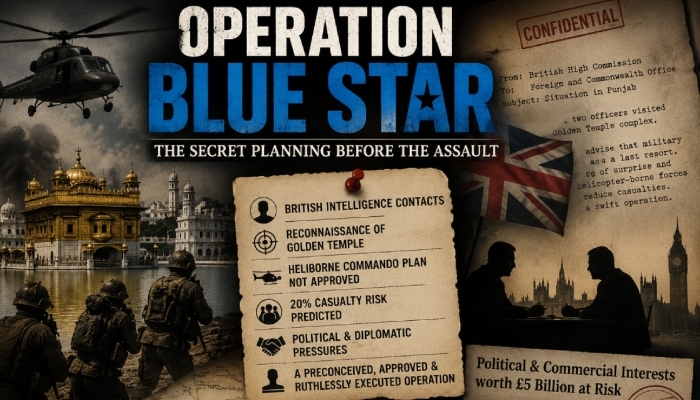
The book by an intelligence officer ( Kaoboys of R&AW) was published in 2007; it stated that 2 officers of intelligence from the UK visited the Golden Temple. An independent researcher journalist from the UK wrote an article and concluded, based on the declassified letters that the then PM of the UK had sent a top-tier commando force official to advise on expulsion of sikh militants. He posted the information on his blog on 13 January 2014. Obviously, the UK leaders of sikh community ( including some members of the House of Commons ) objected to this kind of help and the official role. The then PM of the UK ordered an inquiry by the Cabinet Secretary. Some documents were already destroyed as part of a review by the Ministry of Defence. It confirmed the ' ground recce'; it was also suggested to India that a military operation should be used as a last resort. The element of surprise and use of helicopter-borne forces might reduce casualties, and it would be a swift operation, it was proposed. Of course, we all know that ultimately the Operation Blue Star was a ground assault.
This created an uncomfortable scenario; opposition MPs in the UK wanted the government to apologise for making support available for the operation in which the Golden Temple was attacked, and its sanctity violated. (There were more than 5 lakh sikhs then in the UK; in some constituencies, their numbers mattered)
The British political and commercial interests could also be affected. Indira ji's letter to the British PM was published in this case, but the British PM's letter was not published by the UK government.
Though nothing is stated by the author on the advantage ( economic and diplomatic ) taken by Western countries, in 1986 indian government bought 21 Westland helicopters for 65 million pounds from Britain. (approximately 119 cr rupees then 1788 crore today)
It is noted that official contracts worth 5 billion pounds were also at risk.
Heliborne operation was not approved by the PM; it could have caused many casualties.
In the mid 1982 sidhu was asked whether he could visit Chowk Mehta complex to get a detailed map. The author sensed that he could be recognised and it could alert Bhindranwale about the plan.
Later, an intelligence officer was asked to visit as a reporter, but he was noticed and forced to leave. After the incident, 2 of Bhindranwale's associates were arrested, and he moved into the Guru Nanak Niwas. The act, the author thought, was probably to alert Bhindranwale that Chowk Mehta was not safe.
Guru Nanak Niwas had many advantages. It could provide better protection and was not part of the Temple complex. It could help to build pressure on the Akalis too.
The author thinks that probably capturing him alone could not have served the purpose. Bhindranwale alive in detention probably was a liability to the government; there might be fear of his revealing some inconvenient information. The situation in Punjab might have been beyond the government's control. He describes the phase as the time to find the final solution. The ferocious image of Bhindranwale was very carefully developed. He was to be presented as a tough enemy who was dealt with a strong hand to save society. The author feels that the operation was ' preconceived, approved, and ruthlessly executed '. An activist labeled it as a political murder.
(This is the seventh part of a series of 13 articles based on the book The Khalistan Conspiracy, written by author GB Sidhu. To read the previous part, click here)

Prof. Vidya Deshpande
Professor Vidya Deshpande has had a journey of more than four decades in the field of education. Her main expertise is in the subject of Philosophy, and she has worked as a teacher of philosophy and logic with Nowrosjee Wadia college for 36 years. She has been associated with the Janakalyan Blood bank for last for 38 years and has also carried out the responsibility as a management committee member of Karve Stree Shikshan Sanstha for 10 years. Her special fields of interest are Philosophy of social sciences, school education, development of skills for self reliance, and top up skills to make students profession ready,