The day politics took a back seat to public safety
But if one resignation helped reduce the possibility of greater violence and ensured that young Indians returned home safely, then history may ask a different question—not who won the protest, but whether a larger tragedy was averted.
NewsBharati 27-Jul-2026 16:08:06 PM
Total Views |


The resignation of Dharmendra Pradhan has changed the political conversation. For the supporters of the Cockroach Janta Party (CJP), it was a moment of celebration. Videos of leaders and supporters declaring that they had "made the government bend" quickly spread across social media. To them, the resignation was proof that sustained public pressure can force even the highest levels of government to respond.
But politics is rarely that simple.
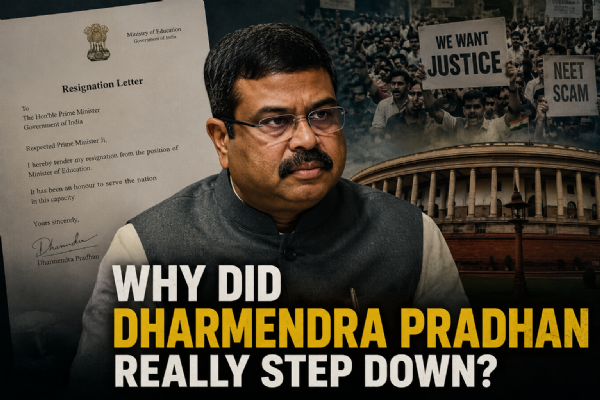
Governments do not make decisions in a vacuum. Every major protest creates multiple pressures at once: public opinion, administrative concerns, law and order, parliamentary politics, and the country's broader security environment. A cabinet reshuffle or resignation may satisfy one demand, but it can also serve other strategic purposes that remain known only to the decision-makers.
That is why the timing of this resignation has generated debate.
The CJP protests began as a movement centred on the NEET issue. But as the weeks passed, the movement appeared to expand far beyond its original demand. The protest stage began featuring activists, public figures, and political voices from across the ideological spectrum. Personalities such as Shabana Azmi, Anjali Bharadwaj, and Prashant Bhushan were seen sharing the stage with Sonam Wangchuk at different events, while several political parties also expressed support for the movement.
At the same time, issues that had little direct connection with NEET, such as Article 370, the Ram Mandir, and the imprisonment of Umar Khalid, began finding space in speeches and slogans. What started as a student-led campaign over an examination gradually evolved into a broader political platform where multiple causes and competing narratives converged. Whether this transformation happened organically or reflected the influence of different interest groups remains a subject of public debate.
Whenever questions were raised about the possible involvement of external or ideological groups in the movement, they were strongly rejected by many activists and several left-leaning media outlets. They consistently maintained that the protests remained a spontaneous, student-led movement with no hidden political or organisational backing.
However, on 23 July, Sonam Wangchuk made remarks after ending his fast that reignited the debate. In his address, he said that the movement had attracted the attention of various groups, leading to fresh discussion over who had become associated with the protests and how the movement had evolved beyond its original purpose.
Speaking to supporters, he said that "anti-social elements" had hijacked the movement. The remark was striking because it came from the person who had become the most prominent face of the protests
The timeline makes the sequence of events significant. On 20 July, the "Chalo Sansad" march announced as a peaceful march towards Parliament on the opening day of the Monsoon Session, descended into clashes between protesters and the police. Tear gas was fired, lathi charges followed, and several police personnel were injured during the confrontation. In the aftermath, the Cockroach Janta Party (CJP), which had organised the march, maintained that those responsible for the violence were "ill elements" and not the students leading the movement. Three days later, Sonam Wangchuk's remarks added a new dimension to that narrative. His statement that "anti-social elements" had hijacked the movement appeared to echo concerns that the protests had, over time, attracted actors beyond their original student-led character.

It should be noted that, before the 20 July "Chalo Sansad" march, reports indicated that intelligence agencies had alerted authorities to potential security threats around the protest. According to the intelligence report, there were concerns that terrorist elements could attempt to exploit the gathering, including through a possible suicide bombing. Acting on these inputs, authorities significantly tightened security in and around Parliament and the protest route.
What unfolded on the ground was difficult to ignore. The violence on the streets, the heightened security concerns, and the reports of potential threats changed the context in which the government had to act. Prime Minister Narendra Modi appears to have chosen de-escalation over confrontation. Modi made a difficult choice. Faced with a rapidly escalating situation, he chose the safety of India's Gen Z over political optics. A cabinet minister can be replaced. A young life cannot. If the resignation helped defuse tensions and reduce the risk of further violence, then it was a political sacrifice made in the interest of protecting the nation's youth, the generation that will shape India's future.
The decision also reflected a larger principle of governance. Governments are expected not only to respond to political crises but also to prevent them from spiralling into tragedies. Once a protest begins attracting confrontation, heightened security concerns, and the possibility of violence, the priority shifts from political messaging to public safety. In my view, that is exactly what happened here. By choosing de-escalation over escalation, the government placed the lives of thousands of young protesters above the political cost of losing a senior cabinet minister. History may ultimately judge the resignation not as a political defeat, but as an attempt to ensure that a student movement did not end in irreversible loss.
Those decisions were criticised at the time, but history remembers them as acts of restraint. Whether the government's decision in this case was driven by political calculation, administrative necessity, or a genuine desire to prevent further escalation will continue to be debated. But if one resignation helped reduce the possibility of greater violence and ensured that young Indians returned home safely, then history may ask a different question—not who won the protest, but whether a larger tragedy was averted. Sometimes, the biggest political victory is the disaster that never happens.
Shivani Shinde
Shivani Shinde has completed her graduation in Journalism and Mass Communication and is pursuing her Masters further. She keeps interest in writing on Science and Technology and Entertainment.