Cauvery water row resurfaces: Karnataka farmers protest CWRC's water release order; all you need to know
Karnataka farmers argue the state is already facing a poor monsoon, leaving reservoirs like KRS at critically low levels, barely enough for the state"s own drinking water and irrigation needs.
Total Views |


Farmers across the Cauvery basin escalated their protests on Tuesday, July 28, following a directive from the Cauvery Water Regulation Committee (CWRC) instructing Karnataka to release 3,500 cusecs of water daily to Tamil Nadu over a 15-day period. The order sparked large-scale demonstrations in Mandya district, with farmers, political leaders, and agricultural bodies cautioning the State Government against complying.
Protesters pointed out that the KRS reservoir was currently holding water at approximately 92 feet, and that a sustained release of 3,500 cusecs over 15 days would sharply reduce these stocks. They cautioned that such a step could endanger irrigation for existing crops and potentially trigger a drinking water shortage in multiple districts, including Bengaluru, Mysuru, and Mandya. Farmers noted that crops were already suffering from insufficient rain, with both people and animals bearing the brunt of the
Politicians and their say over the issue
The legislator further reaffirmed Karnataka's resolve to move forward with the Mekedatu balancing reservoir project, notwithstanding Tamil Nadu's objections. He proposed that Tamil Nadu, rather than opposing the project, should instead build a reservoir downstream of the Mettur dam to capture water that would otherwise be lost to the sea.
He pointed out that key reservoirs in the Cauvery basin KRS, Kabini, Hemavathi, and Harangi held limited water due to a weak monsoon, with catchment areas receiving nearly half of their expected rainfall. Consequently, inflows into these reservoirs had dropped significantly. He called on the State Government to petition the CWMA to reconsider the release order in light of the current hydrological conditions.
The Cauvery water dispute: Background
The Cauvery is a major river originating in Karnataka's Western Ghats and flowing through Tamil Nadu before reaching the Bay of Bengal. Both states depend heavily on it for irrigation and drinking water, which has made it one of India's oldest and most contentious inter-state river disputes. The conflict traces back to agreements from 1892 and 1924 between the Madras Presidency and the Kingdom of Mysore over sharing the river's water. After independence, disagreements persisted as both states' populations and irrigation needs grew.
_202607291658571438_H@@IGHT_624_W@@IDTH_700.jpg "Farmers protest Karnataka")
The current unrest among farmers is believed to have been triggered when sporadic protests broke out in Mysuru and Mandya districts, the heart of the Cauvery river basin, after the CWRC directed Karnataka to release water to Tamil Nadu.
In the given case as well, Karnataka Federation of Farmers’ Associations president Kurubur Shanthakumar has urged the State Government to appeal to the CWMA for reconsideration of the release order, taking into account the prevailing hydrological situation.
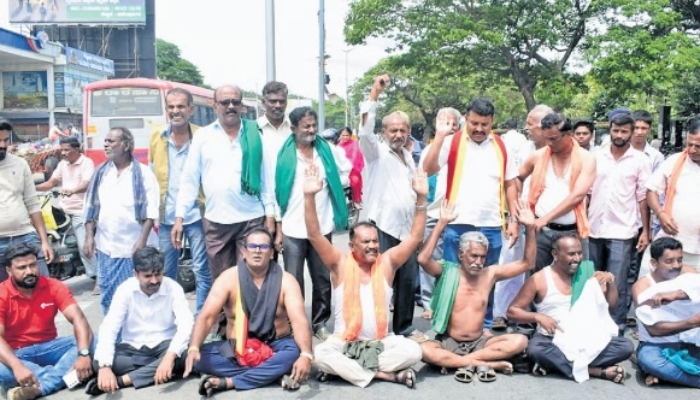
Hundreds of farmers and members of various organisations gathered at Sanjay Circle in Mandya and subsequently blocked the old Mysuru-Bengaluru Highway. Demonstrators chanted slogans declaring they would "give blood, but not water," and several farmers even stripped down as a form of semi-nude protest to voice their opposition. They insisted that Karnataka must not release water to Tamil Nadu under any circumstances, citing severe strain on the state's own drinking water and irrigation supplies due to poor monsoon rainfall.
Farmers protest against the Cauvery Water Regulation Committee’s directives, in Mandya on Tuesday
Protesters pointed out that the KRS reservoir was currently holding water at approximately 92 feet, and that a sustained release of 3,500 cusecs over 15 days would sharply reduce these stocks. They cautioned that such a step could endanger irrigation for existing crops and potentially trigger a drinking water shortage in multiple districts, including Bengaluru, Mysuru, and Mandya. Farmers noted that crops were already suffering from insufficient rain, with both people and animals bearing the brunt of the
water scarcity.
Mandya, Karnataka: Farmers and activists, including the Karnataka State Farmers' Association, stage a protest in Srirangapatna condemning the CWRC order and opposing the release of Cauvery water to Tamil Nadu. Protesters block the Bengaluru–Mysuru highway, causing traffic… pic.twitter.com/UZDgobht2x
— IANS (@ians_india) July 29, 2026
Politicians and their say over the issue
Former legislator Annadani appealed to Chief Minister DK Shivakumar to defy the CWRC's order. He referenced past instances where former chief ministers S Bangarappa and HD Deve Gowda had similarly refused to comply with directives from Cauvery authorities in order to safeguard Karnataka's interests. He cautioned that releasing water this time would provoke intensified protests from farmers.
Separately, Mandya MLA Ganiga Ravikumar challenged Tamil Nadu's request for additional Cauvery water by sharing what he termed a "reality check" video. He claimed the footage, filmed during a recent visit to Tamil Nadu, depicted substantial amounts of Cauvery water flowing unused into the Bay of Bengal near Chidambaram. Ravikumar argued that Tamil Nadu's continued demand for more water was unjustified given that large volumes were already being lost to the sea. "If so much water is already flowing into the sea, on what basis is Tamil Nadu demanding more water from Karnataka?" he asked, calling on the state government to turn down the CWRC's directive.
Mysuru, Karnataka: The Karnataka State Sugarcane Growers Association holds a road blockade protest, condemning the CWRC's order and opposing the release of Cauvery water to Tamil Nadu. During the protest, led by State President Hallikerehundi Bhagyaraj, farmers perform uru seva… pic.twitter.com/M5f6ovGxDg
— IANS (@ians_india) July 29, 2026
The legislator further reaffirmed Karnataka's resolve to move forward with the Mekedatu balancing reservoir project, notwithstanding Tamil Nadu's objections. He proposed that Tamil Nadu, rather than opposing the project, should instead build a reservoir downstream of the Mettur dam to capture water that would otherwise be lost to the sea.
Kurubur Shanthakumar, president of the State Federation of Farmers' Associations, also spoke out against the CWRC's order, stating that current conditions made it unfeasible for Karnataka to release water. He urged the state government to formally communicate to the Cauvery Water Management Authority (CWMA) that existing reservoir levels were only just enough to meet Karnataka's drinking water requirements and sustain standing crops.
He pointed out that key reservoirs in the Cauvery basin KRS, Kabini, Hemavathi, and Harangi held limited water due to a weak monsoon, with catchment areas receiving nearly half of their expected rainfall. Consequently, inflows into these reservoirs had dropped significantly. He called on the State Government to petition the CWMA to reconsider the release order in light of the current hydrological conditions.
The Cauvery water dispute: Background
The Cauvery is a major river originating in Karnataka's Western Ghats and flowing through Tamil Nadu before reaching the Bay of Bengal. Both states depend heavily on it for irrigation and drinking water, which has made it one of India's oldest and most contentious inter-state river disputes. The conflict traces back to agreements from 1892 and 1924 between the Madras Presidency and the Kingdom of Mysore over sharing the river's water. After independence, disagreements persisted as both states' populations and irrigation needs grew.
In its landmark 2018 judgment, the Supreme Court constituted the Cauvery Water Management Authority (CWMA) and the Cauvery Water Regulation Committee (CWRC) as statutory mechanisms to regulate and implement water-sharing between the two states. These bodies determine how much water Karnataka must release to Tamil Nadu, especially during dry periods.
The current unrest among farmers is believed to have been triggered when sporadic protests broke out in Mysuru and Mandya districts, the heart of the Cauvery river basin, after the CWRC directed Karnataka to release water to Tamil Nadu.
Karnataka farmers argue the state is already facing a poor monsoon, leaving reservoirs like KRS at critically low levels, barely enough for the state's own drinking water and irrigation needs. This isn't new; nearly identical protests happened in 2023 (and earlier), always following the same script viz, monsoon shortfall, CWMA/CWRC orders a release, Karnataka farmers protest, citing drought and drinking-water needs, Tamil Nadu farmers counter-protest for their share of water for crops like kuruvai paddy.
In the given case as well, Karnataka Federation of Farmers’ Associations president Kurubur Shanthakumar has urged the State Government to appeal to the CWMA for reconsideration of the release order, taking into account the prevailing hydrological situation.