Ramraksha or Paksharaksha?
The people of Maharashtra and indeed the country will judge this campaign not merely by its rhetoric but by its consistency.
NewsBharati 06-Jul-2026 12:51:18 PM
Total Views |


Politics often borrows the language of faith, but the public has every right to ask whether that language reflects conviction or convenience. Shiv Sena (UBT)'s decision to launch a statewide "Ramraksha" agitation over the alleged embezzlement of donations linked to the Ayodhya Ram Temple has brought this question into sharp focus.
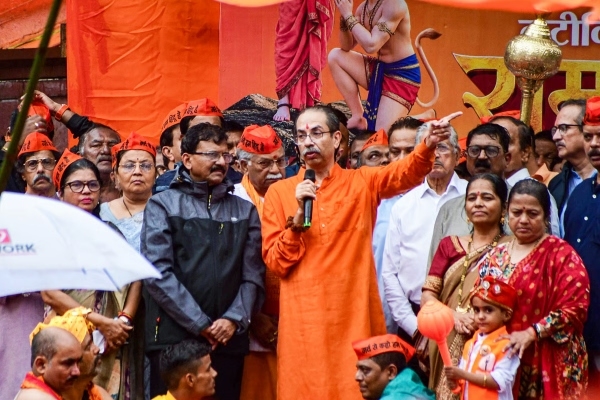
If money offered by devotees has indeed been misappropriated, the sentiment is justified. Every rupee donated in the name of Prabhbu Ramchandra carries not merely financial value but also the faith of millions of devotees. Those responsible must face a transparent investigation and exemplary punishment. However, beyond the demand for accountability lies another political question. Is this truly a campaign for Ramraksha, or is it an exercise in Paksharaksha, a bid to protect a fading political identity?
No individual or organisation can claim exclusive ownership over Prabhu Ramchandra. He is a civilisational symbol revered across India. Therefore, any allegation involving donations made in His name deserves serious scrutiny. The issue should not be trivialised, nor should it be shielded. Transparency is essential, and if wrongdoing is established, the guilty must be punished regardless of their status or affiliations.
ALSO READ: Kerala's Mar Thoma Church opens membership to transgenders in a first for Indian Churches; move revives debate over church's shifting doctrinal positions
This is where questions of consistency arise. For nearly three years, the UBT leadership remained aligned with parties that had historically opposed or questioned the Ram Mandir movement. During the years when the temple issue dominated national discourse, Shiv Sena (UBT)'s political priorities were markedly different. Its alliance politics often required it to soften or recalibrate the aggressive Hindutva positioning that had once defined the undivided Shiv Sena. Today, invoking Prabhu Ramchandra once again naturally invites scrutiny. Voters are entitled to ask what has changed principle or political necessity.
The larger concern extends beyond one party. Indian politics has frequently witnessed religion being invoked selectively. Political actors who remain silent when one faith is mocked but become vocal for appeasement politics. Conversely, some who champion religious causes fail to uphold transparency and accountability when allegations arise within institutions associated with those causes. Both tendencies weaken public confidence. Faith deserves respect, but respect for faith also demands integrity.
The Ram Temple occupies a unique place in India's contemporary history. For millions, it represents the culmination of a decades-long civilisational aspiration. It is therefore imperative that every institution connected with it maintains the highest standards of financial propriety and administrative transparency. Any allegation of corruption should be investigated swiftly and fairly. Seeking accountability in such matters should never be dismissed as political mischief. Equally, political campaigns built around these allegations should not escape scrutiny regarding their own motivations.
ALSO READ: Pak’s Bulldozer Justice: Preaching Human Rights, Demolishing Gurdwaras
Ultimately, the issue is not whether one supports an inquiry into alleged financial irregularities. Every responsible citizen should. The issue is whether Prabhu Ramchandra should become a recurring political instrument whenever electoral fortunes decline. Faith cannot become seasonal. It cannot be rediscovered only when political relevance is under strain.
The people of Maharashtra and indeed the country will judge this campaign not merely by its rhetoric but by its consistency. If Shiv Sena (UBT) is genuinely committed to protecting the sanctity of Prabhu Ramchandra and ensuring that devotees' contributions are safeguarded, it deserves to pursue that cause with seriousness and sincerity. But if the campaign is primarily intended to recover lost political ground, voters will recognise the difference. That is why the question refuses to go away. Is this truly Ramraksha a principled demand to protect the sanctity of faith? Or is it Paksharaksha an attempt to protect a political party searching for its lost ideological identity? In a democracy, only consistent conduct, not compelling slogans, can answer that question.
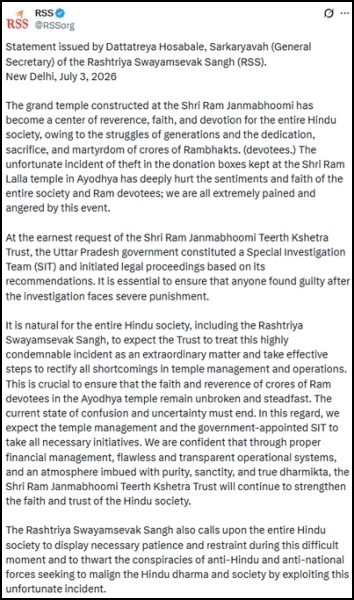
The episode also lends relevance to the recent observation of Rashtriya Swayamsewak Sangh (RSS) Sarkaryawah Dattatreya Hosabale that Hindu society must remain vigilant against forces that seek to create divisions within it for political or ideological gain. Whatever one's political affiliation, allegations involving institutions associated with Hindu faith should not become an opportunity for vested interests to deepen internal fault lines or erode public confidence in civilisational symbols. Wrongdoing, if established, must certainly be punished, but Hindus must also recognise attempts to pit one section against another or to convert matters of faith into instruments of political polarisation.

Editor's Desk
Editor's Desk