Ajmer: Jailer Saddam Hussain suspended for arranging video calls of convicts with Nafees Chishti, convicted in 1992 sex scandal
A jailer posted at Ajmer Central Jail has been suspended after a purported video surfaced allegedly showing three convicted prisoners using his mobile phone to speak to Nafees Chishti, one of the key convicts in the infamous 1992 Ajmer rape and blackmail case. The Rajasthan Prisons Department has ordered a departmental inquiry and is registering an FIR against the jailer and others.
Total Views |


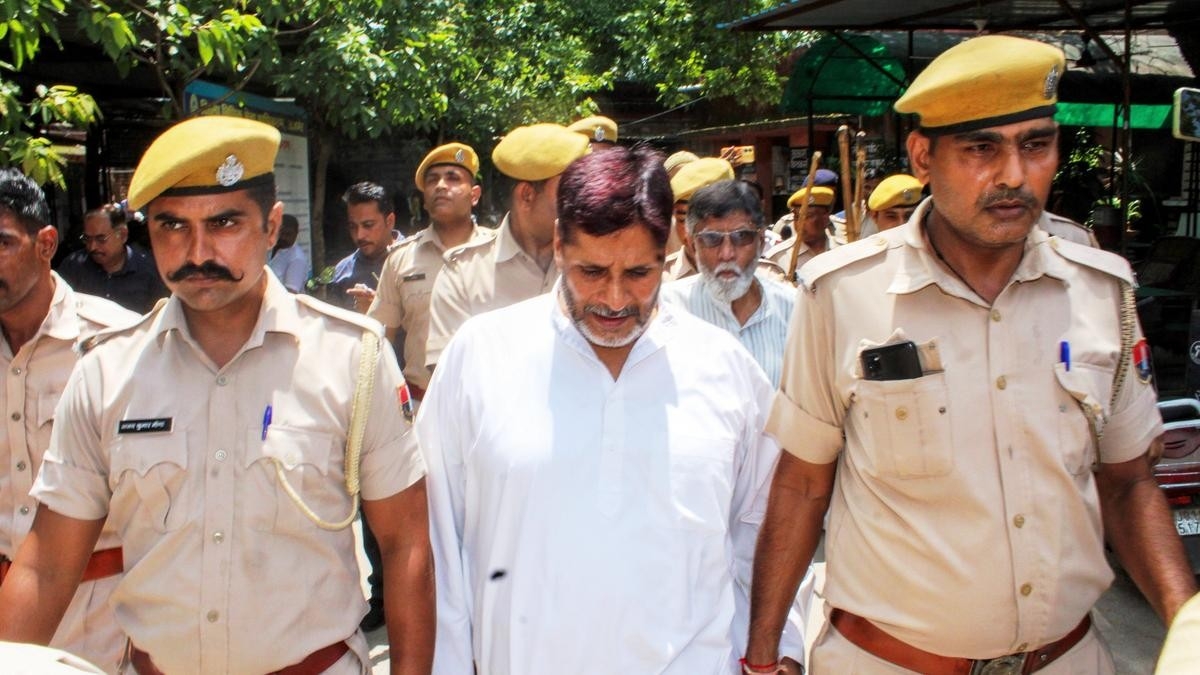
(Nafees Chisthi who has been booked in the Ajmer 1992 sex scandal case)
Rajasthan Director General of Prisons Ashok Rathore ordered the immediate suspension of Ajmer Central Jail jailer Saddam Hussain after a video surfaced allegedly showing three inmates speaking to Nafees Chishti, a convicted accused in the 1992 Ajmer rape and blackmail case.
The video reportedly shows prisoners Syed Tariq Chishti, Syed Tausif Chishti alias Chikki and Fakhar Jamali speaking to Nafees Chishti over a video call from inside the prison.
Officials said the inmates allegedly used Hussain's mobile phone for the call. The conversation appears to have taken place from the jailer's office, making the allegation particularly serious because prisoners are prohibited from possessing or using unauthorised mobile phones.
Hussain has been suspended pending a departmental inquiry. During his suspension, he has been directed to report to Sriganganagar Central Jail.
The prison administration has also initiated the process of registering an FIR against Hussain and others at Civil Lines police station in Ajmer.
Video believed to be from November 2025
Officials believe the video was recorded in November 2025.
Based on the date of the three inmates' conviction and a statement attributed to Syed Tausif Chishti, officials believe the call may have taken place between November 20 and November 30, 2025.
The exact circumstances under which the call was made, who facilitated it and whether other prison officials were aware of it are now part of the inquiry.
Two unidentified people were also reportedly visible alongside Nafees Chishti during the call.
The prison department is examining whether any other officials or staff members played a role in the alleged communication.
What happened inside Ajmer jail?
The three inmates seen in the video were convicted in a separate criminal case involving an attack on Haji Syed Bilal Hussain Chishti.
They were sentenced by an Ajmer court on November 7, 2025, in a case involving allegations including assault, grievous injury, attempt to murder and weapons-related offences.
SENSATIONAL: Ajmer Central Jail Jailer Saddam Hussain arranged a video call from his own office and personal phone, allowing three inmates to speak with Nafees Chishti- the mastermind of the 1992 Ajmer sex scandal involving over 100 girls.The inmates- Tariq Chishti, his son… pic.twitter.com/uMYwSW7EBF
— Megh Updates 🚨™ (@MeghUpdates) August 11, 2026
Another account of the case said the three men were sentenced to seven years' imprisonment in connection with a 2014 attack, with the verdict subsequently upheld by the High Court.
Syed Tariq Chishti and Fakhar Jamali were released in July 2026. Syed Tausif Chishti was still serving his sentence at Ajmer Central Jail when the controversy emerged and has since been shifted to Bharatpur Central Jail.
Nafees Chishti: Name at the centre of 1992 Ajmer scandal
The person on the other end of the alleged video call is Nafees Chishti, a key accused who was later convicted in the 1992 Ajmer rape and blackmail case.
The scandal, which came to light in 1992, involved the systematic sexual exploitation and blackmail of young girls in Ajmer. Reports and court records have described a pattern in which girls were lured into a network, sexually assaulted and photographed in compromising situations. The photographs were then allegedly used to blackmail victims and force them to bring other girls into the network.
The case has been described as one of India's most notorious sex-abuse and blackmail scandals of the period. Contemporary and subsequent reports have put the number of victims at around 100 or more, while some media accounts have cited figures running into several hundred. The victims were largely school and college-going girls, with reports identifying victims as being between approximately 11 and 20 years old.
How the Ajmer scandal operated
According to accounts of the case, the operation involved a chain of offenders who targeted young women and girls.
One of the patterns described in court and subsequent reporting involved a girl being introduced to members of the group and subsequently taken to a farmhouse or bungalow outside the city. After she was sexually assaulted and photographed, the images were allegedly used to threaten and blackmail her.
The victim was then pressured into bringing other classmates or friends into contact with the accused. Those girls could then become victims themselves, creating a chain through which the number of victims expanded.
The scandal eventually came to public attention after reporting by the local newspaper Dainik Navajyoti. The revelations triggered widespread outrage in Ajmer and led to a police investigation and the filing of cases against multiple accused.
Political and local influence became major issue
The case attracted particular attention because several accused were described in contemporary and later accounts as having significant local and political influence.
Nafees and Farooq Chishti were associated with the influential Chishti family connected to Ajmer Sharif's hereditary caretaking tradition, according to accounts of the case. Farooq Chishti had also held a position in the Ajmer Youth Congress, while Nafees Chishti was described in reporting as having political connections.
The influence surrounding some of the accused was also cited as one of the reasons victims were reluctant to come forward.
Former Rajasthan police officials later spoke about the difficulties investigators faced in encouraging victims to testify, given the social stigma surrounding sexual assault and the influence of the accused.
The case also generated communal and political tensions in Ajmer after the identities and backgrounds of the accused and victims became public.
The investigation resulted in 18 offenders being charged in September 1992, while the wider case involved 19 accused according to subsequent accounts. One accused later died by suicide, while several others remained absconding for years.
The first major trial resulted in convictions and life sentences for eight accused in 1998.
However, the Rajasthan High Court acquitted four of them in 2001, leaving the legal battle far from over.
Several accused remained outside the reach of the law for years.
One accused, Suhail Ghani, remained absconding for about 26 years before surrendering in 2018. Salim Chishti was arrested by the Rajasthan Police's Special Operations Group in 2012. Another accused, Syed Almas, has remained wanted, with an Interpol Red Notice reportedly issued against him.
Six accused sentenced to life in 2024
A major development came on August 20, 2024, when a special POCSO court in Ajmer sentenced six accused to life imprisonment in the case.
Those sentenced were:
• Nafees Chishti
• Naseem alias Tarzan
• Salim Chishti
• Iqbal Bhati
• Sohail Ghani
• Syed Zameer Hussain
The court also imposed a fine of Rs 5 lakh on each of the six convicts.
The 2024 verdict was significant because it came more than three decades after the scandal first came to light.
Nafees Chishti, who is now at the centre of the Ajmer jail video-call controversy, was therefore not merely an accused in the old scandal but one of the six people convicted and sentenced to life imprisonment in 2024.
Rajasthan High Court later suspended sentences
There was, however, a subsequent development in the legal status of four of those convicts.
On August 8, 2025, the Rajasthan High Court suspended the sentences of Nafees Chishti, Zameer Hussain, Iqbal Bhati and Salim Chishti and granted them bail, according to reports. They had been among the six men sentenced to life imprisonment by the special POCSO court in August 2024.
Thus, while Nafees Chishti had been sentenced to life imprisonment by the trial court in 2024, his sentence was subsequently suspended by the High Court in 2025.
It was after this period that the alleged video call from Ajmer Central Jail is believed to have taken place in November 2025.
Why jail video has raised serious questions
The video call has triggered questions beyond the conduct of the three inmates.
Prisons routinely restrict access to mobile phones because unauthorised communication can allow inmates to contact people outside the facility without monitoring.
In this case, officials allege that the phone used for the video call belonged to jailer Saddam Hussain.
More significantly, the call appears to have taken place inside the jailer's office.
Hussain was also reportedly holding charge of the superintendent's duties until December 15, 2025.
If the allegations are established, the incident would raise questions about how an unauthorised communication was allowed to take place inside a prison and whether any other officials knew about it.
DG Prisons Ashok Rathore ordered Hussain's suspension pending a departmental inquiry.
Officials said the suspension was necessary to prevent any possibility of interference with the investigation.
The prison department is examining the circumstances surrounding the alleged video call and is also looking into whether other officials or staff members were involved.
Ajmer Central Jail Superintendent Anteshwar said an inquiry was underway and statements and other evidence were being collected. He said appropriate action would be taken on the basis of the findings.
FIR being registered
The jail administration has moved to lodge a formal complaint at Civil Lines police station in Ajmer.
An FIR is being registered against Hussain and others in connection with the alleged incident.
The police investigation is expected to examine the source of the mobile phone, how it came into the possession of the prisoners, who was present when the alleged call took place and whether the communication was deliberately facilitated.
What happened to the three prisoners?
The three prisoners seen in the video are no longer all at Ajmer Central Jail.
Syed Tariq Chishti and Fakhar Jamali were released in July 2026.
Syed Tausif Chishti, who remained in custody, has been transferred from Ajmer Central Jail to Bharatpur Central Jail following the controversy.
The prison authorities are continuing to investigate the circumstances surrounding the alleged video call.
A 32-year-old case returns to the spotlight
The controversy has brought the 1992 Ajmer scandal back into public attention more than three decades after it first shook Rajasthan.
The original case involved allegations of systematic sexual exploitation, rape and blackmail of young girls, with compromising photographs allegedly used to silence victims and draw more girls into the network.
The prolonged legal proceedings have stretched across decades, with multiple trials, convictions, acquittals, absconding accused, arrests and later convictions.
The 2024 life sentences for six accused represented one of the most significant developments in the case in decades, although the subsequent suspension of four sentences by the Rajasthan High Court added another chapter to the long-running legal battle.
Now, the use of a jailer's mobile phone to connect prisoners with Nafees Chishti has created a new controversy, this time over prison security and the conduct of jail officials.
The departmental inquiry and police investigation will determine whether the allegations against jailer Saddam Hussain and any other officials are established.