Why plastic, why now, why Rs 10, Rs 20 denominations? Govt's approval to polymer banknote trial explained
Somewhere around 45–60 countries use polymer notes in some form today, but only a smaller subset (roughly 10-15) have gone fully polymer for their entire currency, like Australia (first, in 1988), New Zealand, Romania, Canada, and the UK being the big names.
NewsBharati 12-Aug-2026 11:48:19 AM
Total Views |


India's Rs 10 and Rs 20 notes may soon get a new look, with the government approving field trials for polymer versions of both denominations. As part of this move, 100 crore (1 billion) plastic notes will be issued for each denomination. Finance Minister Nirmala Sitharaman, on Tuesday, August 11, shared these details in a written reply to the Rajya Sabha, adding that any decision on their long-term future will hinge on how well they perform in terms of usage and durability.
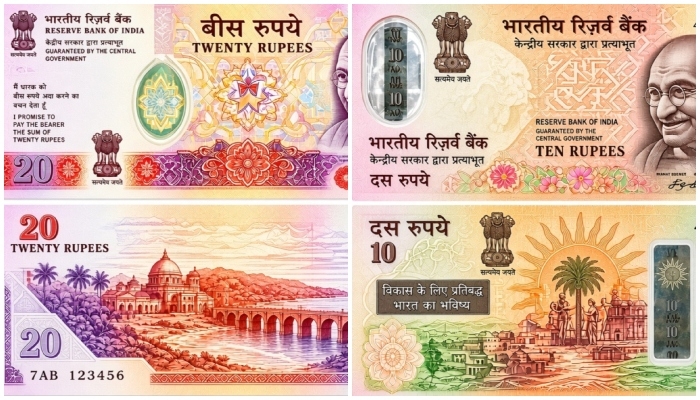
As per the reports, the main driver behind the RBI's crucial move is durability. As per the official reports, since Rs 10 and Rs 20 notes are used so frequently, changing hands constantly for small everyday transactions, they tend to wear out much faster than higher-value notes. The RBI sees polymer notes as a way to test whether a tougher, longer-lasting material can help solve this problem.
Is India getting polymer notes permanently?
To answer it briefly, yes, though not for widespread public use just yet. What the government has actually cleared is a set of field trials, giving the RBI the go-ahead to test polymer notes before any decision is made on full-scale printing and distribution. That call will depend entirely on how the trials pan out.
As for how it will work in practice, the RBI plans to introduce polymer notes as a complement to paper currency, not a replacement for it. In other words, both paper and polymer notes are expected to circulate together, at least for now.
How many polymer notes are being issued at present?
According to the government, 100 crore (1 billion) polymer notes will be produced for each of the Rs 10 and Rs 20 denominations, adding up to 200 crore notes in total. But this figure isn't meant for immediate, full-scale circulation; it's specifically the quantity earmarked for the field trial phase.
What actually changes when a note goes from paper to polymer?
The core change lies in the substrate, essentially the raw material the note is made from. Most Indian currency today is printed on a paper-based substrate, whereas polymer notes swap this out for a specialised plastic-based material instead. Visually and functionally, a polymer note works just like any paper note you'd use day-to-day; the difference is under the hood, in what it's made of. That shift in material is what's expected to make the notes sturdier and more durable.
RBI Governor Sanjay Malhotra has flagged this improved durability as a central reason for exploring polymer notes, especially for lower denominations. "These notes are handled so frequently and pass through so many hands that they need a material built to withstand that wear and tear," he said.
Why start with Rs 10 and Rs 20 notes?
It largely comes down to how often these notes are used. Rs 10 and Rs 20 denominations are the workhorses of everyday transactions; people reach for them constantly, whether it's buying groceries, grabbing a cup of tea, paying for an auto or bus ride, or making other small, routine payments. Because they're changing hands so rapidly, they're also far more prone to tearing, getting dirty, or wearing out quickly compared to higher-value notes. Improving the lifespan of these low-denomination notes is therefore a key priority for the RBI.
There's also a global angle to this decision. The RBI isn't approaching polymer notes as an untested concept; Governor Sanjay Malhotra has pointed out that several countries around the world have already been using polymer currency for more than three decades, giving India a substantial body of international experience to draw on.
That said, paper notes aren't going anywhere just yet, she indicated. The RBI intends to keep existing paper Rs 10 and Rs 20 notes in circulation alongside their polymer counterparts, so for the time being, both versions of these denominations will likely be seen in everyday use.
Representative Image (AI)
As per the reports, the main driver behind the RBI's crucial move is durability. As per the official reports, since Rs 10 and Rs 20 notes are used so frequently, changing hands constantly for small everyday transactions, they tend to wear out much faster than higher-value notes. The RBI sees polymer notes as a way to test whether a tougher, longer-lasting material can help solve this problem.
Interestingly, somewhere around 45–60 countries use polymer notes in some form today, but only a smaller subset (roughly 10-15) have gone fully polymer for their entire currency, like Australia (first, in 1988), New Zealand, Romania, Canada, and the UK being the big names. India, with this RBI trial, would just be dipping a toe in.
STORY | Government approves introduction of one billion polymer banknotes of Rs 10 and 20
— Press Trust of India (@PTI_News) August 11, 2026
The government has approved the introduction of one billion polymer banknotes of Rs 10 and Rs 20 for field trials, Parliament was informed on Tuesday.
The Reserve Bank of India (RBI), with… pic.twitter.com/wUjl0DL93Z
Is India getting polymer notes permanently?
To answer it briefly, yes, though not for widespread public use just yet. What the government has actually cleared is a set of field trials, giving the RBI the go-ahead to test polymer notes before any decision is made on full-scale printing and distribution. That call will depend entirely on how the trials pan out.
This approval traces back to a proposal put forward by the RBI's Central Board under Section 25 of the Reserve Bank of India Act, 1934, which the government has now signed off on. Finance Minister Nirmala Sitharaman confirmed this development in a written reply to the Rajya Sabha on Tuesday, August 11.
As for how it will work in practice, the RBI plans to introduce polymer notes as a complement to paper currency, not a replacement for it. In other words, both paper and polymer notes are expected to circulate together, at least for now.
How many polymer notes are being issued at present?
According to the government, 100 crore (1 billion) polymer notes will be produced for each of the Rs 10 and Rs 20 denominations, adding up to 200 crore notes in total. But this figure isn't meant for immediate, full-scale circulation; it's specifically the quantity earmarked for the field trial phase.
The process will unfold in stages: first, these notes will be put into circulation and tested under actual, real-world usage conditions. Based on this, the RBI will then evaluate factors like how durable the notes prove to be, any practical challenges around handling or maintaining them, and ultimately whether the results justify moving toward a larger, nationwide rollout.
What actually changes when a note goes from paper to polymer?
The core change lies in the substrate, essentially the raw material the note is made from. Most Indian currency today is printed on a paper-based substrate, whereas polymer notes swap this out for a specialised plastic-based material instead. Visually and functionally, a polymer note works just like any paper note you'd use day-to-day; the difference is under the hood, in what it's made of. That shift in material is what's expected to make the notes sturdier and more durable.
Why start with Rs 10 and Rs 20 notes?
It largely comes down to how often these notes are used. Rs 10 and Rs 20 denominations are the workhorses of everyday transactions; people reach for them constantly, whether it's buying groceries, grabbing a cup of tea, paying for an auto or bus ride, or making other small, routine payments. Because they're changing hands so rapidly, they're also far more prone to tearing, getting dirty, or wearing out quickly compared to higher-value notes. Improving the lifespan of these low-denomination notes is therefore a key priority for the RBI.
There's also a global angle to this decision. The RBI isn't approaching polymer notes as an untested concept; Governor Sanjay Malhotra has pointed out that several countries around the world have already been using polymer currency for more than three decades, giving India a substantial body of international experience to draw on.

Siddhi Somani
Siddhi Somani is known for her satirical and factual hand in Economic, Social and Political writing. Having completed her post graduation in Journalism, she is currently engaged in completing her Masters in Politics. The author meanwhile is also exploring her hand in analytics and statistics.