Foreign funds and internal foes
NewsBharati 13-Aug-2026 14:24:51 PM
Total Views |


The government may have moved a step ahead in pushing the FCRA Amendment Bill, but the larger lesson goes far beyond the fate of a legislation. It is a lesson not merely for the government, but for the entire nation. It concerns a disturbing question that India cannot afford to ignore. How do extra-territorial forces attempt to influence a country, and how do they operate when they find willing or unwitting allies within?
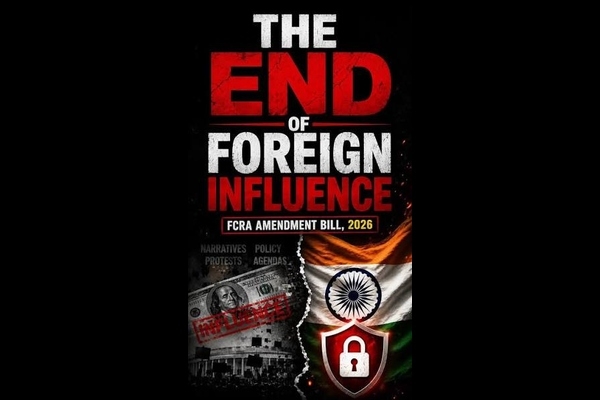 The suspicion has existed for years that foreign funds were being used in some cases for religious conversion, activities detrimental to national interests and attempts to influence India's social fabric. These concerns deserved serious examination rather than political dismissal. The Congress had every opportunity to address these concerns when it was in power. If stronger safeguards were necessary, why did it not bring them much earlier? Why was the loophole allowed to persist? Why did successive governments fail to create a framework strong enough to ensure that foreign money could not be misused against India's national interests?
These are legitimate questions. Congress owes the nation an answer. Instead, the party today appears determined to oppose the amendment. Its conduct raises an even larger question. Why was Parliament repeatedly prevented from functioning when a legislation dealing with foreign contributions was before it? Was the opposition merely political opposition, or was there a deeper anxiety that the legislation might actually pass?
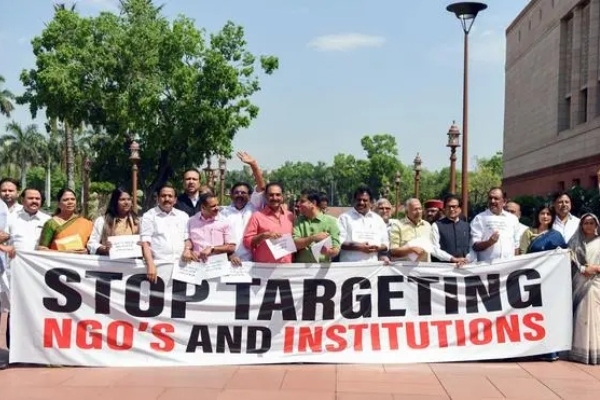
The Congress and other opposition parties therefore owe an explanation to the nation. If they oppose the FCRA amendment, what exactly do they oppose? Which provision should be removed? What alternative safeguards do they propose? And why should foreign funding enjoy a regulatory environment that is weaker than the safeguards maintained by other countries? Unless these questions are answered, suspicion will inevitably grow. People believe that Congress and other political parties follow appeasement politics. Opposition to the FCRA amendment has further strengthened this belief.
And that suspicion is not confined to the FCRA Bill. The events of the past two months raise an even more disturbing possibility that deserves to be examined rather than brushed aside. Is it possible that apparently separate episodes were part of a larger attempt to destabilise the country, create disorder and generate political pressure at precisely the moment when the government was seeking to strengthen its control over foreign contributions? No responsible government or citizen should be so naive as to dismiss the possibility of organised attempts by extra-territorial interests to influence India's internal affairs.
The pattern deserves vigilance. It began, politically speaking, with the spectacle of the "cockroaches" and the agitation surrounding Jantar Mantar. The rhetoric has subsequently become increasingly aggressive. The question is not merely who is protesting or what political party is participating. The question is whether different streams of agitation, political mobilisation and disruptive politics are converging into a larger ecosystem whose ultimate objective may be to weaken institutional authority and create instability. And there is little indication that this phenomenon will disappear soon.
That is not the language a mature democracy should encourage. The government must therefore remain alert. But the responsibility does not end with the government. Citizens too must learn to distinguish legitimate dissent from organised disruption, genuine civil society activity from externally influenced campaigns, and democratic opposition from attempts to destabilise democratic institutions. India cannot afford internal enemies working consciously or unconsciously in the interests of external forces. Nor can political parties afford to become instruments through which foreign influence acquires domestic legitimacy.
India must not wait for the answer after the damage is done. The government must remain vigilant, institutions must remain firm and citizens must remain alert. The lesson of FCRA is therefore larger than FCRA itself - extra-territorial forces can operate only when they find space within. Closing that space is not majoritarianism. It is national self-preservation.
The FCRA debate has exposed precisely such a vulnerability. For years, foreign money has had considerable space to operate in India through organisations receiving overseas contributions. The fundamental question was never whether every organisation receiving foreign funds was acting improperly. It was whether a sovereign nation could afford an arrangement in which foreign money entered its social, religious and political ecosystem without the strongest possible safeguards.
These are legitimate questions. Congress owes the nation an answer. Instead, the party today appears determined to oppose the amendment. Its conduct raises an even larger question. Why was Parliament repeatedly prevented from functioning when a legislation dealing with foreign contributions was before it? Was the opposition merely political opposition, or was there a deeper anxiety that the legislation might actually pass?
Congress has not demonstrated, provision by provision, how the proposed amendment discriminates against minorities. It has not convincingly established which particular clause is intended to target a religious community. But the charge of an attack on minorities continues to be repeated.
This is precisely where the political argument becomes weak. If Congress believes that a particular provision is objectionable, it should identify that provision, explain its consequences and offer an alternative. Parliament is the place for precisely such a debate. Disrupting Parliament does not answer the question. Nor does repeatedly invoking minorities without establishing how the proposed law violates their rights.
The issue is foreign money. It is not a particular religion. Every serious nation regulates foreign funding entering its territory. Foreign contributions are not an ordinary domestic transaction. Money originating outside a country's borders can carry influence, priorities and interests that may not necessarily coincide with the interests of the recipient country. A sovereign nation therefore has every right and indeed an obligation to know where the money comes from, where it goes and what it is being used for. Why should India be an exception? The opposition cannot demand sovereignty in one context and then object to safeguards designed to protect that sovereignty in another.
The Congress and other opposition parties therefore owe an explanation to the nation. If they oppose the FCRA amendment, what exactly do they oppose? Which provision should be removed? What alternative safeguards do they propose? And why should foreign funding enjoy a regulatory environment that is weaker than the safeguards maintained by other countries? Unless these questions are answered, suspicion will inevitably grow. People believe that Congress and other political parties follow appeasement politics. Opposition to the FCRA amendment has further strengthened this belief.
And that suspicion is not confined to the FCRA Bill. The events of the past two months raise an even more disturbing possibility that deserves to be examined rather than brushed aside. Is it possible that apparently separate episodes were part of a larger attempt to destabilise the country, create disorder and generate political pressure at precisely the moment when the government was seeking to strengthen its control over foreign contributions? No responsible government or citizen should be so naive as to dismiss the possibility of organised attempts by extra-territorial interests to influence India's internal affairs.
The pattern deserves vigilance. It began, politically speaking, with the spectacle of the "cockroaches" and the agitation surrounding Jantar Mantar. The rhetoric has subsequently become increasingly aggressive. The question is not merely who is protesting or what political party is participating. The question is whether different streams of agitation, political mobilisation and disruptive politics are converging into a larger ecosystem whose ultimate objective may be to weaken institutional authority and create instability. And there is little indication that this phenomenon will disappear soon.
The language used by Rahul Gandhi since the Jantar Mantar episode deserves particular scrutiny. It has acquired an intensity that makes one wonder whether the political battle is being presented as some kind of final opportunity—as though a last chance is being given to force the government onto the defensive.
The FCRA amendment, therefore, should not be viewed merely as another political confrontation between the government and the opposition. It is a test of India's understanding of sovereignty. Foreign money cannot be allowed to become foreign influence, and foreign influence cannot be permitted to become foreign control. Congress had years to close the doors it now claims are dangerous. It did not.
Today, when the government attempts to strengthen those doors, Congress obstructs Parliament and raises the spectre of minority victimisation without identifying the offending provision. That contradiction demands an explanation. The nation deserves one. Until then, the suspicion will remain: are some political forces merely opposing a law, or are they protecting a larger ecosystem of foreign influence?

Editor's Desk
Editor's Desk