From a Handful of Prayer Rooms to Thousands of Mosques: How Europe's Religious Map Changed
The Dramatic Growth of Mosques Across Europe Mirrors the Rapid Muslim Population Increases Driven by Migration and Higher Birth Rates
Total Views |


Fifty years ago, a Muslim looking for Mosques in most European cities had few options. In Britain, most worship happened in the front rooms of terraced houses or rented council flats, with larger buildings only becoming common from the 1980s onward, as historians of British Islam note. Today the picture is completely different. The organisation MuslimsInBritain.org, which keeps the most detailed running count of British mosques, lists close to 2,200 masjids, prayer rooms and shared spaces across the UK as of early 2026, up from about 1,640 registered mosques it recorded in 2015.
France has seen the same climb. According to the French Council of the Muslim Faith (CFCM), the country now has more than 2,500 mosques, compared with roughly 2,000 in 2015. France's own historians trace the real acceleration to the 1970s and 1980s, when migration from North Africa and later family reunification created demand for permanent places of worship. Germany today has an estimated 2,600 mosques and prayer spaces. In every case the story is the same: an initially small community that grew and built.
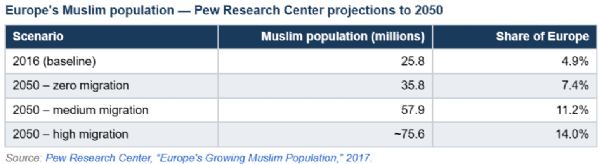
What is driving this? The clearest answer comes from population data rather than opinion. The Pew Research Center, one of the most respected demographic bodies in the world, estimated Europe's Muslim population at 25.8 million in 2016 (about 4.9% of the total), up from 19.5 million (3.8%) in 2010. Two forces are behind that rise. The first is migration, both regular arrivals and majorly the large refugee flows after 2014, when people fled conflicts in Syria, Iraq and Afghanistan. The second is younger age and higher birth rates amongst muslims. Pew found Muslims in Europe are on average 13 years younger than other Europeans and have about one more child per woman (2.6 versus 1.6).
Because of this, the numbers keep rising even in Pew's “zero migration” scenario, meaning that if every border closed tomorrow, the Muslim share would still climb from 4.9% to 7.4% by 2050, simply because the wider European population is ageing and shrinking. If migration continues at medium levels, the share could reach roughly 11%. This shows that migration is not the only problem, high fertility rates is also at the center of it.
The change is not spread evenly. Germany's Muslim share could rise from 6% in 2016 to nearly 20% by 2050 under high migration, while Poland's would barely move from 0.1%. Let us remember, it was German Chancellor Angela Merkel’s disastrous policy to let migrants from conflict ridden Islamic countries flood Germany. Britain's own 2021 census recorded about 4 million Muslims, or 6.5% of England and Wales. This west-east split, heavy in countries that took in post-war workers and later refugees, like in central Europe, explains why the debate feels so different from Paris to Warsaw.
One would argue that none of this tells you anything about security or radicalism issue. A mosque is a place of worship and the overwhelming majority serve ordinary families. But what the data does show, beyond argument, is scale and speed: a religious community that was a rounding error in 1970s Europe is now a settled and growing part of the continent's life. That single fact, measurable, sourced and hard to dispute is the starting point for every other conversation Europe is now having about integration, identity and security.