Kashmir: From fear to Tricolour
NewsBharati 14-Aug-2026 14:10:08 PM
Total Views |


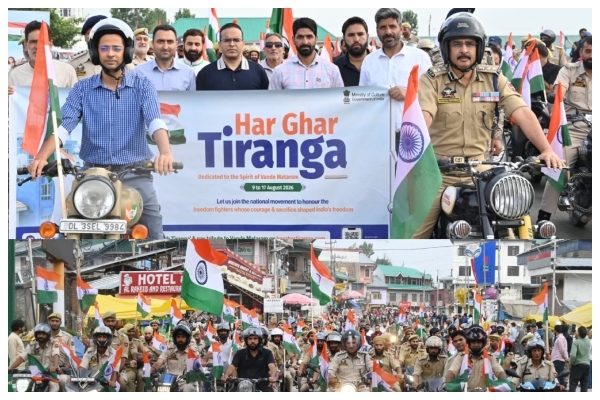
There are moments when history does not need a speech. A photograph is enough. The Tricolour flying over Lal Chowk in Srinagar is one such moment. For decades, Lal Chowk was presented as the symbolic heart of separatism. The national flag could not be raised there without turning it into a confrontation. In 1992, when Murli Manohar Joshi and Narendra Modi led the Ekta Yatra to unfurl the Tricolour at the Clock Tower, the event required extraordinary security. The message was unmistakable: India would not surrender its claim over its own territory. Look at Lal Chowk today.
 The change did not happen by accident. Nor did it happen because separatism suddenly changed its mind. It happened because the Indian State finally demonstrated the political will to confront a problem that had been allowed to fester for decades. The abrogation of Article 370 on August 5, 2019, was therefore much more than a constitutional exercise. It was a declaration of national confidence that Jammu and Kashmir is an integral part of India, and there can be no permanent constitutional ambiguity about that fact. That decision required what can only be described as rock-like determination.
His sacrifice remained an unfinished chapter in India's national-integration story for decades. The political decision of 2019 closed that chapter. Abrogation of Article under BJP government is not a political accident but a strong reflection of BJP's firm determination and conviction to the cause of Kashmir and geographical integrity of India.
Not through slogans, but through ordinary aspirations. A young Kashmiri who wants a job is less interested in a separatist shutdown. A shopkeeper who wants tourists is less interested in a hartal. A village representative who has to answer voters about roads and drinking water has a different relationship with democracy from a political worker whose only vocabulary is protest. This is why Lal Chowk matters so much.
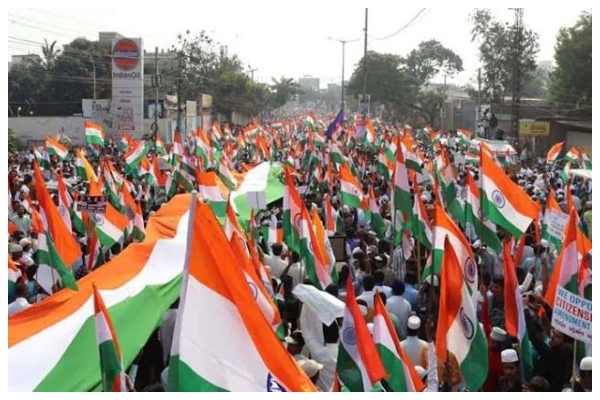
The same place that once required an organised national campaign to assert the presence of the Tricolour can now witness people gathering around it as part of public celebrations. The flag has not changed.
Kashmir's relationship with the flag has changed. That is the real story of Article 370's aftermath.
There is still much work to be done. Terrorism remains a threat. Pakistan remains determined to exploit violence. Development and employment require sustained attention. Political reconciliation cannot be taken for granted. But normalcy is not the absence of every problem. Normalcy is when problems are addressed through institutions rather than guns. When citizens vote rather than boycott, when tourists arrive rather than flee, when shops open rather than shut and when the national flag can fly without becoming an invitation to violence. That is Kashmir emerging today.
Dr Syama Prasad Mukherjee died because he refused to accept an incomplete India. Decades later, a Tricolour flying over Lal Chowk offers a powerful reminder that his question was never merely about a constitutional provision. It was about national integration. For years, Kashmir was described as a problem for India. Today, increasingly, Kashmir is demonstrating that it can also become one of India's great success stories. The most powerful victory over separatism is not when a slogan disappears. It is when ordinary people no longer feel the need to listen to it. And perhaps the most powerful image of that change is the simplest one: The Tricolour flying over Lal Chowk and Kashmiris treating it as their own
Ahead of Independence Day 2025, the Tricolour was ceremonially unfurled at the historic Ghanta Ghar. In January 2026, a Tiranga rally moved through Lal Chowk, with people participating in a scene that would once have been difficult to imagine. The most powerful aspect was not the flag itself. It was the atmosphere around it. The flag was no longer merely an instrument of political assertion. It was becoming part of ordinary public life. On Wednesday, Lieutenant Governor Manoj Sinha led a massive Tiranga Rally, drawing thousands from across Kashmir. Tiranga rallies were held across all 20 districts from August 9 to 17, with 14,03,496 flags requisitioned an extraordinary display of public participation and a powerful symbol of Kashmir’s changing mood. This is the new Kashmir.
And to understand its historical significance, one must remember Dr Syama Prasad Mukherjee. Mukherjee had challenged the very idea that an integral part of India could have a separate constitutional arrangement, a separate flag and a separate set of political conditions. His famous formulation one country cannot have two Constitutions, two heads and two flags was not rhetoric for him. He acted upon it. In 1953, he entered Jammu and Kashmir without the required permit, was arrested and died in custody.
The consequences are now visible. The old Kashmir was marked by terrorist violence, stone-pelting, shutdowns and attempts to keep people away from democratic institutions. The new Kashmir is increasingly marked by tourism, economic activity, elections and participation. The change in terrorism is particularly significant. Government figures show terrorist-initiated incidents falling from 228 in 2018 to just 12 in 2025. Stone-pelting, once a familiar feature of Kashmir's streets, has effectively disappeared as an organised phenomenon. These figures do not mean that terrorism has vanished. The Pahalgam attack was a grim reminder that Pakistan-sponsored terrorism remains a serious threat. But the ecosystem that once allowed terror and separatism to dominate everyday life has been weakened dramatically and drastically.
The most encouraging change, however, is democratic. Kashmiris are voting. The 2024 Lok Sabha election saw significantly higher participation in the Valley than in 2019. The subsequent Assembly election demonstrated again that people were willing to use the ballot to choose their representatives. At the grassroots level too, elections to panchayats and District Development Councils have created political space for ordinary citizens to address roads, schools, electricity, employment and development rather than being trapped permanently in the politics of confrontation. That is how society changes.
Not through slogans, but through ordinary aspirations. A young Kashmiri who wants a job is less interested in a separatist shutdown. A shopkeeper who wants tourists is less interested in a hartal. A village representative who has to answer voters about roads and drinking water has a different relationship with democracy from a political worker whose only vocabulary is protest. This is why Lal Chowk matters so much.
Kashmir's relationship with the flag has changed. That is the real story of Article 370's aftermath.
There is still much work to be done. Terrorism remains a threat. Pakistan remains determined to exploit violence. Development and employment require sustained attention. Political reconciliation cannot be taken for granted. But normalcy is not the absence of every problem. Normalcy is when problems are addressed through institutions rather than guns. When citizens vote rather than boycott, when tourists arrive rather than flee, when shops open rather than shut and when the national flag can fly without becoming an invitation to violence. That is Kashmir emerging today.
Dr Syama Prasad Mukherjee died because he refused to accept an incomplete India. Decades later, a Tricolour flying over Lal Chowk offers a powerful reminder that his question was never merely about a constitutional provision. It was about national integration. For years, Kashmir was described as a problem for India. Today, increasingly, Kashmir is demonstrating that it can also become one of India's great success stories. The most powerful victory over separatism is not when a slogan disappears. It is when ordinary people no longer feel the need to listen to it. And perhaps the most powerful image of that change is the simplest one: The Tricolour flying over Lal Chowk and Kashmiris treating it as their own

Editor's Desk
Editor's Desk